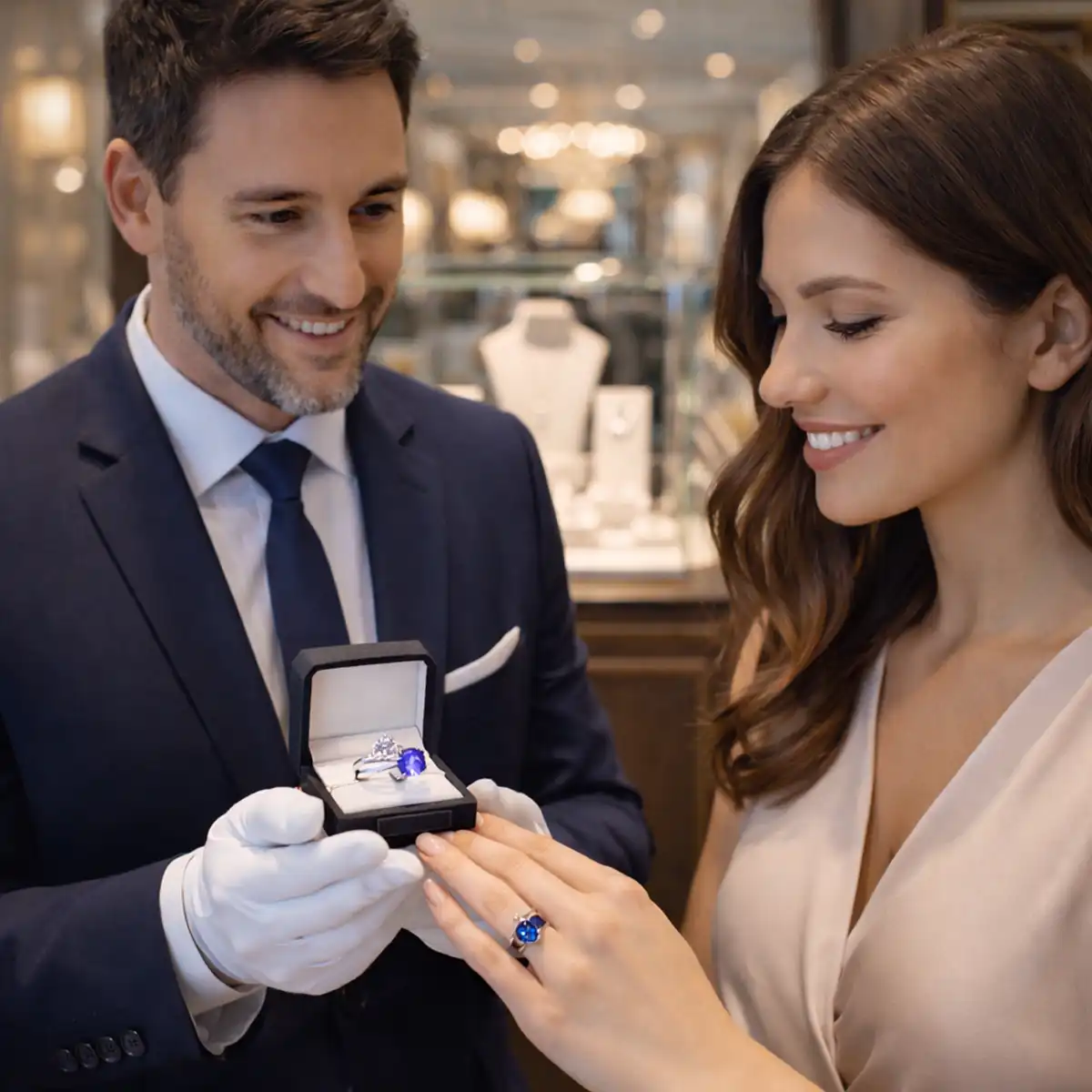
For 2026, classic solitaire engagement rings are no longer the only serious option. Couples are gravitating towards designs that feel personal, romantic and a touch unconventional, with Toi et Moi engagement rings and vintage cut diamonds leading the way. The result is a new engagement language where your setting does more than sparkle; it tells a story.
In our Hatton Garden studio, this shift is unmistakable. Fewer clients are asking for a standard round brilliant on a plain band. Instead, they arrive with references, ideas and heirloom stones, looking for a ring that reflects their relationship rather than a generic ideal. Two styles consistently sit at the heart of those conversations: the expressive two-stone design of Toi et Moi, and the soft, candlelit glow of old-cut diamonds.
This guide explores why these designs dominate 2026, how to choose between them and how to ensure your ring looks and feels as refined in real life as it does in your imagination.
Engagement rings in 2026 are defined by individuality, not uniformity. The most in-demand designs celebrate personal symbolism, heritage and a tailored fit to modern life, while still feeling luxurious and enduring.
The traditional round brilliant still has a place, particularly for those who prize maximum sparkle and a familiar silhouette. Yet many modern couples want a ring that feels less like a standard issue and more like a piece of fine jewellery they might have commissioned for themselves, even without the proposal. This is where vintage engagement rings and more sculptural two-stone designs come in.
Social media has accelerated the shift. Couples see antique pieces, bespoke commissions and unusual stone combinations in real time, often from independent designers rather than global brands. When they arrive in Hatton Garden, they already know that a unique cut or an asymmetric layout can feel more sophisticated than a formulaic setting, provided it is executed with care.
In that context, Toi et Moi and vintage cuts offer two powerful ways to inject character without sacrificing elegance or longevity.
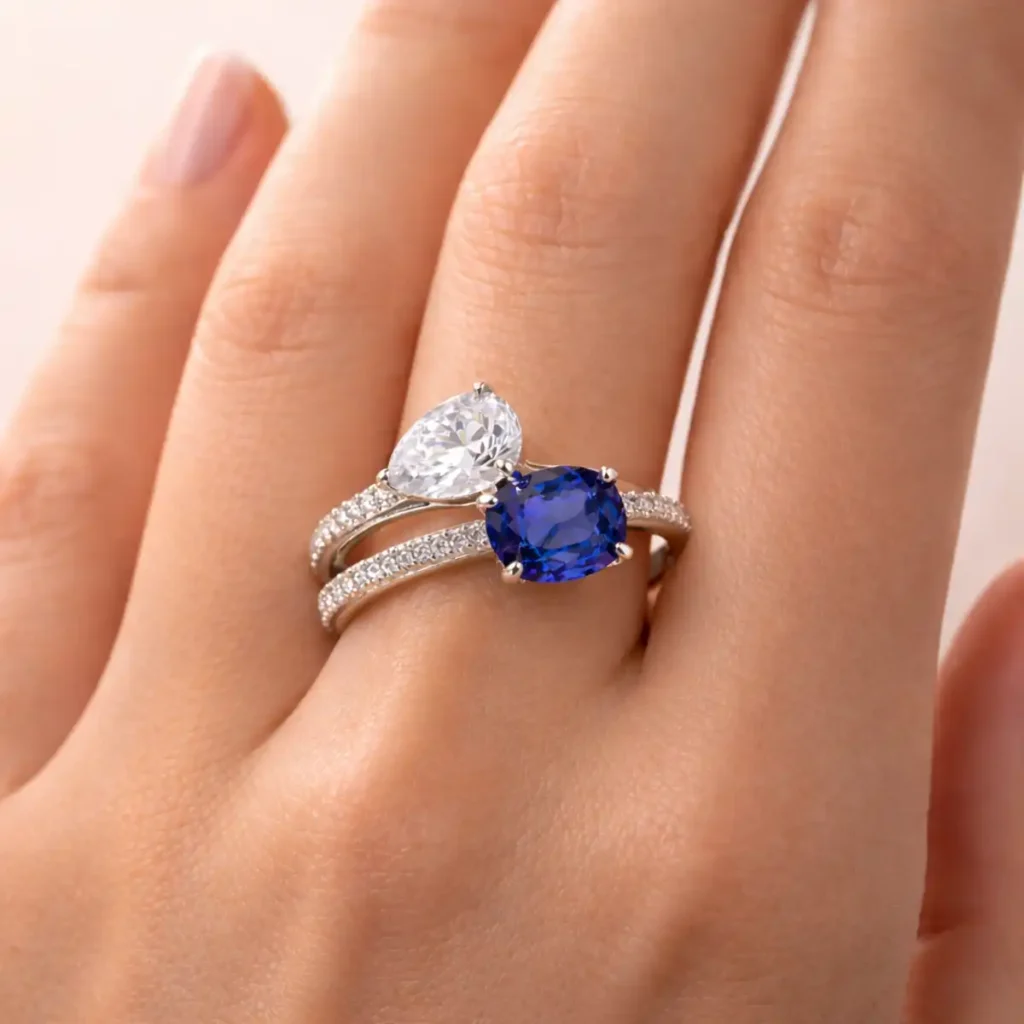
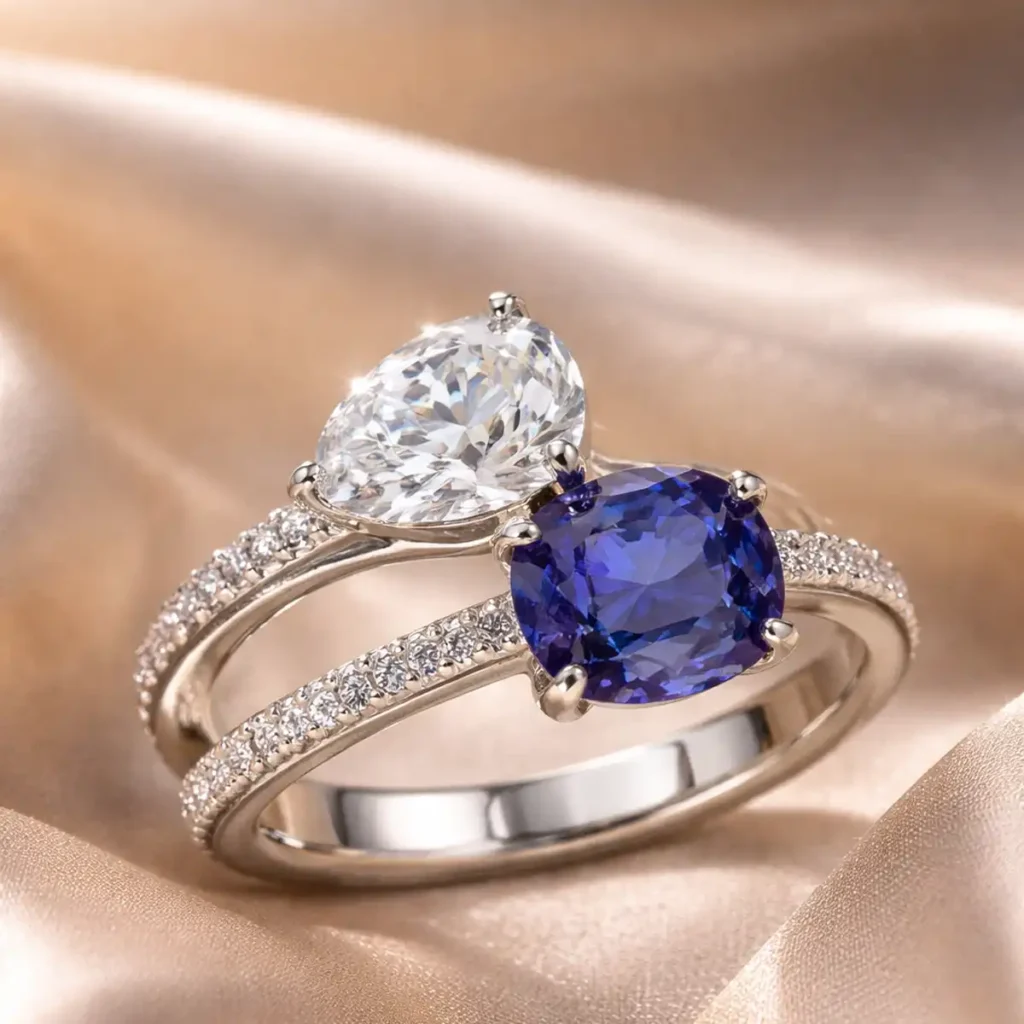
A Toi et Moi ring features two principal stones set side by side, close enough to feel intertwined yet distinct enough to retain their own presence. The idea is centuries old, famously chosen by Napoleon for Josephine with a pairing of sapphire and diamond, but its current incarnation feels strikingly modern.
The symbolism is clear. Each stone represents one partner, equal in importance yet different in personality. Together, they create a single composition that is more interesting than either stone alone. For couples who value sentiment as highly as style, that metaphor is compelling.
The latest Toi et Moi designs embrace contrast rather than symmetry. Instead of matching shapes and colours, our clients increasingly favour bold juxtapositions that feel curated, almost like pairing fine art works.
Popular combinations include:
The key is not making the stones identical but ensuring they carry similar visual weight. A slightly smaller but more intense coloured stone can balance a larger white diamond. Likewise, a deeper, higher-crowned vintage cut can stand beside a lower, modern brilliant of similar presence, even if the measurements differ.
Sourcing such pairings is not a trivial exercise. Matching colour grades, proportions and personality across different cuts often requires access to both modern stock and carefully selected antique stones. This is one reason bespoke Toi et Moi rings are rarely handled well by mass market jewellers. The process demands both technical knowledge and a curator’s eye.
For many years, the modern round brilliant was treated as the endpoint of diamond innovation. It was engineered to maximise light return, with tight tolerances and mirrored facets that create intense sparkle. To some couples in 2026, that perfection now feels a little clinical.
By contrast, antique cuts bring softer, slower light. These stones were cut by hand in eras lit by candlelight and gas lamps, with proportions chosen to create broad flashes of colour rather than a continuous glitter. When set in refined modern mounts, they offer a kind of quiet intensity that feels especially suited to an engagement ring meant to be worn for decades.
Old Mine cuts and Old European cuts are the forerunners of today’s cushion and round shapes. They tend to have higher crowns, smaller tables and often a visible open cutlet, giving them a distinctive profile when viewed from the side.
Visually, they produce larger, bolder flashes of light with notable fire. Under evening lighting, they can appear to breathe and move in a way that feels almost liquid, especially in vintage diamond rings with minimal metal around the stone.
These cuts are rarely identical, even when they share a certificate. Their hand-finished nature means slight asymmetries are common, which many clients now see as part of their character. A skilled goldsmith can use subtle bezel and claw choices to enhance the charm while maintaining security and proportion.
The Asscher cut, refined during the Art Deco period, offers a different sort of drama. As a step cut, its long parallel facets create a hall of mirrors effect rather than a spray of scintillation. It does not sparkle so much as flash in structured bands of light.
An Asscher cut diamond is unforgiving of inclusions and off colour, because the open facet structure provides nowhere to hide. Where a brilliant cut might disguise minor features, an Asscher exposes them. For most clients, that means aiming for higher clarity grades and careful attention to colour selection.
Set in a clean-lined platinum mount or a slim Asscher cut engagement ring halo, the effect is quietly confident. It suits those who prefer architectural design and crisp tailoring to overt prettiness.
Fun fact: many antique Asscher cut diamonds were originally mounted in brooches and tiaras, which is why repurposed stones sometimes bear tiny evidence of old settings on their girdles once removed.
Sustainability is no longer a niche concern in fine jewellery. Increasing numbers of clients ask not only about the look of their ring, but also about its footprint in the world. For that reason, repurposed antique stones have moved from curiosity to centre stage.
Reusing an antique diamond or coloured stone allows couples to enjoy a piece of history while avoiding the need for new large-scale extraction. The stone may have spent decades in a Victorian brooch, a Georgian cluster or a mid-century cocktail ring before being reset into a contemporary ethical engagement ring.
From a design perspective, antique stones demand thoughtful mounting. They may not match modern measurements or symmetry, and their girdles can be uneven. Computer-aided design alone is rarely sufficient. Hand-forged bezels and tailored claw work are crucial to tracing each stone’s outline precisely so that it sits securely and comfortably against the finger.
For many clients, the knowledge that their centre stone has lived a previous life adds depth to the engagement story. It feels less like a new purchase and more like becoming the next custodian of an object with provenance.
As preferences have shifted towards characterful stones, settings have evolved too. The days when a high, delicate claw mount was the default are fading, particularly for clients with busy, active routines.
Two styles dominate the conversations we have with professionals, creatives and parents who want to wear their ring every day without worry: bezels and gypsy settings.
A bezel encircles the stone’s girdle with a continuous rim of metal. When done well, it offers maximum protection with minimal visual bulk. The outer line can be razor-thin around a round brilliant diamond or a little more substantial around an old mine cut to frame its softer edges.
In 2026, bezels are no longer associated only with chunky, utilitarian design. Our clients often choose ultra-fine bezels combined with knife-edge or softly rounded bands in platinum or 18ct gold, creating a silhouette that feels contemporary and quietly luxurious.
A bezel is particularly powerful for step cuts and vintage stones. It can smooth minor asymmetries, protect vulnerable corners and create a sleek outline that works beautifully with simple wedding bands and eternity rings.
A gypsy setting, sometimes called a flush set, sinks the stone directly into the band so that the metal surface runs smoothly around it. The diamond sits within a precise aperture rather than on top of claws, making the design highly resistant to catching or knocking.
This approach suits clients who favour understated luxury. A gypsy set engagement ring in yellow gold with a vintage cut diamond can read more like a piece of high jewellery than a traditional engagement style, especially when combined with subtle hand engraving or a tapering band.
Gypsy settings also appeal to those who want their ring to feel gender neutral or to echo design codes seen in fine watches and signet jewellery.
One of the practical questions that often arises with more expressive engagement designs is how they will sit alongside a wedding band. This is particularly relevant for Toi et Moi rings and for settings where the stone is low or off-centre.
Standard straight wedding bands are designed to fit snugly against classic solitaire mounts. By contrast, a low-slung two-stone design or a wide vintage bezel often leaves a visible gap when paired with a straight band. Some clients do not mind this. Others find it disrupts the clean, stacked look they had imagined.
Rather than forcing a compromise, it is usually better to design the engagement ring and wedding band as a pair from the outset. That way, the profiles can be considered together, and the finished rings will look intentional whether worn as a set or individually.
A tracer band is a shaped wedding ring that follows the exact contour of the engagement ring. It may feature a gentle curve to flow around a Toi et Moi arrangement, a V to nestle under a marquise or pear, or a more sculpted silhouette to frame a wider antique bezel.
Because these bands are created for a specific ring, they require accurate measurements and often physical fitting once the engagement piece is complete. In our workshop, we frequently invite clients back with their engagement ring so we can hand-finish the tracer band for a nearly invisible joint.
For those who prefer something more minimal, a slim diamond set tracer band can mirror the line of the engagement ring without overwhelming it. In other cases, a plain polished band in a contrasting metal provides a subtle frame that lets the main ring remain the star.
Metal colour plays a crucial role in how both Toi et Moi and vintage cut rings present on the hand. In 2026, there is a notable move away from default platinum in favour of more nuanced combinations.
Yellow gold flatters, the deeper body colour often found in antique diamonds and pairs beautifully with warm-toned skin. It is particularly effective for yellow gold engagement rings featuring old mine or old European cuts, where the soft glow of the metal enhances the stone’s fire without drawing focus away from it.
For Toi et Moi designs that pair a white diamond with a coloured stone such as emerald or sapphire, yellow gold can unify the composition, bringing coherence to stones that might otherwise feel disparate.
Platinum and white gold remain popular for those who prefer a cooler, contemporary palette. They are especially suited to high colour, high clarity Asscher and emerald cuts, where the clean white metal accentuates the graphic step facets.
In Toi et Moi pieces, platinum allows contrasting stones to play off each other clearly. For example, a white diamond and a pale champagne diamond can look surprisingly understated set side by side in a fine platinum band.
Mixed metal designs are also gaining ground. A two-tone ring where one stone sits in yellow gold and the other in platinum can subtly emphasise the duality at the heart of the Toi et Moi concept.
Commissioning a bespoke Hatton Garden engagement ring can feel daunting, particularly if you are used to browsing ready-made designs. In practice, the process becomes far more straightforward once you know which questions to consider before your consultation.
Before you meet your jeweller, it helps to reflect on a few key points:
Having a rough sense of budget also helps your designer guide you towards appropriate stone sizes, qualities and design complexity. Knowing whether you prefer to prioritise stone size, rarity, or intricate handwork allows for more nuanced options.
A typical bespoke process begins with sketches or digital visuals, followed by the selection of stones. For Toi et Moi and vintage designs, stone sourcing is often the longest and most important stage. Your jeweller may present several candidate pairs or antique stones, explaining their characteristics and how they would translate into finished rings.
Once the design is agreed and stones are chosen, the mount is created, either by hand forging, computer-aided design, followed by casting, or a hybrid of both. For irregular antique stones and complex two-stone layouts, hand finishing is critical to ensure every angle sits correctly on the finger and that claws or bezels grip precisely without overwhelming the stones.
Fittings allow adjustments to be made to shank width, height and comfort. Your jeweller can also discuss wedding band options at this stage so that the eventual set works cohesively.
The dominance of Toi et Moi and vintage cutting rings in 2026 does not signal the end of the classic solitaire. Rather, it reflects a broader truth: couples now feel free to treat an engagement ring as a piece of fine jewellery with deep personal resonance, instead of a fixed template passed from one generation to the next.
Whether you are drawn to a sculptural Toi et Moi ring, a softly glowing old mine cut in a slim bezel, or a gypsy set Asscher that feels more like a jewel you would buy for yourself, the constant is intention. These rings are designed to harmonise with the wearer’s life, to respect their values on sustainability and craftsmanship, and to feel quietly distinctive from the first day they are worn.
In the end, choosing an engagement ring is less about following trends and more about choosing a narrative. Toi et Moi speaks of partnership, vintage cuts speak of continuity and memory, and modern settings speak of how you move through the world today. When those elements are balanced well, the ring on the hand becomes less a symbol of a moment and more a companion to the life that follows.