
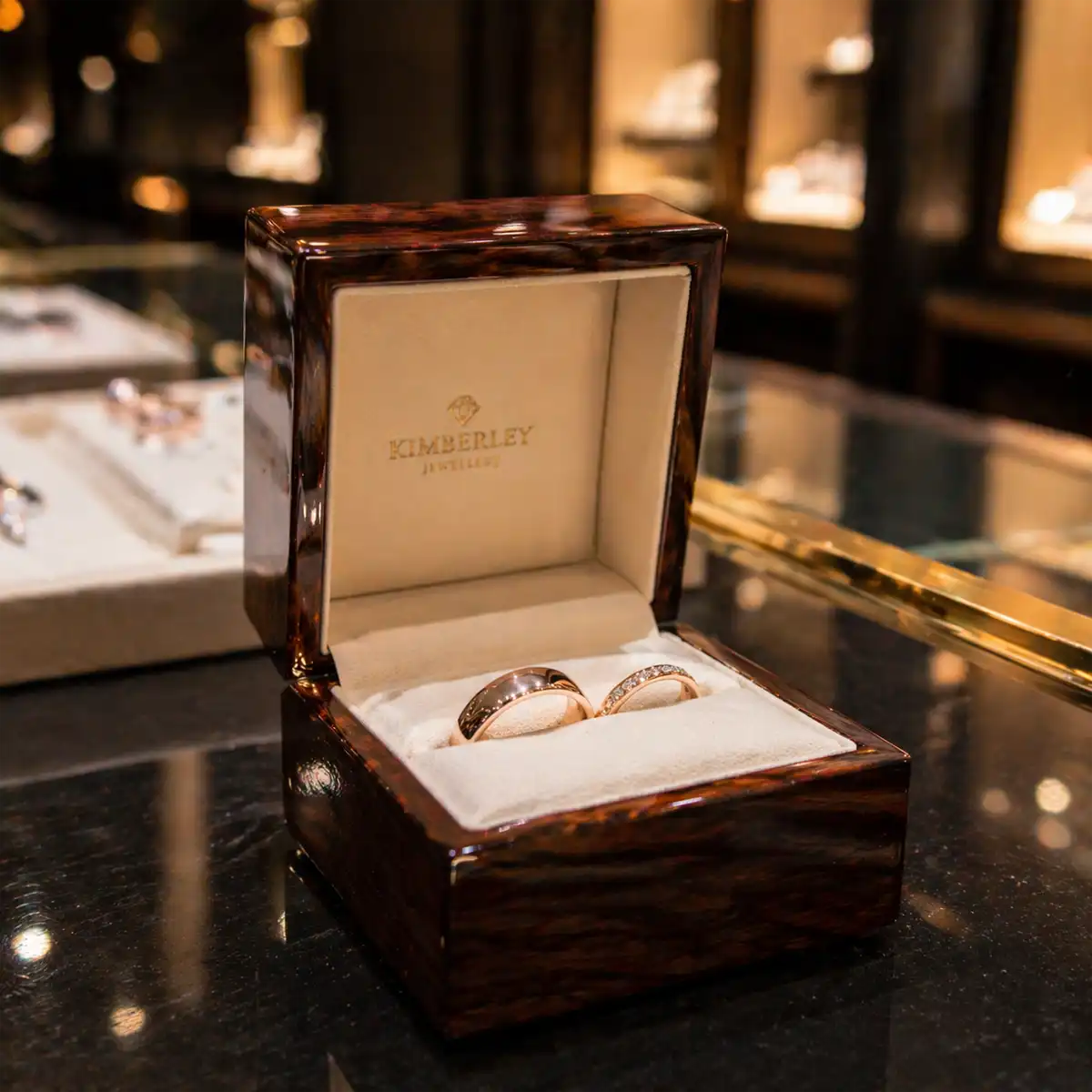
Most people who are about to commission a bespoke engagement ring have the same quiet question somewhere in the background. Not whether it will be beautiful. That part, they are fairly confident about. The question is: what does this actually involve? How long will it take? What will I need to know, decide, bring, and say? And is it going to be complicated in a way I am not prepared for?
The answer is no. It is not. The bespoke ring process at Smith & Green Jewellers, 9 Hatton Garden EC1N, follows a clear and well-practised sequence that most clients find considerably more enjoyable than they expected. The decisions are guided, not abandoned to you. The timeline is honest. And the result is a ring that exists because of choices you made specifically, not because it happened to be in a case on a Tuesday morning.
Here is exactly what happens, from the first conversation to the moment you collect it.
The initial consultation is a conversation, not a test. You do not need to arrive with a technical brief or a design vocabulary. You need to arrive with some sense of what your partner loves, what they wear, and how they use their hands. That is enough to start with.
If you have images from Instagram, saved screenshots, or photographs of jewellery your partner has admired, bring them. They do not need to be precise or consistent with each other. Often, the most useful reference collection is an apparently mixed set of images that share an underlying quality, a preference for clean lines, or warmth in the metal, or an appreciation of detail at close range. A jeweller who knows what they are looking at will identify the common thread. You may not even have noticed it yourself.
Bring also an honest budget range and a date by which the ring needs to be ready. The bespoke timeline is the most important practical constraint in the process, and no one should be vague about it. From initial consultation to a finished ring, expect a minimum of 6 to 10 weeks at most Hatton Garden workshops. During peak seasons, including the period from October to December, allow more. If the proposal date is fixed, work backwards from it.
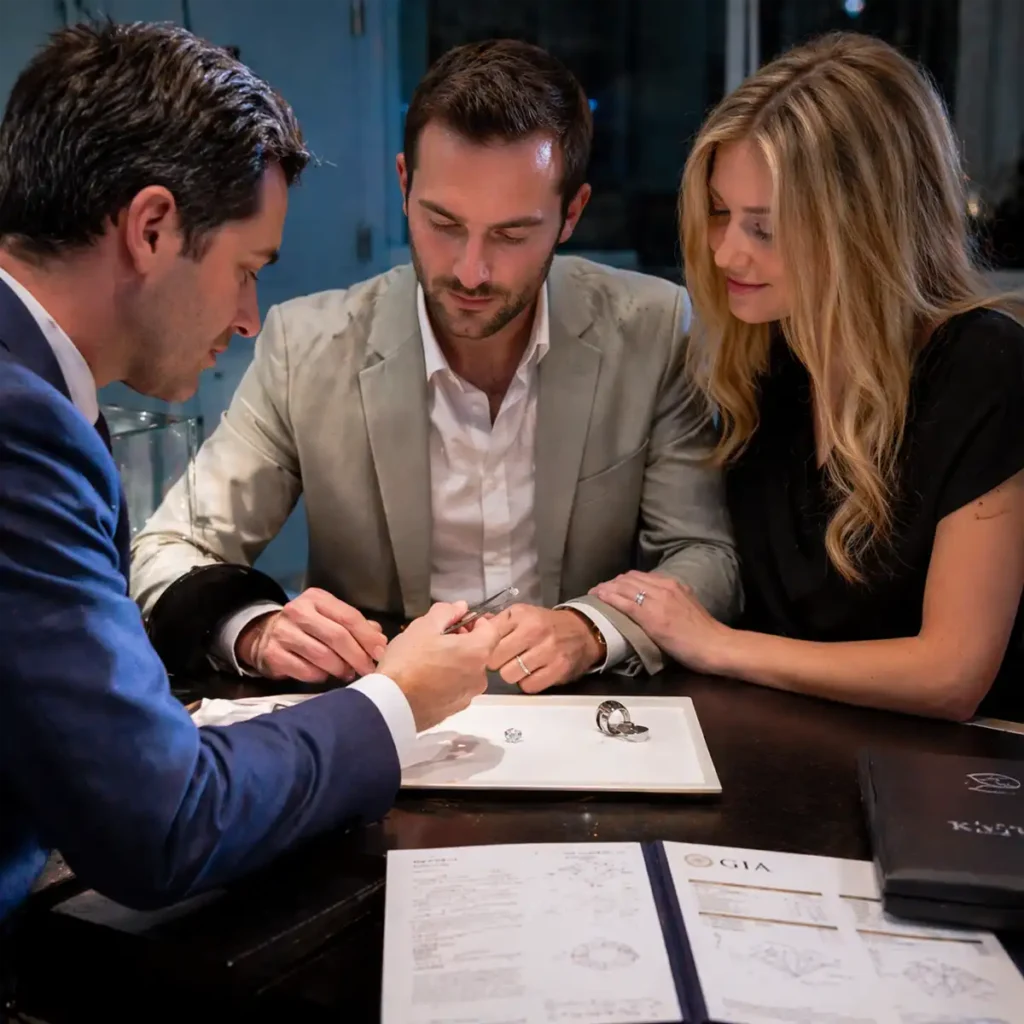
After the initial design conversation, stone selection follows. This is the stage most clients find unexpectedly absorbing. The jeweller presents a selection of stones that meet the agreed specifications of quality grade, shape, and approximate size for the budget. You look at them. In natural light if possible, because natural light is what the ring will actually be worn in.
A stone that grades G VS1 by GIA on paper may be presented alongside a stone graded H VS2. Under natural light, held in the hand, the difference in light return between an Excellent cut and a Very Good cut of the same grade tells you considerably more than the grading report alone. This is the part of the process that online ring buying cannot replicate. You are choosing a specific stone, not a specification.
For a bespoke engagement ring with a coloured gemstone centre stone, the selection conversation expands to include colour saturation, tone, and the specific characteristics of origin. A Ceylonese blue sapphire and a Montana sapphire of the same size and similar clarity grade can look entirely different under the same light. The viewing stage is where that difference becomes visible and personal.
Once the stone is selected, the design takes shape around it. The first stage is a detailed brief, and the second is a working drawing or, in most contemporary workshops, a CAD rendering produced using specialist 3D design software. The rendering shows the ring as a photorealistic image from multiple angles, with precise proportions adjusted to the specific dimensions of your chosen stone.
This is the stage where you can see the ring before it is made and request adjustments. Prong style, shoulder profile, band width, gallery shape: all of these can be modified in the digital model before a single gram of metal has been committed. Seeing the proportions in three dimensions, against the exact stone you have selected, resolves almost every doubt clients carry into this stage.
At Smith & Green in Hatton Garden, close to the Chancery Lane underground station, CAD rendering is part of the bespoke process. You will see the ring you are commissioning before you give the final go-ahead. That is not a given at every jeweller. It should be.
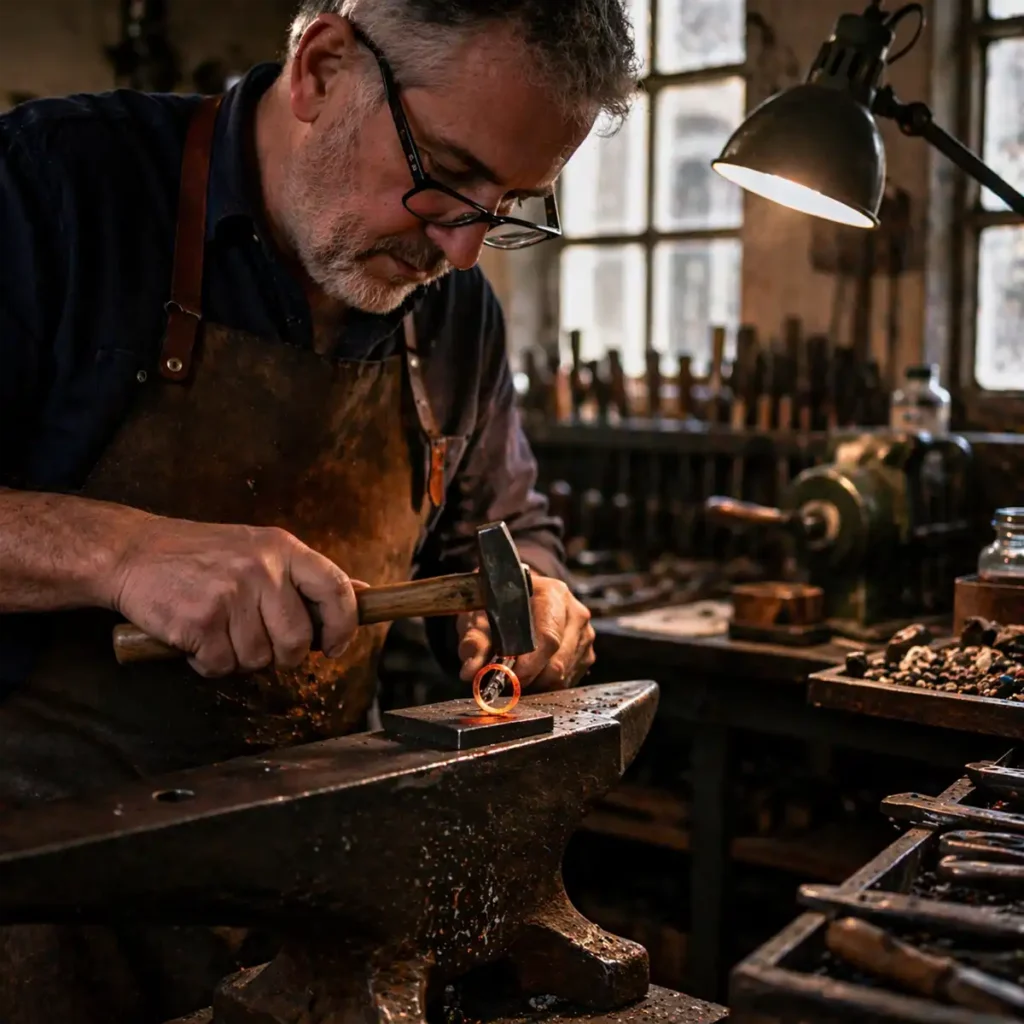
Once the design is approved, the ring moves into physical production. The CAD model is used to produce a wax model, either by milling from a wax block or by printing in a high-resolution wax resin. The wax model is the precise three-dimensional form of the finished ring, scaled exactly to the stone and designed with all the construction details the setting requires.
The wax is then used in lost-wax casting, one of the oldest fabrication techniques in metalworking. The wax model is invested in plaster, the plaster is fired to burn out the wax and leave a precise cavity, and molten precious metal is injected into that cavity under pressure or vacuum. When the plaster is broken away, the raw casting emerges: the ring in rough form, accurate in shape but requiring extensive finishing work to become what you saw in the rendering.
Hand-finishing is what separates a well-made ring from a merely accurate one. The surfaces are refined through a sequence of progressively finer abrasives. Interior corners are cleaned. Prong tips are shaped. The metal is polished to either a mirror finish or a satin surface, depending on the design specification. This work takes time, and the time is visible in the result.
The stone is set last. This sequencing is deliberate. The final ring structure must be correctly finished before a stone is placed into it, because setting a stone into a poorly finished ring can trap debris, create pressure points, or make subsequent adjustments more difficult.
A skilled setter places each prong or bezel element precisely against the stone’s girdle, securing it with the minimum metal movement necessary to hold it safely without stressing the stone. For a diamond, this is a precise and practised action. For a delicate coloured stone, particularly an emerald with its characteristic internal fractures, it requires additional care. The quality of the setting work is where a ring’s long-term security is determined.
After setting, the ring receives a final inspection at each stage of completeness, and then the hallmarking stage. Under the Hallmarking Act 1973, all precious metal articles above a minimum weight that are sold in the UK must be assayed and hallmarked by a UK assay office before sale. The London Assay Office at Goldsmiths’ Hall is the relevant authority for most Hatton Garden pieces. The hallmark confirms the metal’s fineness and the year and office of testing. It is, in effect, the state’s endorsement of the metal’s quality.
Fun fact: Lost-wax casting, also known as cire perdue, has been used to create precise metal objects for over 6,000 years, with some of the earliest known examples being copper objects produced in what is now modern Israel around 3700 BCE, the same fundamental technique used in every Hatton Garden workshop today.
The collection appointment is the moment the process produces its result. You will be shown the finished ring, the grading certificate for the centre stone, the hallmark documentation, and any warranty or aftercare information. Take the time to look at it carefully, in natural light, before you leave. Check that the stone is secure. Look at the finish. Ask any questions you have.
The ring has been made for one specific person, to one specific brief, around one specific stone. There is no other ring in existence that is this ring. That is what bespoke means, and it is worth knowing that clearly before you commission one.
Between ready-to-wear and full bespoke sits our made to order engagement rings route, with the diamond chosen first.
The timeline, the process, and the decisions involved in a bespoke engagement ring commission at Smith & Green Jewellers are manageable and, for most clients, genuinely enjoyable. Begin with an honest brief, a clear budget, and enough time for the work. Everything else follows from there.