
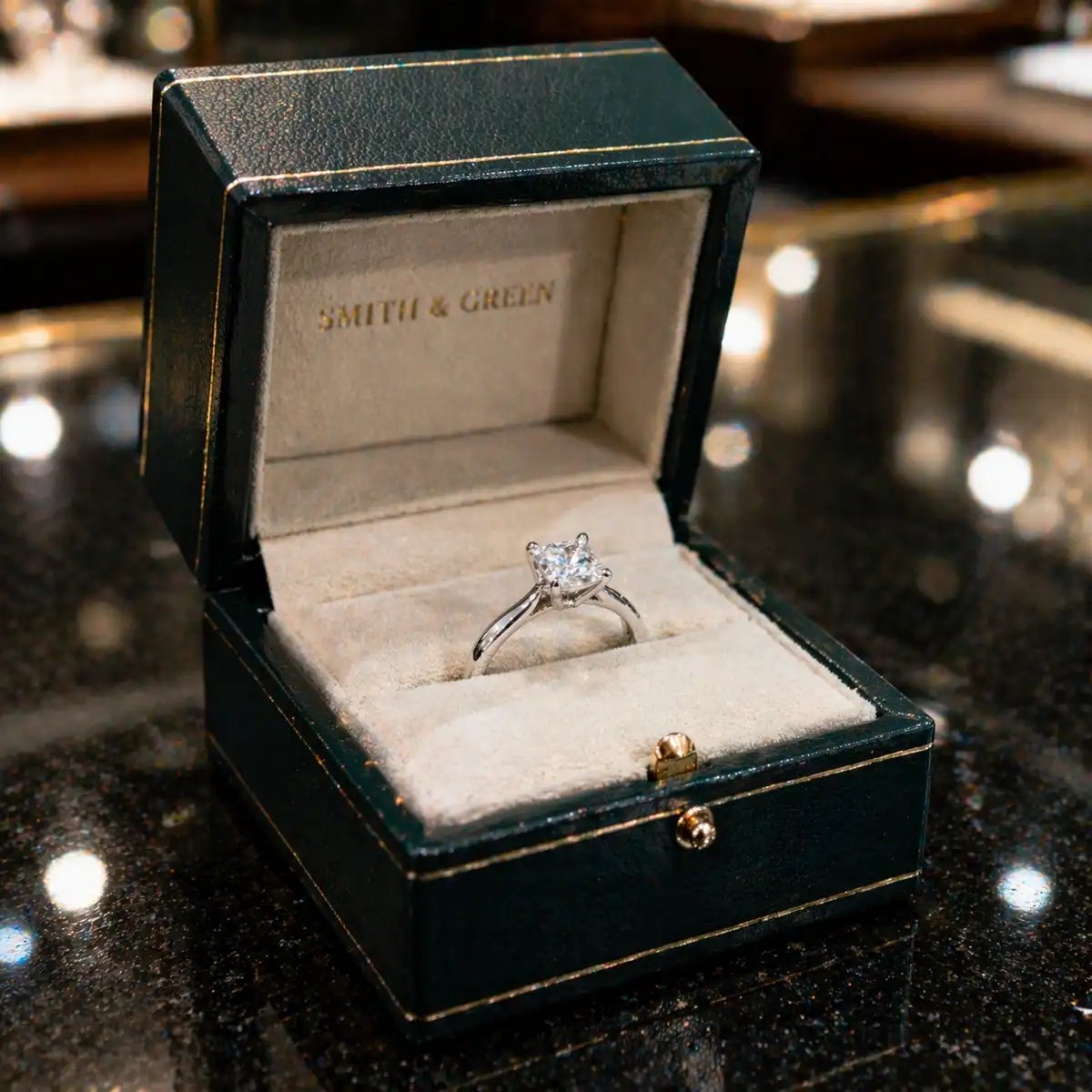
Stop searching for a definitive answer on jewellery forums and get one here. Platinum vs white gold is the most debated metal question in engagement ring buying, and the reason there is no consensus online is that most people writing about it are being diplomatically vague to avoid offending either camp. This article is not going to do that.
Both metals make excellent engagement rings. That is the honest starting position. But they are not equivalent materials, and pretending otherwise does buyers a disservice. One is more durable. One is more expensive. One requires maintenance, the other never will. And the right choice depends on factors that are specific to you, not on which metal is categorically superior. Smith & Green Jewellers, at 9 Hatton Garden EC1N, works with both daily. Here is what the difference actually means.
950 platinum is platinum in its near-pure state. The number refers to the parts per thousand of platinum in the alloy: 950 parts platinum, with the remaining 50 made up of iridium or ruthenium, both of which increase hardness while preserving platinum’s characteristic density and weight. What you wear is essentially a platinum ring with a trace of hardening agent. Nothing else.
18ct white gold is a different proposition. Pure gold is yellow. To make it white, it is alloyed with palladium or nickel, and the resulting alloy still carries a slight yellowish warmth that is entirely masked by rhodium plating applied as a final surface treatment. The 18ct designation means 750 parts per thousand are gold, the rest is the whitening alloy. Without the rhodium plating, an 18ct white gold ring is noticeably warm in tone. With it, the surface is a crisp, bright white that is visually indistinguishable from platinum.
This distinction matters because rhodium is a surface treatment, not a permanent one. It wears. And when it does, the ring needs re-plating to restore the white finish.
Platinum is denser and heavier than gold. A platinum ring of the same dimensions as an 18ct white gold ring will weigh approximately 60% more. That weight is tangible on the finger. Some wearers love it. Others find it surprising and prefer the lighter feel of gold.
The critical durability difference is in how each metal behaves under impact and wear. 950 platinum is ductile rather than hard. When it is scratched or impacted, the metal displaces rather than being lost. Over time this produces a patina: a surface texture of fine scratches that many wearers find deeply appealing. A platinum ring that has been worn daily for 20 years has character in its surface. Crucially, the metal has not actually gone anywhere. A professional re-polish restores a mirror finish in minutes.
18ct white gold is harder and more scratch-resistant in the short term. It will maintain its surface finish longer before requiring re-polishing. However, yellow gold alloys do experience measurable metal loss over decades of wear. The ring gradually becomes thinner at its most worn points.
Neither metal breaks nor deforms under normal conditions. Both are highly durable for engagement ring purposes. The difference matters over a timeframe of decades rather than years.
This is where the choice becomes genuinely practical for many buyers. 950 platinum, once purchased, requires no specific maintenance for the metal itself. It will develop a patina. If you prefer a mirror finish, you bring it in for re-polishing. If you prefer the patina, you do nothing. There is no treatment schedule and no chemical wearing off of a surface layer.
18ct white gold requires rhodium replating when the surface shows warmth or yellowing beneath the white finish. For most wearers, this occurs every 12 to 24 months, depending on wear intensity, exposure to chemicals, and individual skin chemistry. A professional re-plating is a straightforward, inexpensive procedure. But it is a procedure that must be repeated throughout the ring’s life.
If your partner is someone who will bring their ring in for regular care without difficulty, white gold’s maintenance schedule is entirely manageable. If your partner is someone who will not think about ring maintenance until there is a visible problem, platinum removes that variable entirely.
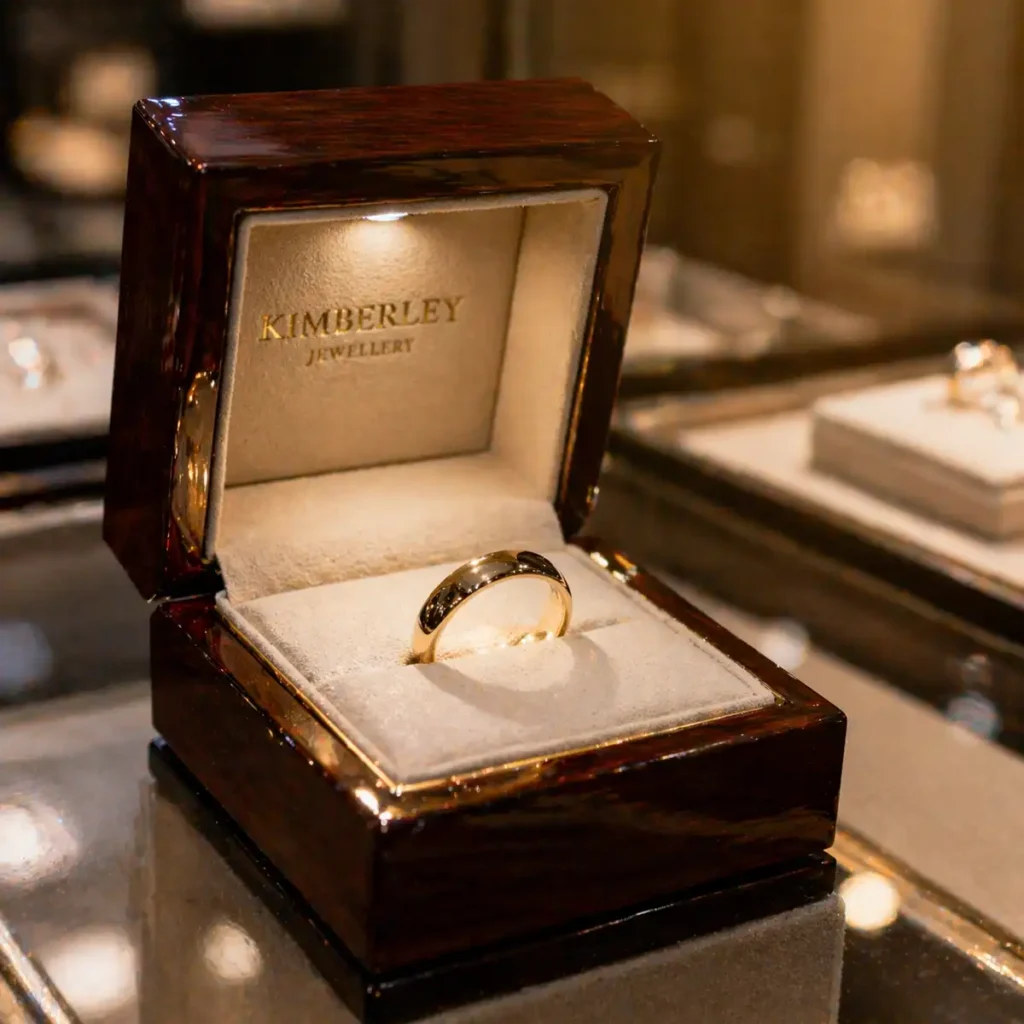
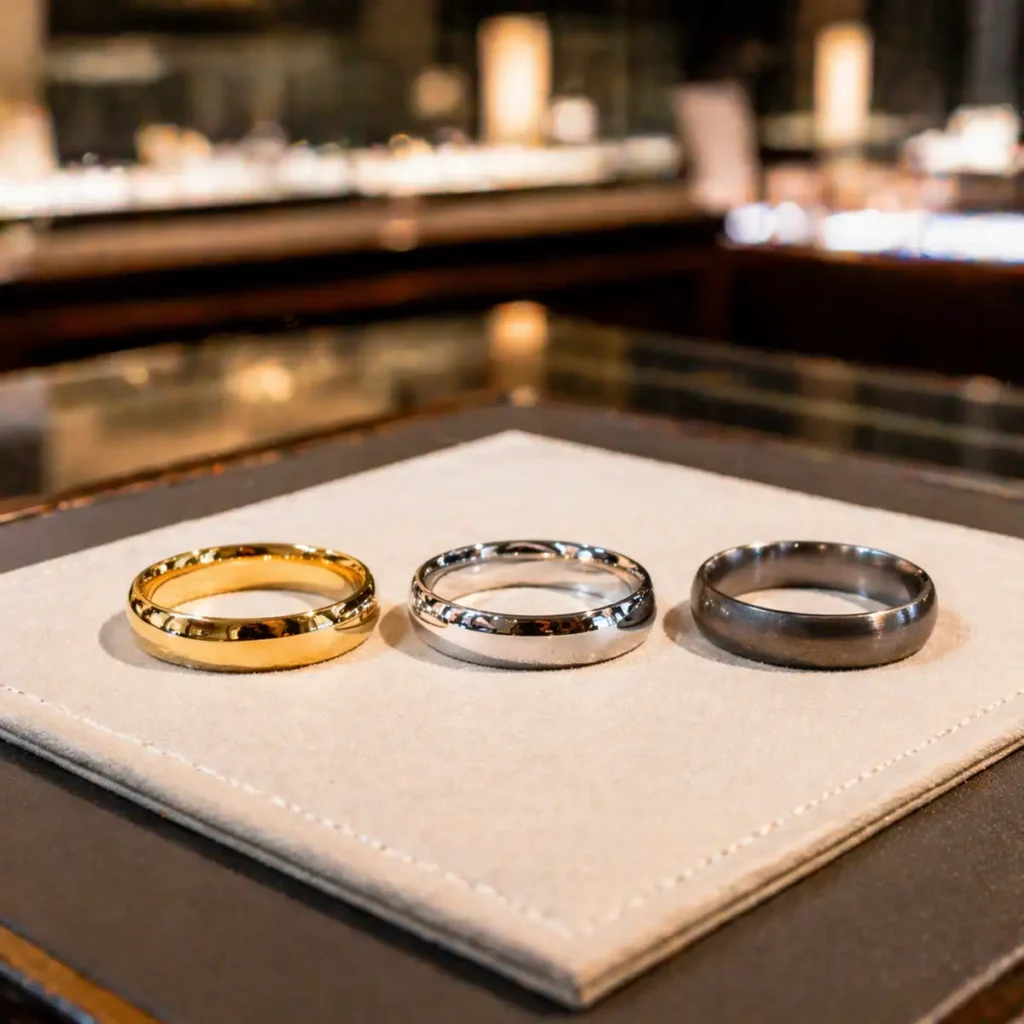
950 platinum currently commands a premium over 18ct white gold for the same ring design. The premium reflects 3 things: the higher raw material cost of platinum, the greater skill and time required to work with a denser and less malleable metal, and the larger amount of metal required because platinum’s density means more mass per ring.
For a straightforward solitaire setting, the premium is typically meaningful but not dramatic. For an intricate bespoke design with complex setting work, the fabrication labour adds more significantly to platinum’s price because the working time is longer.
Platinum vs white gold is, therefore, also a budget question. At the same overall ring budget, choosing 18ct white gold frees up a percentage of the total that can go toward a better stone grade, a more complex setting, or additional design elements. Some buyers make exactly that trade deliberately and rationally. Others decide that platinum’s long-term properties justify the additional cost. Both are defensible positions.
950 platinum holds stones more securely over long time periods than white gold. Its ductility means that prongs deform plastically under impact rather than snapping, and they can be pushed back into position by a skilled jeweller. Gold prongs, being harder and slightly more brittle, are more prone to snapping under sharp impact rather than bending. For buyers whose partners are hard on their rings, this is a genuine advantage for platinum.
Platinum’s density also means that settings made in the metal have greater mass, supporting the stone. A pavé halo in 950 platinum holds its individual stones more securely over a decade of wear than the same setting in 18ct white gold, provided both were set with equal skill at the outset. The metal itself provides a more substantial foundation.
Here is the direct answer. If your partner is active, hard on jewellery, or allergic to nickel (a component in some white gold alloys), choose 950 platinum. If your budget requires maximum allocation toward the stone and your partner is not particularly hard on rings, 18ct white gold is an entirely credible choice that will serve well for decades with modest maintenance. If your partner is sensitive to ring weight or prefers a lighter feel, white gold wins that category. If your partner values the prestige of a pure precious metal with no surface treatment requirement, platinum wins it.
The Hatton Garden jewellers who have been at this for 30 years will tell you the same. Smith & Green are accessible from the Farringdon Elizabeth line along Greville Street, and the consultation is the place to hold both metals, feel the weight difference in the hand, and decide based on the actual ring rather than a specification sheet.
There is no wrong answer here. But there are answers that are wrong for specific buyers. Know which buyer you are before you decide.
Fun fact: 950 platinum is rarer than gold in the Earth’s crust by a factor of approximately 30, and all the platinum ever mined would fit into a cube roughly 6 metres on each side, considerably less than the equivalent volume for gold, which is a major reason for the price premium.
Come to your consultation having already discussed this question with your partner, if it is not a surprise purchase. Many wearers have a strong preference for one or the other that overrides every technical argument. Weight preference alone is a perfectly valid reason to choose gold over platinum, regardless of the durability comparison. The ring is worn every day. It should feel right on the finger, not just correct on a specification sheet.
At Smith & Green Jewellers in Hatton Garden EC1N, the platinum vs white gold conversation is part of every ring consultation that touches on white metals. The answer is specific, honest, and grounded in the actual ring you are building and the actual person who will wear it.