
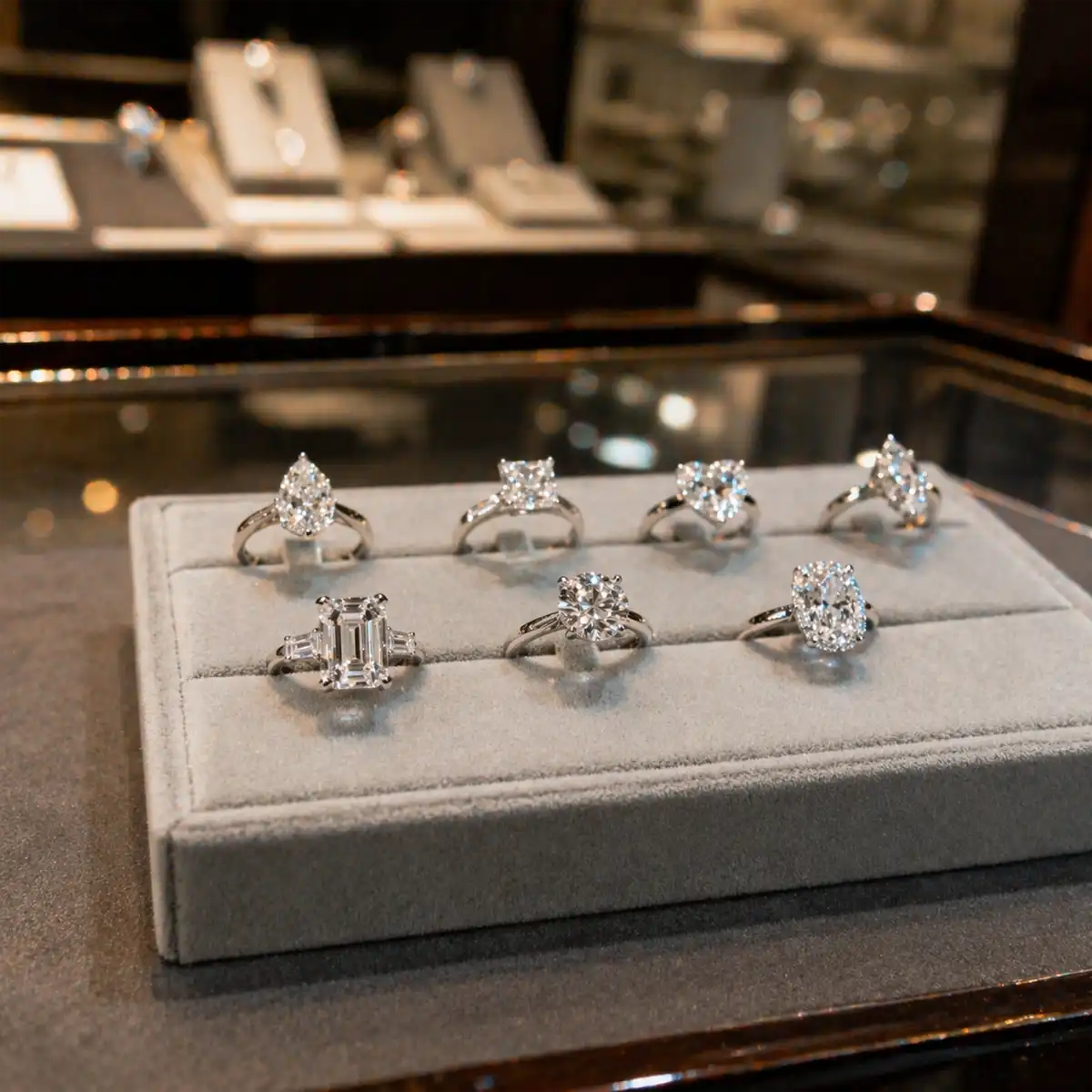
Pick up a diamond grading certificate in a Hatton Garden consultation room, and you are holding something considerably more specific than a piece of reassurance. You are holding a scientific assessment: a record of how one diamond compares to every other diamond ever graded, produced by one of the two laboratories most buyers will encounter. GIA, the Gemological Institute of America, and IGI, the International Gemological Institute, both issue grading reports. Both assess the 4Cs. Both are cited by jewellers across EC1N and around the world as evidence of a stone’s quality. And yet they are not the same document; they do not always produce the same grades for the same stone, and the differences between them have real consequences for what you pay and what you receive.
Understanding what these reports contain, how to read them, and why the issuing laboratory matters is not a technical indulgence. It is one of the most practically useful things you can do before spending a significant sum on a diamond. Smith & Green Jewellers, at 9 Hatton Garden, works with certified stones across both its ready-to-wear and bespoke ranges. What follows is what you need to know before you look at a single price tag.
A GIA or IGI diamond grading report documents a stone’s 4 principal quality characteristics: cut grade, colour grade, clarity grade, and carat weight. It includes a proportions diagram showing the stone’s exact dimensions, a clarity plot mapping internal and external features, and a unique report number that can be verified online against the issuing laboratory’s database. Both laboratories follow this same core structure across natural and lab-grown stones.
The cut grade is the most complex single assessment on either report. GIA applies it exclusively to round brilliant cut diamonds, evaluating not just the proportions a cutter has worked to but the resulting optical performance: brightness, fire, and scintillation assessed together into a single grade running from Excellent to Poor. For fancy shapes, cushion, oval, pear, emerald cut, asscher, neither GIA nor IGI assigns an overall cut grade. Polish and symmetry are assessed separately instead, which means the quality of a cushion or oval stone requires closer reading than a round brilliant does. The report will not tell you how beautiful the light return is. A qualified jeweller, with the stone in hand and good natural light overhead, will.
Colour grading runs on a D-to-Z scale, where D is perfectly colourless, and Z carries a visible yellow or brown tint. Grades are determined by trained examiners comparing the stone face-down against a master set of comparison diamonds. Each letter represents a range, not a fixed point, which is why 2 stones graded G by the same laboratory may read slightly differently in person when placed side by side. The most commercially active range for engagement ring buyers sits between E and I, with F and G offering a near-colourless appearance at a considerably lower price than D or E.
Clarity grades run from Flawless at the top to I3 at the bottom, with VS1 to SI2 covering the range most buyers will realistically consider. The grade tells you how many characteristics were found and how significant they are to a trained examiner under 10x magnification. It does not tell you whether the stone looks clean to the naked eye at wearing distance. That distinction matters enormously when comparing price points.
This is where buyers need to pay careful attention, because the answer directly affects pricing.
GIA is widely considered the most consistent and conservative of all major grading laboratories. Its standards were formalised in the 1950s and remain the benchmark against which other labs are measured by the trade globally. A stone graded G VS1 by GIA will, with very few exceptions, meet what a professional would expect for those grades. GIA’s process requires multiple examiners working independently, with the final grade achieved by consensus. No single examiner’s assessment is accepted without verification from at least one other grader, and the stone never carries identifying information while it is being assessed.
IGI grades both natural diamonds and lab-grown diamonds, and the grading behaviour differs somewhat depending on the category. For natural diamonds, independent research has consistently shown that IGI grades run approximately 1 to 2 colour and clarity grades more generously than GIA for equivalent stones. A stone graded H VS2 by IGI might receive a grade of I SI1 from GIA on the same characteristics. This is not misrepresentation. It reflects a genuine and documented difference in grading calibration, and the market prices it in accordingly. An IGI-graded natural diamond will typically cost less than a GIA-graded stone with the same printed grades, because buyers and dealers apply a discount that reflects the grading differential.
For lab-grown diamonds, IGI has become the dominant certification body, and its grading in this category is considered well-calibrated and broadly consistent. GIA also certifies lab-grown stones and issues reports that follow its full grading process. If you are buying a lab-grown diamond, an IGI certificate is entirely credible. If you are buying a natural diamond at a significant price point, a GIA report provides the stronger independent assurance, and the premium paid for a GIA-graded stone is in large part a premium for the consistency of the grading behind it.
HRD Antwerp, the third laboratory buyers occasionally encounter in Hatton Garden, applies standards broadly comparable to GIA for natural diamonds and is well regarded, particularly within the Belgian and wider European trade. Its reports carry the same level of confidence for buyers who understand its standing, though it is less commonly seen at the level of individual retail consultation.
The report number on a GIA certificate can be checked in seconds at GIA’s online Report Check. Enter the number, and you can verify that the stone in your hand corresponds exactly to what the laboratory assessed. The proportions diagram shows table percentage, crown angle, pavilion depth, and girdle thickness: the 4 measurements that determine how efficiently a round brilliant moves light from entry to exit. For an Excellent or Very Good cut grade, these numbers will sit within tight and well-documented tolerances. A stone with an Excellent cut grade but a table percentage of 65% or a pavilion depth of 44% is worth pausing on, even within the grade.
On the clarity plot, filled symbols indicate internal characteristics (inclusions) and open symbols indicate surface characteristics (blemishes). The position of inclusions matters beyond the grade itself. An eye-clean SI1 with inclusions sitting near the girdle or under the crown will look flawless to the naked eye at arm’s length. An SI1 with a concentrated cluster of crystals directly under the table facet may show visible graining even to an untrained observer. The report tells you where the characteristics are. A jeweller who knows what they are doing will tell you what that means for how this specific stone looks and performs when worn.
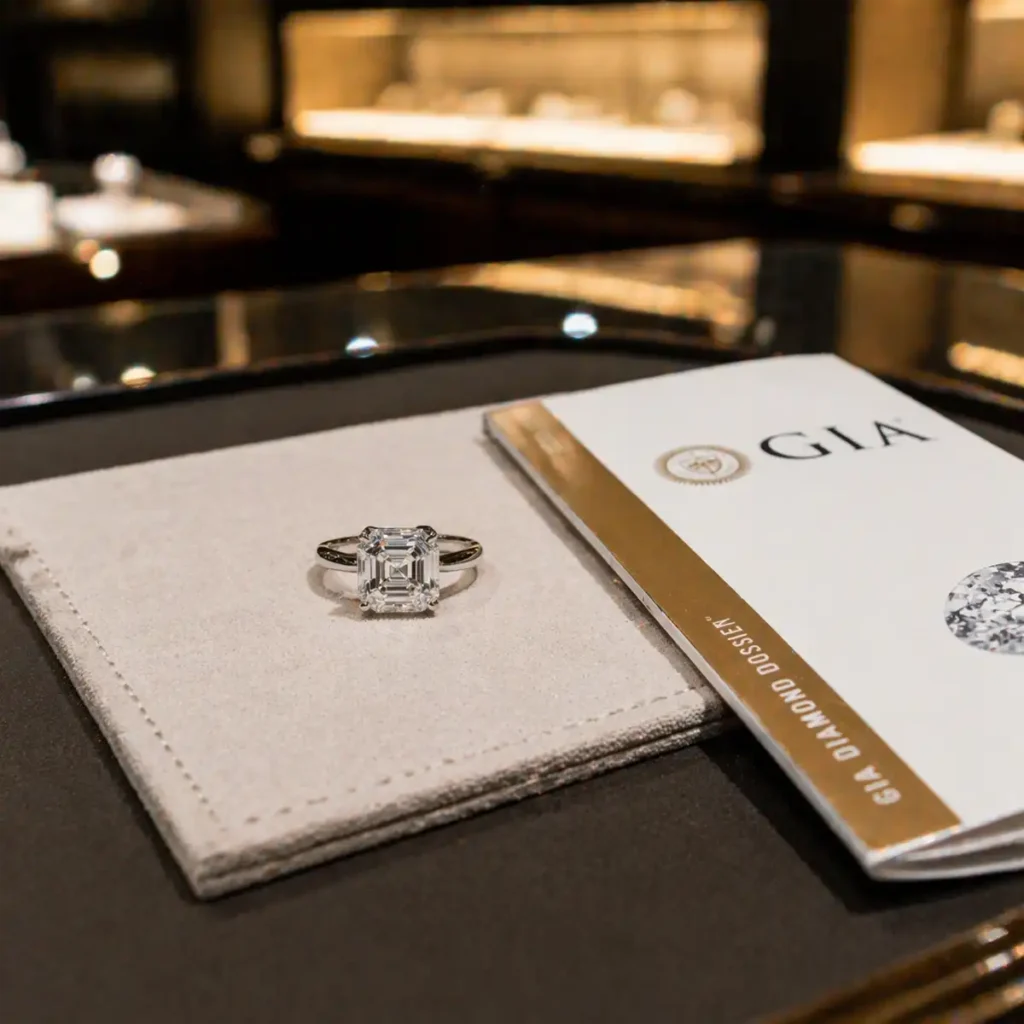
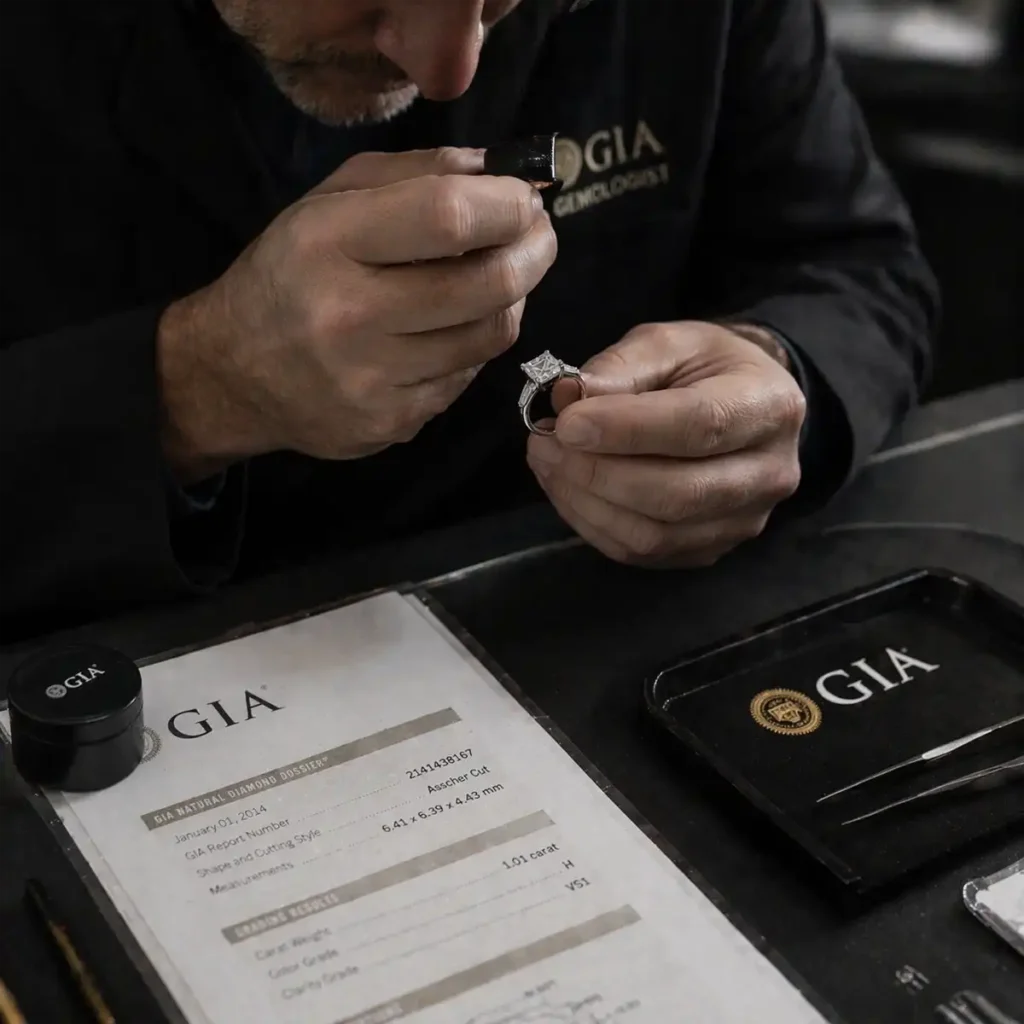
Some buyers assume that diamond certification is primarily relevant for large stones or significant expenditure. This assumption costs them money and clarity at every price point.
At any budget, a grading report from a recognised laboratory protects the buyer from ambiguity. Without one, you are accepting a seller’s verbal description of quality. With one, you have an independent scientific record that specifies exactly what you have purchased. That record supports insurance valuation, simplifies resale if circumstances change, and in the event of loss or damage, gives your insurer the verified information needed to arrange a like-for-like replacement rather than an approximation.
The London Assay Office, at Goldsmiths’ Hall in the City of London, provides hallmarking for precious metals under the Hallmarking Act 1973, confirming metal fineness and the year and assay office of testing. A hallmarked ring alongside a graded GIA or IGI diamond certificate gives a buyer the most complete documentary record possible: the metal confirmed by an independent assay authority, and the stone confirmed by an independent grading laboratory. At Smith & Green, steps from Chancery Lane station on the EC1N end of Hatton Garden, both are standard across certified pieces. No buyer should leave without them.
A grading report is not a valuation. GIA and IGI assess what a stone is, not what it is worth in the current market. A valuation document assigning a monetary replacement figure is a separate instrument, typically produced by a qualified gemmologist, and it is the valuation that your insurer requires. However, the grading report underpins the valuation directly. Without it, a valuer is working from their own assessment of the stone’s characteristics. With it, the valuation is anchored to verified, third-party data, which reduces the scope for dispute at claim time and ensures that a replacement stone would genuinely match what was lost.
After purchasing a certified diamond ring, requesting an insurance valuation is a straightforward and strongly advisable next step. Storing the grading report and valuation together, in a location separate from the ring itself, means that if the ring is ever lost, stolen, or damaged, the entire evidentiary record is intact and immediately available.
Fun fact: GIA invented the standardised diamond grading system in the early 1950s, before which no universal language existed for describing diamond quality, and individual jewellers used entirely private terminology that could mean entirely different things from one shop to the next.
Before committing to a diamond, ask to see the grading report. Confirm which laboratory issued it. Check the report number online while you are still in the consultation. Ask the jeweller to explain what the clarity plot shows and what the inclusions mean for how this particular stone looks in natural light. These are not difficult questions, and any jeweller worth returning to will answer them without hesitation and without any trace of irritation.
At Smith & Green Jewellers in Hatton Garden EC1N, the stones available across bespoke commissions and ready-to-wear pieces come with grading documentation you can verify independently, store alongside your insurance valuation, and rely on for the life of the ring. A certified diamond is not simply a better-evidenced purchase. It is a purchase you can account for fully, now and in thirty years.
Understanding the distinction between GIA and IGI grading standards, knowing how to locate inclusions on a clarity plot, and recognising when a laboratory’s calibration is affecting the price being quoted: none of this requires specialist training. It requires 15 minutes of careful reading and a jeweller who is willing to talk through the report with you in detail. Walk off the Farringdon Elizabeth line, along Greville Street and into Hatton Garden, and take the grading certificate as seriously as the stone it describes.