
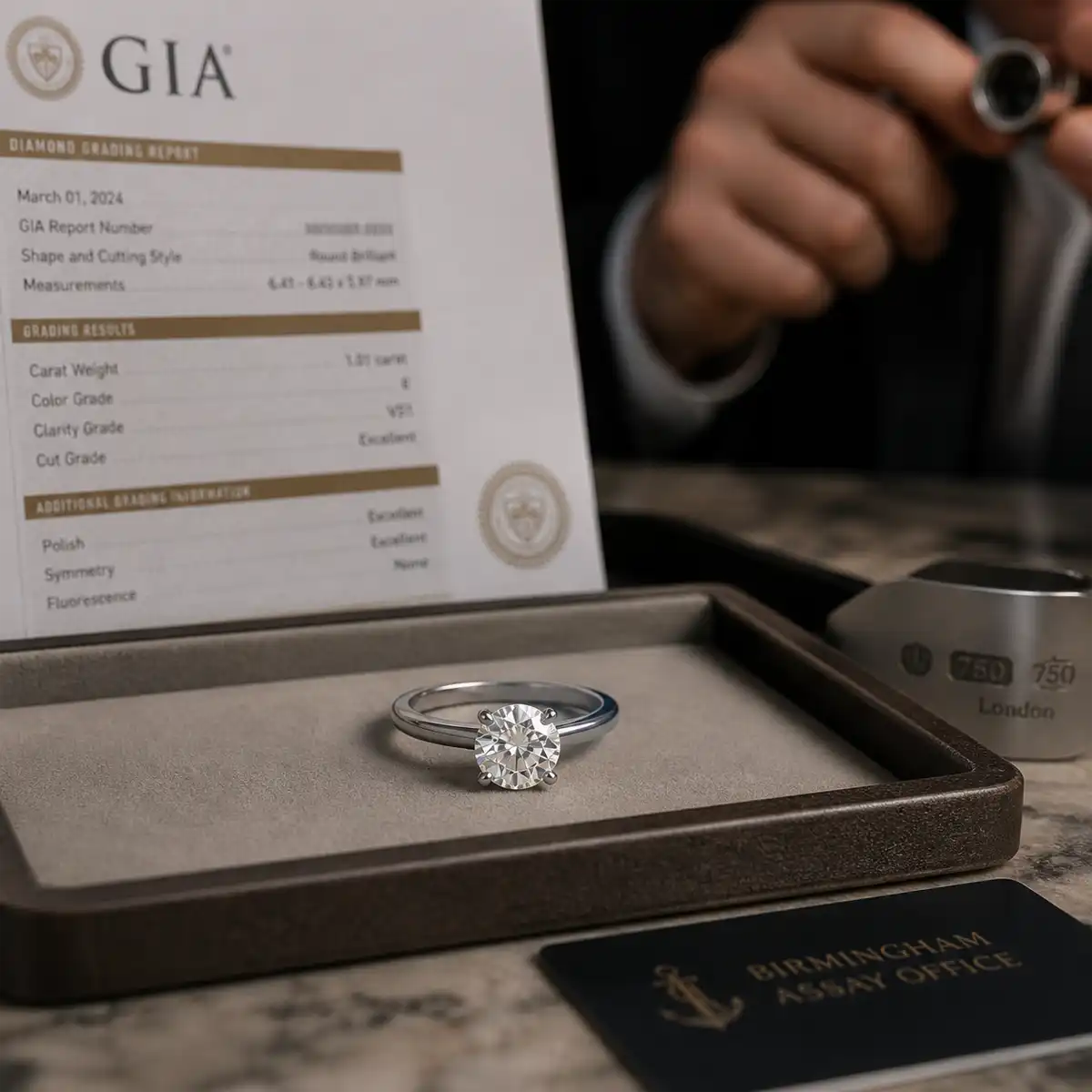
Before any conversation about carat weight or setting style, there is one question a diamond buyer should ask, and almost nobody does: Who graded this stone, and does that matter? The short answer is yes. It matters considerably. A diamond certificate is not a universal document. It is the output of a specific laboratory, using specific grading standards, on a specific day. Two certificates for two stones with identical grades from two different laboratories can describe stones that look and behave very differently in real light. At Smith and Green on Hatton Garden’s EC1N strip, clients regularly arrive with certificates they cannot interpret and a quiet anxiety about whether the numbers on paper mean what they hope. Understanding diamond certification before you buy is not pedantry. It is the foundation of buying confidently.
A diamond grading certificate is a document produced by an independent gemological laboratory that records the physical and optical characteristics of a specific stone. It does not state a value. It does not guarantee quality beyond what is graded. What it does is provide a standardised, third-party record of the stone’s cut, colour, clarity, carat weight, measurements, fluorescence, and any additional characteristics relevant to the stone’s identity.
The certificate allows a buyer to verify that the stone they are purchasing is the stone described, to compare like-for-like between stones at different prices, and to confirm the stone’s characteristics for insurance purposes. A stone without a certificate from a recognised laboratory cannot be independently verified. That is not necessarily a problem for a stone of modest value. For a diamond over 0.50ct in an engagement ring, the absence of a recognised certificate is a gap in the chain of trust.
The Gemmological Institute of America is widely regarded as the most rigorous diamond grading laboratory in the world. GIA introduced the 4Cs grading framework in the 1950s and has maintained consistent, conservative grading standards across its global laboratory network for decades.
GIA grading is conservative by design. A stone graded G VS1 by GIA is unlikely to be overstated. In practical terms, this means two things for a buyer. First, a GIA-certified stone is easier to sell, re-value, or trade because its grades are trusted by the entire industry. Second, GIA certificates carry a resale premium. A stone with GIA paperwork will typically command a higher price on the secondary market than an identical-looking stone with no certificate or certification from a less rigorous body.
For stones above 1.00ct, GIA certification is strongly advisable. For stones in the 0.50ct to 1.00ct range, it remains valuable. Below 0.30ct, the cost of certification relative to stone value makes individual GIA certification impractical, and these stones are typically sold without individual certificates. fluorescence grading on your certificate
The International Gemological Institute is the world’s largest independent gemological laboratory network, with significant operations across Antwerp, Mumbai, New York, and beyond. IGI has become the dominant certification body for lab-grown diamonds, largely because GIA only began issuing full lab-grown grading reports relatively recently, and IGI moved into that space earlier and at scale.
IGI grading standards for natural diamonds have historically been considered slightly more lenient than GIA. In direct terms: a stone graded H SI1 by IGI may present as an I SI1 or even I SI2 under GIA’s stricter loupe. This is not fraud. Different laboratories calibrate their scales differently. But a buyer comparing an IGI-certified stone against a GIA-certified stone purely by grade is not comparing like with like.
For lab-grown diamonds, IGI certification is the recognised industry standard and is entirely appropriate. The stone’s origin is verified, the grades are consistent within IGI’s lab-grown grading framework, and the certificate serves its purpose. For natural diamonds at significant price points, GIA remains the safer choice for buyers who prioritise secondary market value and grade confidence.
*Fun fact: IGI was founded in Antwerp in 1975, placing it at the heart of the world’s historic diamond trading district, the same city that has processed an estimated 80% of the world’s rough diamonds at some point in its history.
HRD Antwerp (Hoge Raad voor Diamant, or Diamond High Council) is one of Europe’s oldest and most respected grading laboratories, based in Antwerp’s diamond quarter. Its standards are considered rigorous and broadly comparable to GIA for natural diamond grading, with some variation in how borderline stones are assessed.
HRD is particularly prevalent in the Belgian, Dutch, and wider European diamond trade. Buyers encountering HRD certificates on stones sourced through European channels are looking at a reputable document. HRD-certified stones are recognised by the London Assay Office and accepted by UK insurance valuers without question.
The practical limitation of HRD for UK buyers is familiarity. GIA certificates are more immediately recognisable to UK valuers, insurers, and resellers. An HRD certificate is credible; it may require a brief explanation in contexts where GIA is the assumed default.
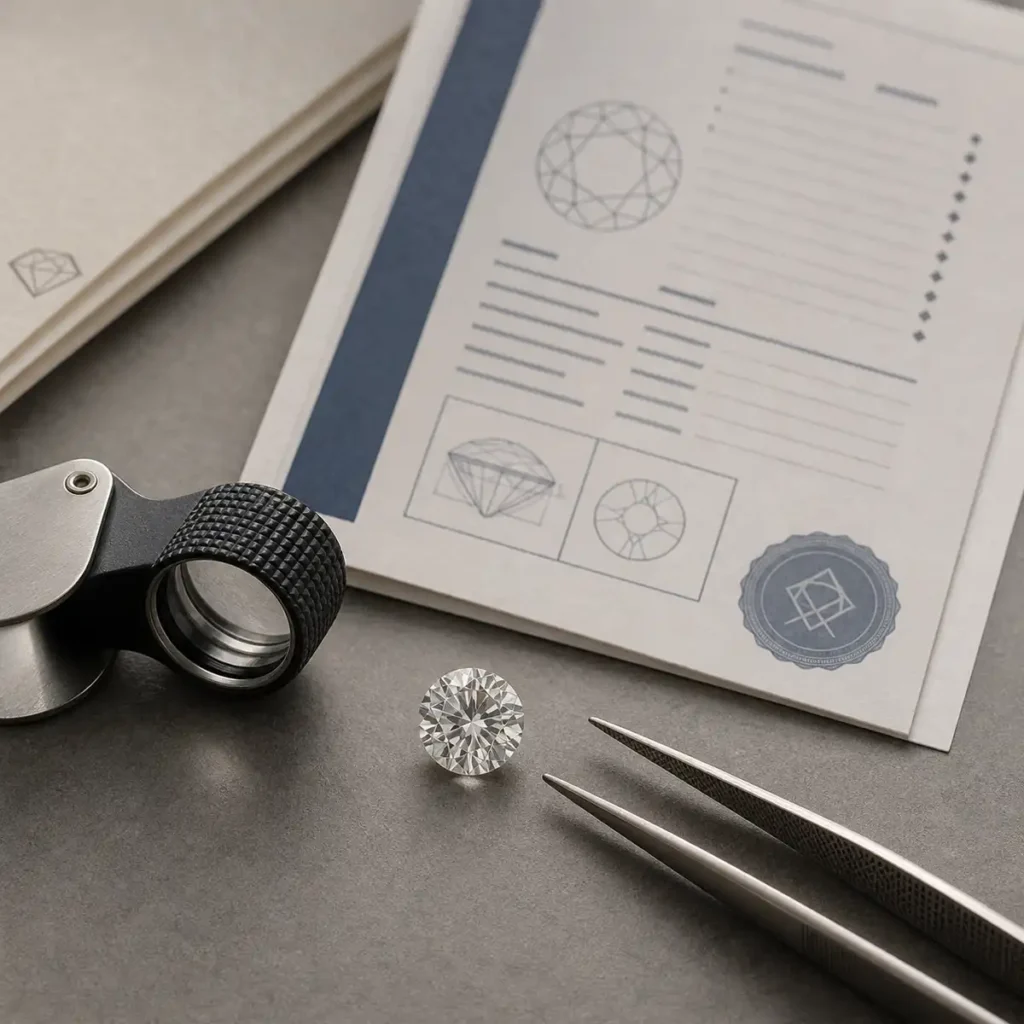

Hallmarking is a separate process from gemological certification and is equally important. Under UK law, any item of jewellery containing precious metal that is supplied commercially must be hallmarked by a recognised UK assay office. The London Assay Office, one of four in the UK alongside Birmingham, Edinburgh, and Sheffield, assesses and stamps metal purity.
A hallmark confirms the metal, its purity, the assay office that tested it, and the date. On a platinum engagement ring, you will see the platinum mark (950 or 950 Pt), the London Assay Office orb symbol, and the date letter. This is not decoration. It is a legal confirmation of what you are buying. Any ring sold without a hallmark in the UK is in breach of the Hallmarking Act 1973.
Smith and Green’s bespoke pieces are hallmarked at the London Assay Office before delivery to the client, standard practice for a Hatton Garden jeweller operating under EC1N’s trading standards. Ask to see the hallmark on any ring before purchase.
Knowing which laboratory issued the certificate is the first step. The second is reading the document correctly. The following fields matter most to a buyer making a final decision.
Cut grade: On a round brilliant, GIA provides an overall cut grade from Excellent to Poor. This is the single most important factor in the stone’s visual performance. Insist on Excellent or Very Good for any round brilliant over 0.50ct. For fancy shapes (oval, pear, cushion, emerald), GIA does not issue an overall cut grade; it evaluates proportions and symmetry grades instead.
Colour grade: On the D-to-Z scale, D through F is colourless; G through J is near-colourless and represents the best value range for most buyers. K and below shows visible warmth. The grade on the certificate is graded face down under controlled lighting. In a setting with metal reflecting into the stone, a G or H can face up as white as an E. Do not over-invest in colour at the expense of cut.
Clarity grade: FL (Flawless) and IF (Internally Flawless) are rare and command significant premiums. For practical purposes, VS1 and VS2 are eye-clean in virtually all stones. SI1 is usually eye-clean in well-cut rounds; in step-cut stones like emerald cuts with their large open facets, SI1 can show inclusions to the naked eye. SI2 requires a case-by-case judgement.
Fluorescence: Covered separately in this series, but flag any strong or very strong fluorescence entry on a certificate and ask to see the stone in natural light. certification for coloured gemstone rings
The certificate is the foundation of a confident diamond purchase. GIA is the benchmark for natural diamonds and carries the strongest resale recognition. IGI is the appropriate standard for lab-grown diamonds and is fully credible in that context. HRD is rigorous and trustworthy, particularly for European-sourced stones. The London Assay Office hallmark confirms the metal you are buying is what it is stated to be.
At Smith and Green, all diamonds are supplied with certificates from recognised grading laboratories, and the team at 9 Hatton Garden, two minutes from Farringdon on the Elizabeth line, will walk through any certificate with you before a purchase decision is made. Bring the certificate to the consultation, ask the cut grade question first, and buy the stone in front of you rather than the grade on the page.