

Most couples arrive at this question after they have already decided they want a white metal. The stone is chosen or nearly chosen. The setting style is taking shape. And then the jeweller asks: platinum or white gold? For many buyers, the question lands as an unwelcome complication. Both metals look the same in the display case. Both are used by every reputable Hatton Garden jeweller. The price difference is real and noticeable. And almost nobody has a clear answer ready.
This article gives you one. The comparison between platinum and white gold for an engagement ring is not a matter of preference dressed up as a technical decision. There are measurable, consequential differences in how each metal performs over years of daily wear. Understanding those differences takes about ten minutes. Making the wrong choice because nobody explained it clearly can cost considerably more.
Platinum as used in fine jewellery is typically 950Pt 95% pure platinum alloyed with 5% ruthenium or iridium for workability. It is naturally white, very dense (approximately 21.4 g/cm³), and requires no surface treatment to maintain its colour.
White gold is a different proposition entirely. Gold is naturally yellow. To produce a white gold, yellow gold is alloyed with white metals, most commonly palladium, silver, or nickel, to achieve a pale, near-white colour. The alloy is then rhodium-plated: a very thin layer of rhodium (a platinum group metal) is electroplated onto the surface to give it the bright white finish buyers associate with the metal. The finished piece looks identical to platinum. The underlying structure is not.
This distinction is the source of every practical difference between the two metals in daily wear.
Here is the most important mechanical difference, and it is frequently misunderstood.
When platinum scratches, the metal displaces. A surface scratch on a platinum ring pushes a tiny ridge of metal to either side of the mark rather than removing it. The metal is still there. Over time, a worn platinum ring develops a soft, slightly textured surface called a patina. Some buyers love this. Others find it dull. A jeweller can re-polish platinum to restore its original bright finish, and because no material is lost in scratching, the ring’s structural integrity is maintained indefinitely.
When white gold scratches, metal is removed. The rhodium plating wears first, then the gold alloy beneath. This is not a structural problem, but it does mean the ring will eventually need re-rhodiuming, typically every one to three years, depending on skin acidity, occupation, and how frequently the ring is worn. Re-rhodiuming at a Hatton Garden workshop like Smith and Green is a minor procedure, but it is a recurring cost and a maintenance commitment that platinum does not require.
Fun fact: Platinum is so dense that a six-inch cube of it would weigh approximately 165 kg heavier than most motorcycles. That density is part of what makes it so effective at holding fine claw tips in place over decades of wear.
Platinum is noticeably heavier than 18ct white gold of the same dimensions. A platinum ring will feel more substantial on the finger. Whether this is an advantage depends entirely on the wearer. Some people find the weight reassuring and tangible. Others find it irritating within weeks.
18ct white gold (75% gold by weight) is lighter and, for many people, more comfortable for continuous daily wear. 9ct white gold (37.5% gold) is lighter still and considerably harder, but it is rarely used in fine engagement rings because the lower gold content affects long-term value and finish quality.
At Smith and Green, most engagement ring commissions in white metal use either 18ct white gold or 950 platinum. The recommendation depends on the client’s wearing habits and the setting design. Pavé settings and micro-claw work in particular benefit from platinum’s malleability, which allows the metal to be worked to finer tolerances without becoming brittle.
Platinum costs more. The premium varies with commodity markets but typically runs at 30% to 50% above an equivalent 18ct white gold ring by weight. The price difference is justified by platinum’s greater density (more material by weight in the same ring), its rarity, and the additional skill required to work with it at high temperatures.
The price gap is not, however, an indicator of quality in the conventional sense. An 18ct white gold ring from a skilled Hatton Garden maker is not inferior to a platinum ring. It is a different metal with different properties. The question is not which metal is better in the abstract, but which is better for the specific buyer and the specific ring.
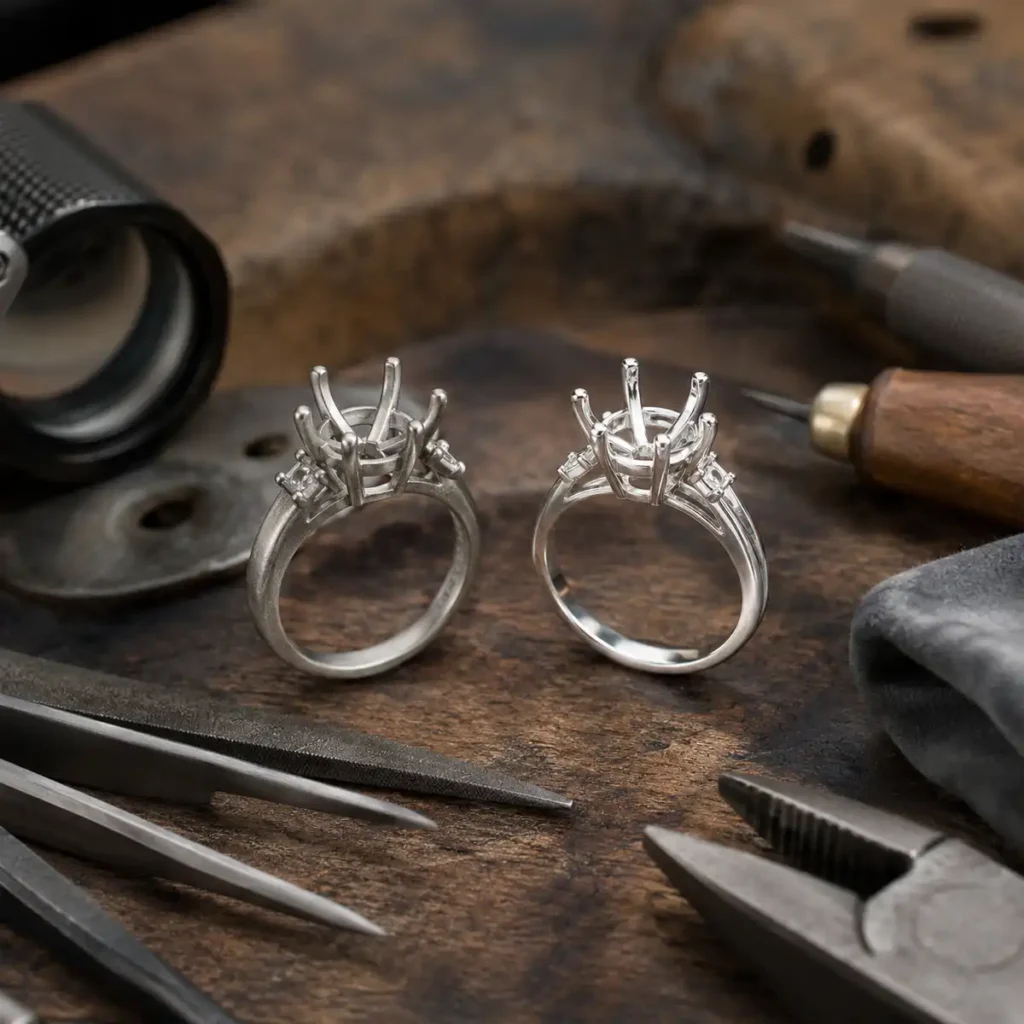
Platinum wins on long-term structural durability, particularly for claw settings. Because platinum displaces rather than removes material when scratched, claw tips on a platinum solitaire will last longer before thinning to the point where they need rebuilding. For a buyer who works with their hands, trains regularly, or simply cannot commit to annual jewellery servicing, platinum repays its higher initial cost over a ten to twenty-year ownership horizon.
White gold is entirely appropriate for normal daily wear. The maintenance requirement (re-rhodiuming when the surface finish dulls) is manageable and inexpensive. For buyers who are disciplined about jewellery servicing and attracted to the lighter weight and lower initial price, 18ct white gold is a completely rational choice.
Platinum develops a patina, a slightly matte, brushed appearance over years of daily wear. This is not damage. It is the natural surface state of a worked precious metal. Many buyers have come to prefer it. The patina can be polished off at any time to restore the original mirror finish.
White gold under rhodium plating will eventually show wear through the plating, most visibly at the highest contact points: the back of the shank, the underside of the claws. When this happens, the underlying white gold alloy (which is pale but not bright white) becomes visible. Re-rhodiuming restores full brightness. The process takes under an hour at Smith and Green’s Greville Street-adjacent workshop and is inexpensive.
Choose platinum if: you prioritise long-term structural durability over initial cost, you want a metal that requires no surface treatment to maintain its white colour, you are commissioning a ring with fine claw work where metal retention matters, or you simply want the most technically robust option available.
Choose 18ct white gold if: initial cost is a meaningful factor in your budget allocation, you prefer a lighter ring for daily comfort, you are happy to commit to re-rhodiuming every one to three years, or the savings on the metal allow you to invest further in the centre stone.
Both are excellent choices in the hands of a skilled maker. The decision is practical, not hierarchical.
Platinum is denser, more durable over the long term, naturally white, and more expensive. White gold is lighter, less costly, visually identical when new, and requires periodic re-rhodiuming to maintain its finish. Neither is categorically superior. The right choice depends on your lifestyle, your maintenance habits, and how you want to allocate your total ring budget.
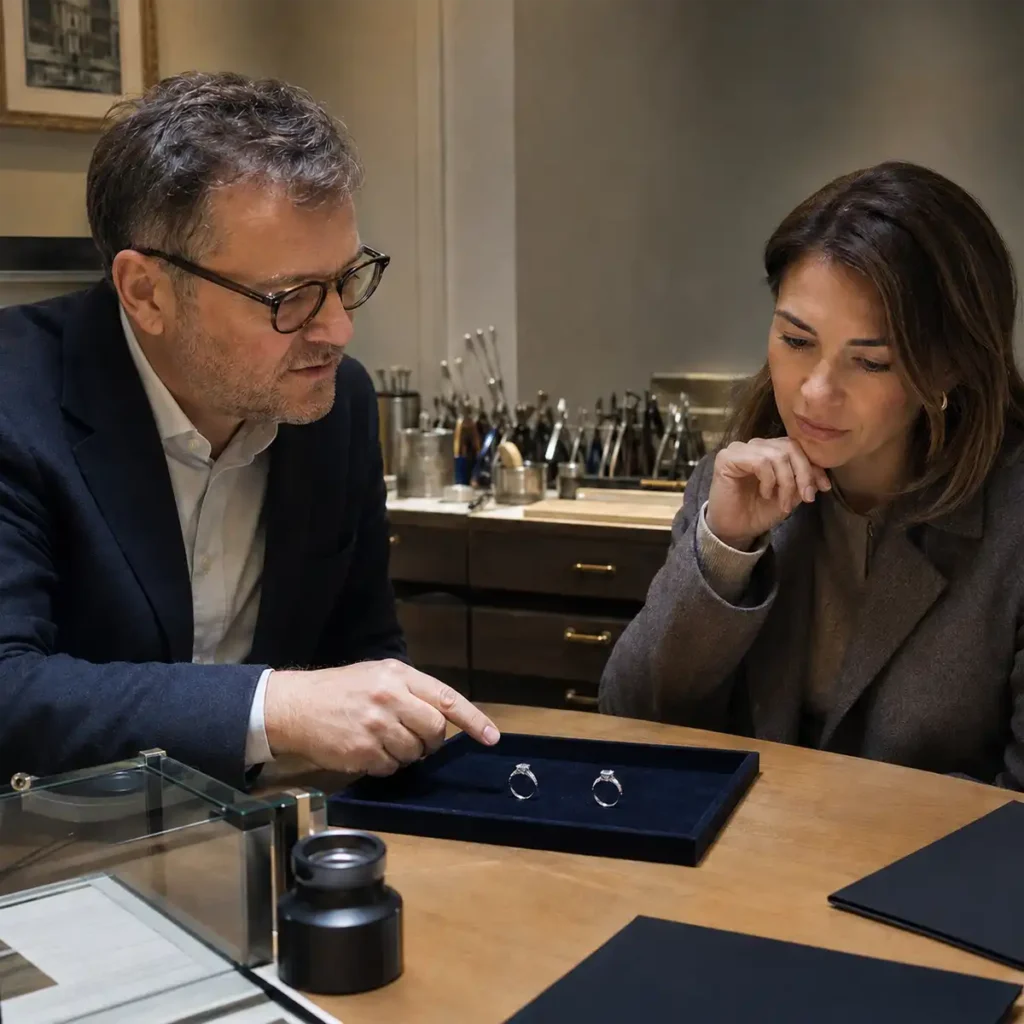
At Smith and Green, the metal conversation happens at the first consultation at 9 Hatton Garden, EC1N 8AH, a short walk from Chancery Lane station. Bring your priorities: stone size, metal feel, and long-term budget for servicing. A ten-minute conversation with one of the team will give you a clear answer that is specific to your ring, your stone, and how you live.