
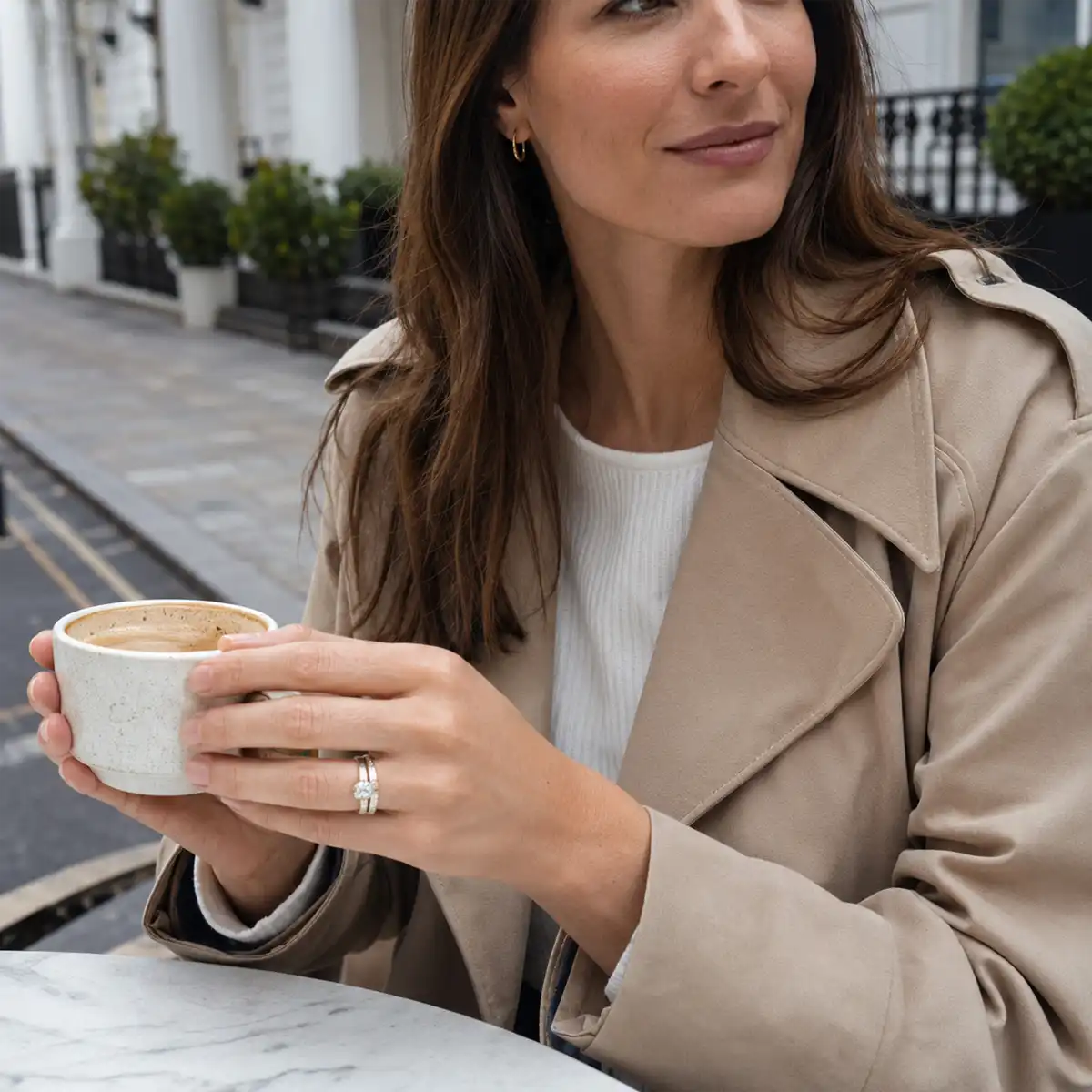
There are four decisions every engaged couple needs to make about the wedding band. Most people are aware of one of them. They choose a metal, assume the band will sit next to the engagement ring in a natural and obvious way, and then arrive at the fitting to discover that the engagement ring’s profile prevents the band from sitting flush, or that the metal they chose looks different in natural light, or that the band they ordered was sized for the engagement ring finger, and their preference has shifted. None of this is a crisis. But all of it is avoidable.
Matching an engagement ring and wedding band is a decision that rewards a small amount of structured thinking applied early. The four key choices, metal, profile, width, and timing, are straightforward individually. Getting them right together is what produces two rings that look as though they belong on the same hand, because they were designed to.
The instinct is to match metals exactly: a platinum engagement ring gets a platinum wedding band; a rose gold engagement ring gets a rose gold wedding band. This is a perfectly sound instinct, and most clients follow it correctly. But the practical considerations are worth understanding before the decision is locked in.
Platinum on platinum wears consistently. Both rings will develop the same surface patina at the same rate, and they will always look tonally matched. This is the lowest-maintenance approach for a white metal pairing.
White gold on white gold also works consistently, provided both rings are rhodium-plated to the same standard at the same intervals. If the engagement ring is re-rhodiumed and the wedding band is not, or vice versa, the tonal difference between a freshly plated ring and a worn one is visible. The practical solution is to have both rings serviced together.
Mixing metals, a yellow gold engagement ring with a platinum or white gold wedding band, is a deliberate design choice that has become increasingly popular. The contrast is intentional and can look considered and contemporary. It is not a compromise. If this is the aesthetic preference, make the decision actively rather than defaulting to it.
One technical note: platinum and white gold should not rub against each other continuously if one ring has been rhodium-plated recently. The harder platinum will, over time, wear through the softer rhodium plating on the white gold ring at the contact point between them. This is a slow process and not a reason to avoid the pairing, but it is a reason to keep white gold servicing regularly when the two rings are worn together daily. how platinum and white gold compare
The setting of the engagement ring determines how the wedding band can sit against it.
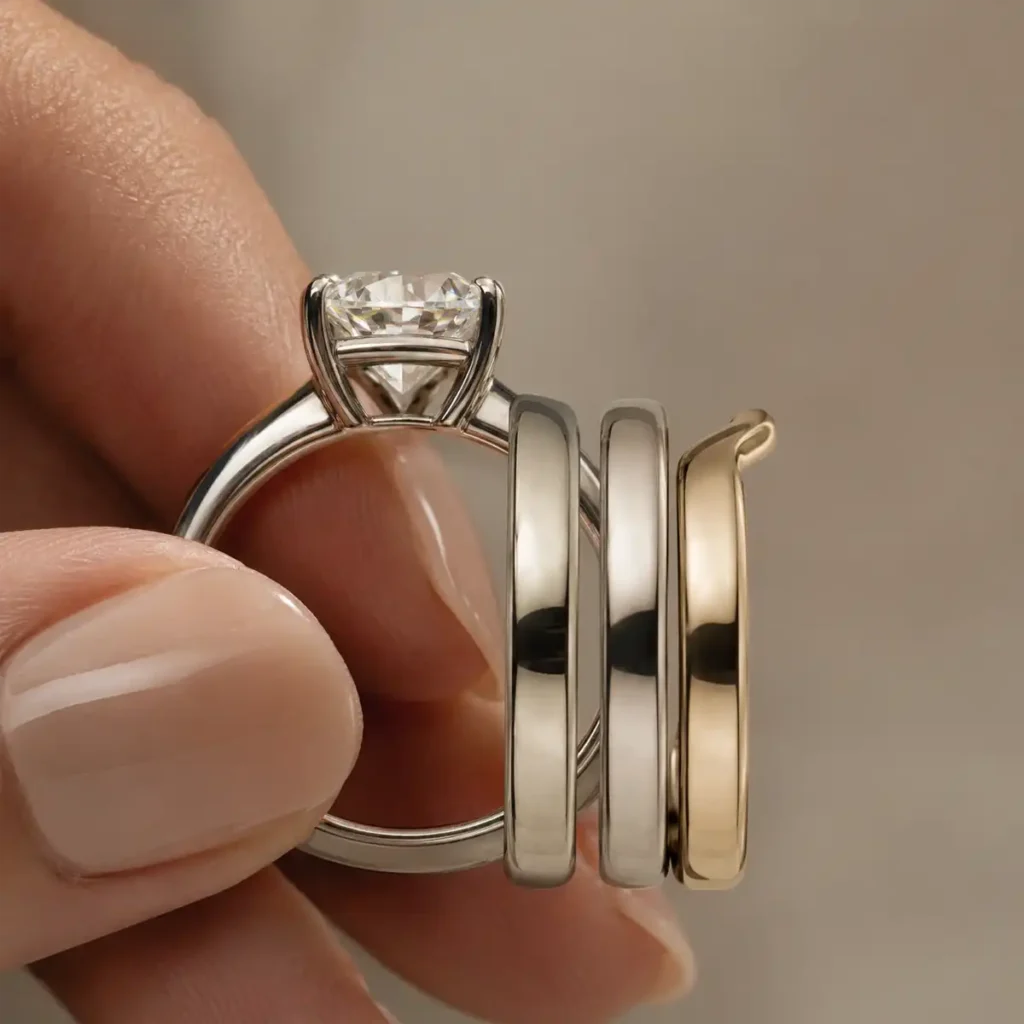
A flush fit or fitted band is designed specifically to follow the contour of the engagement ring’s shank. Where the engagement ring has a shaped or curved profile at the base a cathedral shank, a rounded shoulder, or a carved design, a straight band will sit against it with a visible gap. A fitted band is shaped at the manufacturer’s or workshop to follow that exact contour, allowing the two rings to sit pressed together without daylight between them. This is the cleanest result aesthetically.
A shadow band sits slightly below the engagement ring’s profile, creating a deliberate visual frame rather than a flush join. This is a design choice rather than a compromise.
A straight band can sit correctly against a solitaire on a flat, plain shank. If the engagement ring has no significant profile variation at the base, a standard straight band is the natural choice and involves no bespoke fitting.
The implication: if the engagement ring has a raised or shaped setting, bring it to the wedding band consultation. A smith making a fitted band needs either the engagement ring itself or precise measurements of its base profile to make the fitting accurate. how your setting affects band fit
The width of the wedding band relative to the engagement ring determines whether the two rings look like a set or like two unrelated pieces worn together.
As a general principle, the wedding band should be equal to or slightly narrower than the shank of the engagement ring. A very narrow band (1.5mm to 2mm) will sit elegantly against most engagement ring profiles and disappears visually against rings with significant shoulder detail. A medium band (2.5mm to 3mm) works well with most solitaires and simple-shank rings. A wider band (4mm and above) competes for visual weight with the engagement ring and is most appropriate when the engagement ring itself has a significant, architectural presence.
Fun fact: The tradition of wearing a wedding ring on the fourth finger of the left hand derives from the ancient Roman belief in the “vena amoris” , the vein of love, which was thought to run directly from that finger to the heart. Anatomically this is not accurate, but the tradition has held across two millennia.
For a client who typically wears the engagement ring alone, the weight and width of the wedding band will also affect daily comfort. A 3mm plain platinum band adds perceptible mass to the hand. A slender 2mm white gold band barely registers. Try both in the showroom before committing.
The conventional advice is to order the wedding band at least three months before the wedding. For a bespoke or fitted band, four to six months is a more comfortable timeline, because the design and fitting process takes time and the hallmarking and collection sequence adds additional weeks at the end.
The reason timing matters specifically for a fitted band is that the band is made to fit the engagement ring. If the engagement ring is then resized between the band commission and the wedding, the fit may be affected. If there is any possibility of ring resizing between now and the wedding day, communicate that to the jeweller before the fitted band is made.
For a plain, straight wedding band in a standard width, the timeline is more forgiving, often as few as six to eight weeks from order to collection. For a band with pavé stone setting, engraving, or a complex fitted profile, the longer timeline applies.
Smith and Green’s bespoke wedding band commissions begin with the same consultation structure as engagement ring commissions: a conversation about metal, profile, width, and how the band will relate to the engagement ring. If the engagement ring was made at Smith and Green, the specification is already in the workshop’s files, which simplifies the fitting process. caring for your ring as your collection grows
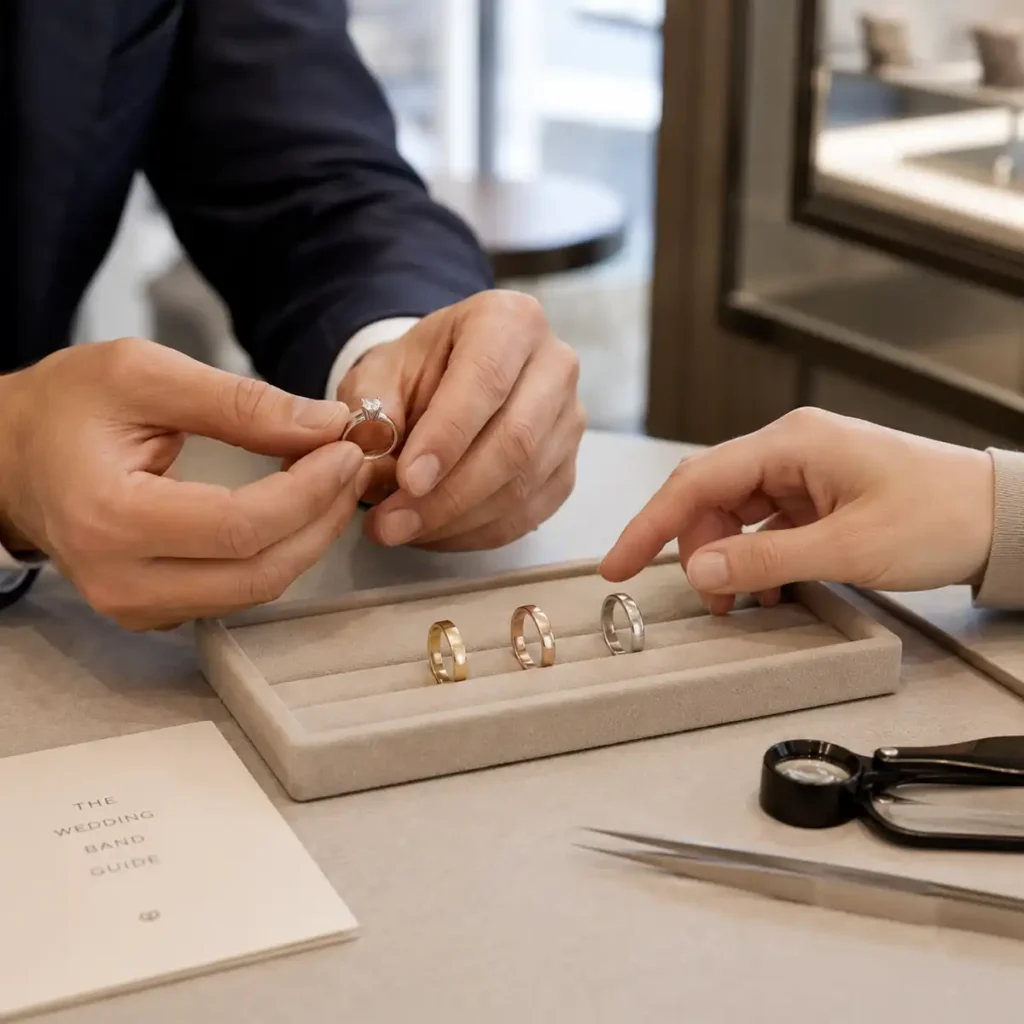
Bring the engagement ring. The jeweller needs to see it, hold it, and assess the base profile before recommending a band design. Bring any reference images of band styles that appeal, including patterned or engraved options you have seen elsewhere. Bring your partner if both rings are being commissioned in the same appointment; the pair should be seen together on the same hands, in the same consultation, wherever possible.
At 9 Hatton Garden, EC1N 8AH, Smith and Green’s team handles wedding band commissions for both ready-to-wear and bespoke pieces. The showroom is open Tuesday to Saturday, accessible from Chancery Lane station on foot.
Four decisions, properly considered, produce two rings that belong together. Match the metal thoughtfully rather than automatically, understand whether a fitted or straight profile suits the engagement ring’s shank, choose a width proportional to the engagement ring’s visual weight, and allow enough time for a bespoke commission to be made and hallmarked without pressure.
The engagement ring and wedding band will be worn together every day, probably for the rest of your life. It is worth giving the pairing thirty minutes of structured thought before the order is placed. The jeweller’s job is to make that conversation easy. At Smith and Green, it usually is.