Opal is a hydrated form of silica (SiO₂·nH₂O) — not a crystal but a mineraloid, which means it has no regular crystal structure. Instead, it is made up of microscopic silica spheres packed together with water trapped between them. That water content typically ranges from 3% to 10% and is part of what makes opal both uniquely beautiful and more delicate than most gemstones. The ancient Romans considered opal the most precious of all stones, believing it contained the beauty of every other gem within it — and once you’ve seen a fine opal flash under natural light, it’s easy to understand why.
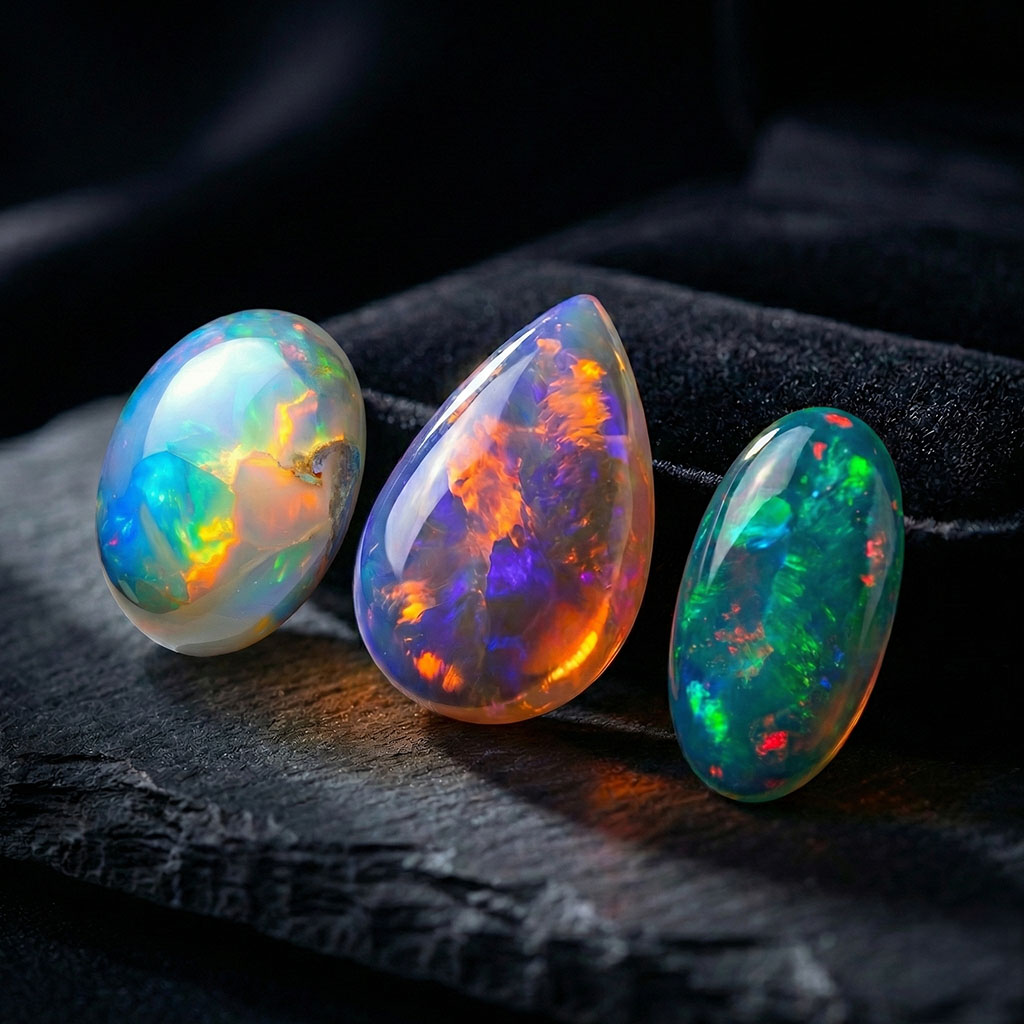
The defining feature of precious opal is its play-of-colour — shifting flashes of spectral colour that dance across the stone as you move it under light. This is caused by the orderly arrangement of those silica spheres: when white light passes through the lattice, it diffracts into its component colours, much like a prism. The size of the spheres determines which colours appear — smaller spheres produce blues and greens, larger ones produce oranges and reds.
Common opal (also called “potch”) shares the same chemical composition but lacks this ordered sphere structure, so it shows no play-of-colour. It can be attractive in its own right — pink opal from Peru is a popular example — but it is precious opal that commands the highest value.
Type | Body Tone | Origin | What Makes It Special |
Black Opal | Dark grey to black | Lightning Ridge, Australia | The rarest and most valuable. Dark body tone makes play-of-colour appear exceptionally vivid. |
White Opal | White to light grey | Coober Pedy, Australia | The most common precious opal. Softer play-of-colour against a pale background. Excellent value. |
Boulder Opal | Variable (with ironstone host) | Queensland, Australia | Thin veins of opal within ironstone. Natural backing adds durability. Can rival black opal in vibrancy. |
Crystal Opal | Transparent to semi-transparent | Various (Australia, Ethiopia) | Light passes through the stone, creating colour both on the surface and within. Mesmerising depth. |
Fire Opal | Yellow, orange, red | Mexico (Querétaro) | Prized for vivid body colour rather than play-of-colour. Some show both. Often faceted rather than cabochon-cut. |
Australia produces approximately 90–95% of the world’s precious opal. Ethiopia has emerged as an important secondary source, producing hydrophane opals with vivid colour — though these are more porous and require extra care.
Solid opal is a single piece of natural opal with no backing or cap — the most valuable form. A doublet bonds a thin slice of precious opal onto a dark backing (ironstone or black potch) to enhance colour and provide strength. A triplet adds a domed cap of clear quartz or glass on top for protection. Doublets and triplets make beautiful opal accessible at a fraction of the solid price — but they should always be disclosed, and you should avoid submerging them in water as moisture can weaken the adhesive.
💡 Insider tip: When evaluating play-of-colour, red is traditionally the most prized hue, followed by orange, then green and blue. But a stone that flashes the full spectrum — every colour of the rainbow — is the rarest and most valuable of all, regardless of which colour dominates. |
Opal rates 5.5 to 6.5 on the Mohs hardness scale — similar to glass — so it is softer than most gemstones. Clean with lukewarm water and a soft cloth; never use ultrasonic cleaners, steam or harsh chemicals. Avoid sudden temperature changes and prolonged direct sunlight, which can cause crazing (fine surface cracks). Store opal separately in a soft pouch. For rings, a bezel setting offers better protection than prongs — and opals suit pendants and earrings particularly well, where daily knocks are less of a concern.
Choose opal if you want a gemstone that is truly one-of-a-kind — no two opals display the same pattern. It is October’s birthstone and carries a beauty no other gem can replicate.
Consider a protective setting if the opal will be worn daily on a ring. For everyday rings, a bezel or halo design shields the stone from knocks.
It can. Opal is softer and more sensitive than most gems, so knocks and heat changes can cause chips or fine “crazing” cracks. For daily wear, use a bezel/halo setting and remove it for gym, DIY, and heavy work.
Splashes are usually fine for solid opal, but avoid soaking. Ethiopian (hydrophane) opal can absorb water and change appearance temporarily. Doublets/triplets shouldn’t be submerged because moisture can weaken the bond.
Ask for written confirmation and check the side view. Doublets show a join line to a backing. Triplets have an added clear cap. A proper receipt or certificate should state the construction.
Confirm solid vs doublet/triplet, and ask if it’s Australian or Ethiopian (hydrophane). Request a daylight video showing movement. Also check return terms—photos often mislead.
Normal. Opal’s colour play changes with light type and angle, so daylight, warm indoor light, and LEDs can look very different. Judge it from a daylight video or in person where possible.