
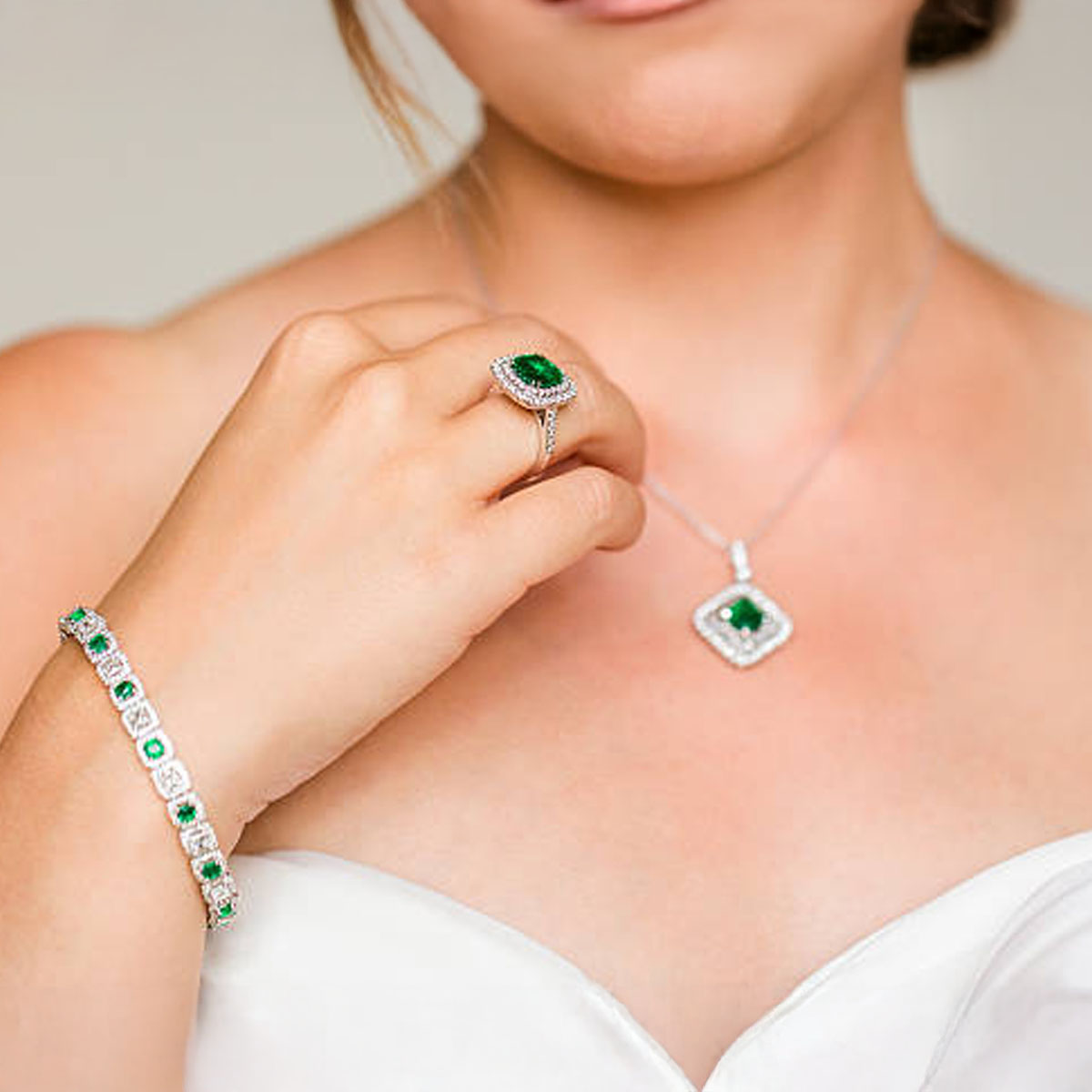
Coveted for millennia by monarchs, mystics and modern connoisseurs, the emerald is more than a pretty stone. It’s a saturated green signal that represents rebirth, love, and wisdom. At the same time, its very existence tells a story of geological chaos resolved into order. Born when rare elements meet under fierce heat and pressure, an emerald’s path from hidden vein to crafted jewel is equal parts science and artistry. What follows recasts everything you need to appreciate, select and care for this singular gem without straying beyond the facts already on record.
At its core, an emerald is beryl, a cyclosilicate with the formula Be₃Al₂(SiO₃)₆. Aquamarine and morganite sit in the same family. Yet, the emerald’s defining trait is its green, which ranges from pure and vivid to slightly bluish or yellowish. That colour must reach a recognised threshold of tone and saturation to earn the name. Anything “too light” is simply green beryl, a distinction that matters to laboratories and serious collectors alike.
On the Mohs hardness scale, emeralds score 7.5 to 8, tougher than steel against scratches. Toughness, however, is a different measure. Because almost every emerald carries internal fractures born of its violent formation, its resistance to breakage is often rated poor. This duality explains why an emerald can survive everyday wear yet still demand respect.
Rarity is written into emerald geology. Beryllium, the light element that builds beryl, typically arises in late-stage magmatic fluids within pegmatites. Chromium and vanadium, the colour givers, are heavier and usually reside in metamorphic rocks linked to the mantle. For emeralds to grow, tectonic collisions or mountain-building events must force these strangers together. Hydrothermal fluids, laden with minerals and heated to roughly 400°C to 700°C, carry and deposit them within fissures in rocks such as schist or limestone. This improbable choreography produces stones far scarcer than diamonds, which form from abundant carbon.
The emerald’s soul is its hue. Chromium (Cr³⁺) and vanadium (V³⁺) ions replace aluminium in the crystal lattice to create that saturated green. Chromium remains the classic, most prized agent. Vanadium can yield a similarly rich tone and, following a 1960s shift in American trade practice, vanadium-coloured beryls are accepted as emeralds there, though European usage can be stricter, sometimes reserving “Colombian emerald” for chromium-dominant stones. Iron, often present, nudges the colour toward blue or yellow and, in higher levels, can mute vibrancy.
Plenty of gems are green, but none replicate the emerald’s full suite of physical, chemical and optical features. Knowing the contrasts helps a buyer recognise the value.
Each figure above mirrors the original table, keeping the facts intact while clarifying the contrasts.
Fun fact: The oldest emerald crystals ever dated are approximately 2.97 billion years old, yet humans have mined them for only a few thousand years.
Emerald history stretches back into antiquity. Egyptian mines, which operated as early as 330 BC and possibly as far back as 3500 BC, supplied a culture that buried emeralds with royalty for protection in the afterlife. Cleopatra famously claimed exclusive rights to the country’s production and wore the stones lavishly.
Romans associated emeralds with Venus, the goddess of love. Across the Atlantic, the Incas and Aztecs revered them for their ceremonial and noble significance. When Spanish conquistadors arrived, they were transfixed and spent nearly 20 years searching for the secret Muzo deposits in Colombia.
The emerald’s green evokes spring, so it naturally stands for renewal, hope and vitality. In Greco-Roman thought, its association with Venus made it a symbol of love and optimism. Today it still marks “faithful, deep and mature love”, with tradition naming it for 20th and 35th wedding anniversaries.
The ancient Egyptians saw it as a gift from Thoth, the god of wisdom. Across cultures, it has come to represent intuition, truth and loyalty, offering calm and a sense of security to its wearer.
Origin shapes character. Collectors speak of terroir because geological context alters chemistry and inclusions.
Every attribute listed reflects the original table: colour profile, clarity tendencies and host rock.
The Four Cs still apply, but emeralds rank them differently. Colour is king, with clarity, cut and carat following in that order.
Gemologists break colour into hue, tone and saturation. The most valuable stones show a pure green to bluish-green hue. A stone that is too yellow or too blue is reclassified, thereby lowering its value. Tone should sit in the medium to medium-dark range: too light and you have green beryl, too dark and the stone looks lifeless. Some experts cite an ideal tone around 75% on a scale where 0% is colourless and 100% is black. Saturation must be strong to vivid; weak or greyish stones are markedly less valuable.
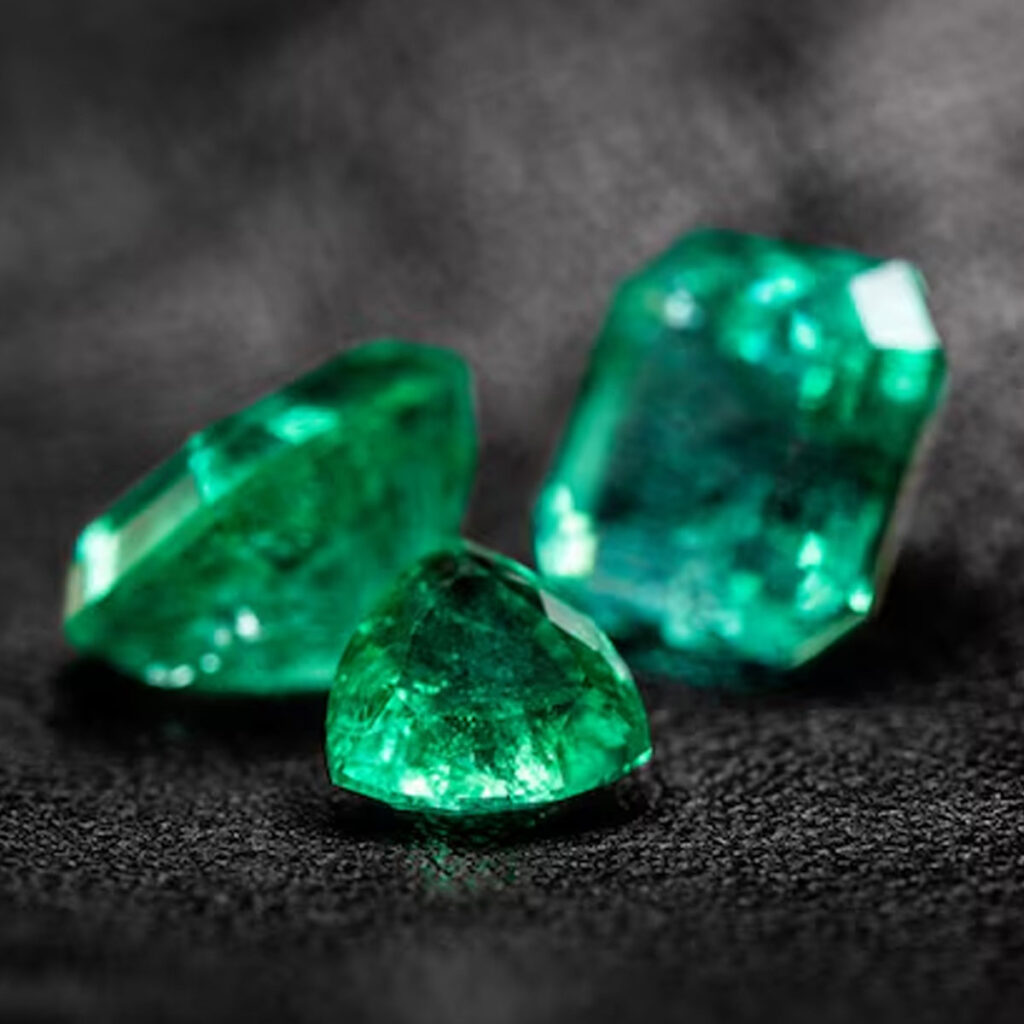
Emeralds are Type III gems, almost always included to the naked eye. Unlike diamonds, they are judged by eye, not strictly at 10x magnification. Their internal landscape, the jardin, resembles mossy gardens of fractures and crystals. Far from flaws, these inclusions confirm authenticity and narrate the stone’s turbulent birth. They may be minute crystals, liquid-filled cavities, gas bubbles or classic three-phase inclusions, especially in Colombian stones. Eye-clean emeralds are exceptionally rare and prized.
Lapidaries walk a fine line: maximise colour and carat weight while steering around fragile inclusions. The emerald cut, a rectangular step cut with trimmed corners, arose to protect vulnerable edges and to create a “hall of mirrors” effect that showcases colour over fire. Ovals, pears and cushions also feature when the rough suggests another route.
Carat measures weight, not dimensions, yet emeralds appear larger than diamonds of the same weight because beryl has a lower density. Size affects price, but not as much as colour and clarity. A smaller stone of top colour outvalues a larger but inferior one. Large, fine emeralds are extraordinarily scarce, so the price per carat climbs steeply as weight rises.
Surface-reaching fissures filled with air stand out because light scatters differently there. Oiling replaces that air with a substance whose refractive index closely matches emerald. Natural cedarwood oil remains the preferred filler for stability and optics. The effect is a cleaner look and often a perceived boost in colour intensity as internal scatter falls.
This treatment is not permanent. Heat, ultrasonic vibrations and harsh chemicals can leach or “sweat” the oil, reducing clarity. Periodic re-oiling by a professional may be required to maintain the stone’s presentation.
Ethical jewellers disclose treatment levels. Laboratories such as the GIA grade enhancement as minor, moderate or significant. Value tracks those grades: all else being equal, a minor is worth more than a major. A fine, untreated emerald is vanishingly rare and commands a premium. The real question is not “is it treated?” but “to what extent, and has a trusted expert verified it?”.
In contemporary luxury, provenance matters. Buyers want assurance that beauty is not marred by environmental harm or exploitation.
Ethical sourcing rests on three pillars:
Bodies such as the Responsible Jewellery Council certify standards throughout the supply chain. Commissioning from a jeweller committed to these principles delivers both aesthetic pleasure and peace of mind.
Selecting an emerald for a custom piece is a thoughtful and intimate process. Each stone carries a unique shade and jardin, making bespoke design the ideal route.
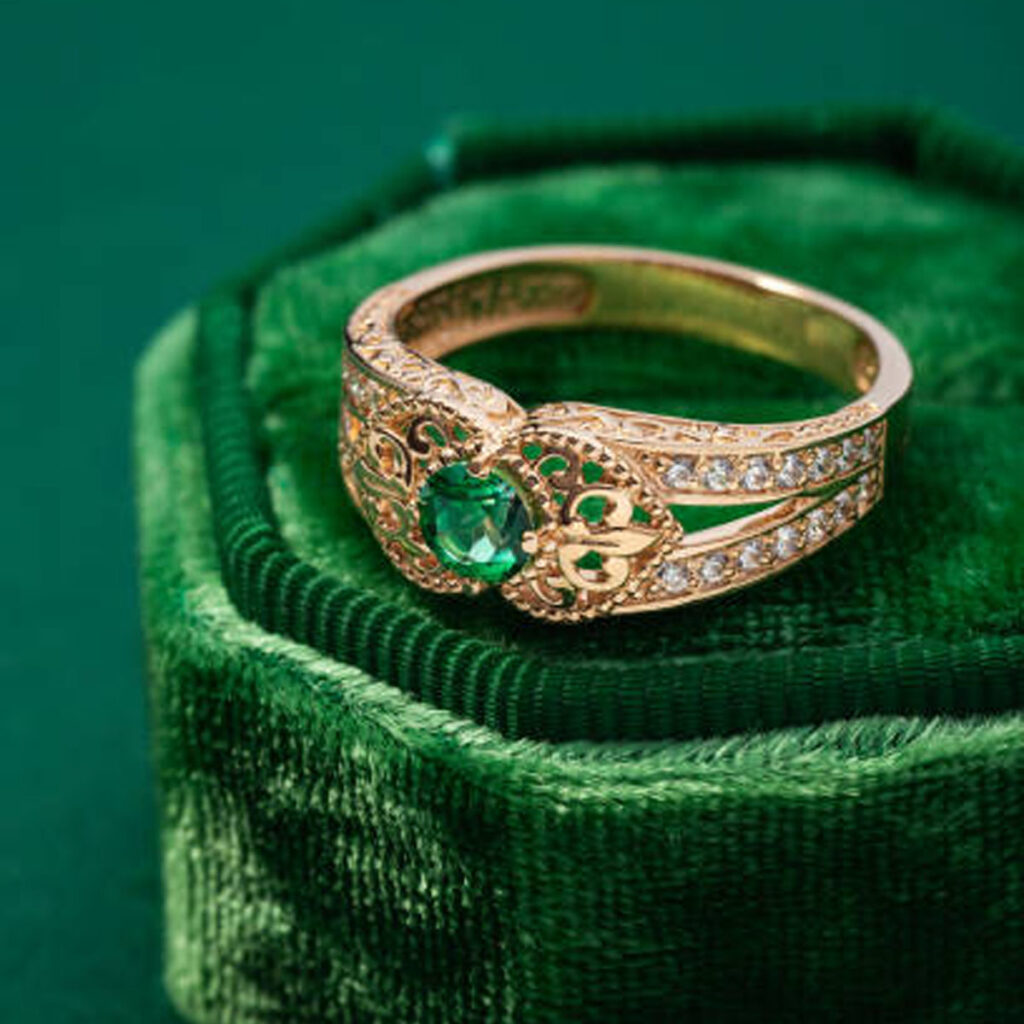
Emeralds have featured across every design era, from Victorian florals to Art Deco geometry. In custom work, the stone leads. A skilled artisan will echo its lines, spotlight its strongest colour and even celebrate its inclusions as character, producing a jewel that exists nowhere else.
Hardness is good, brittleness is not. Daily-wear rings demand protective settings. A jeweller will study surface-reaching inclusions to mitigate risks. For active clients, bezels that encircle the stone or halo designs that buffer edges with smaller gems add protection without sacrificing elegance.
Metal influences perceived colour.
Every entry above preserves both aesthetic and practical notes from the source material.
Emeralds reward gentle care. Their inclusions and treatments mean some standard jewellery-cleaning shortcuts are off the table.
Use lukewarm water, mild dish soap and a very soft toothbrush or cloth. Gently clean around settings, rinse thoroughly and pat dry with a lint-free cloth.
Avoid:
Store emerald jewels separately, ideally in fabric-lined boxes or soft pouches. Harder stones such as diamonds, sapphires and rubies can scratch them. Remove emerald pieces before strenuous work, sport or gardening to prevent chips.
Routine inspections matter. A jeweller can tighten prongs, safely deep-clean, and evaluate whether re-oiling is necessary. This ongoing relationship ensures the piece remains secure and lustrous, ready to pass down as an heirloom.
An emerald is geological improbability solidified, threaded through centuries of cultural meaning and individualised by its internal garden. Its worth lies in more than weight or hue, resting equally on its distinct identity.
To commission a piece is to align natural artistry with human craftsmanship. Whether it marks an engagement, an anniversary or a personal milestone, the finished jewel carries a narrative: of ancient heat and pressure, of historical fascination and of your own chapter in that continuum. Like a well-tended garden, its beauty endures when cared for, reminding us that value often lives in character, not perfection. As the saying goes, “fine things are timeless when tended well” — a sentiment as accurate for emeralds as for relationships.