Most diamonds are graded on the GIA’s D-to-Z colour scale, which measures the absence of colour — the closer to D, the more colourless and valuable the stone. But some diamonds sit outside that scale entirely. When a diamond shows a noticeable hue — yellow, pink, blue, green, orange, or even red — beyond Z, it enters the world of fancy colour diamonds, where the rules reverse: the more colour a stone has, the more desirable it becomes.
Roughly one in every 10,000 gem-quality diamonds mined displays natural fancy colour. That rarity is what makes them so sought-after — and why understanding the origin of a diamond’s colour is just as important as the colour itself.
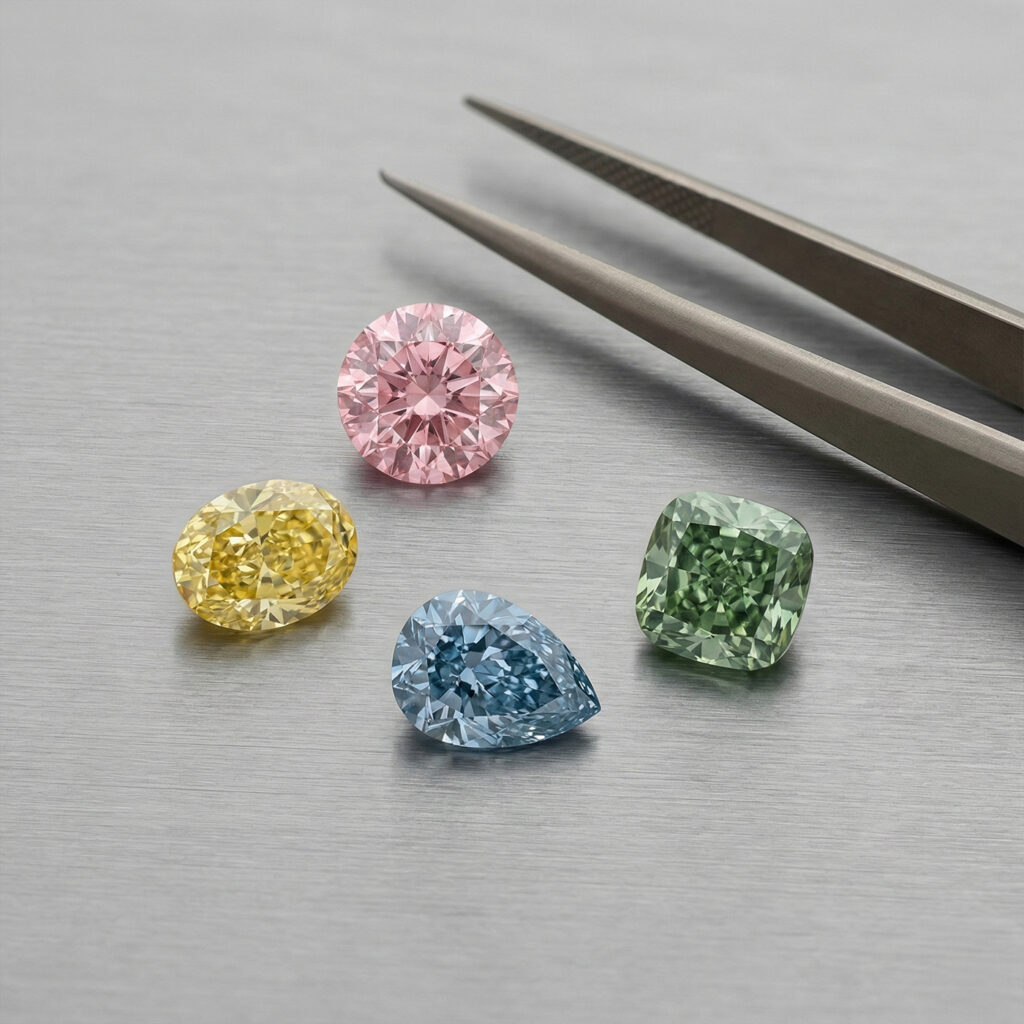
In natural fancy colour diamonds, the colour is caused by trace elements or structural irregularities formed over millions of years deep in the Earth. Nitrogen produces yellow and orange. Boron creates blue. Pink and red result from distortions in the crystal lattice — a phenomenon scientists still don’t fully understand. Green diamonds get their colour from natural radiation exposure underground.
These effects can be replicated through treatments (applied to existing natural diamonds) or during the lab-growing process itself. All three routes produce real diamond — the difference is how the colour got there and what that means for rarity, value and certification.
The GIA grades fancy colour diamonds on three components: hue (the actual colour), tone (how light or dark it appears), and saturation (how strong and vivid the colour is). These combine into nine intensity grades, from weakest to strongest:
Faint → Very Light → Light → Fancy Light → Fancy → Fancy Intense → Fancy Dark → Fancy Deep → Fancy Vivid
Fancy Vivid and Fancy Intense command the highest prices. Unlike white diamonds, where cut is king, with fancy colours the intensity and purity of colour is the single most important value factor — a heavily included stone with vivid colour can be worth more than a flawless stone with a weaker hue.
💡 Insider tip: When a diamond has more than one hue, the dominant colour is listed last. So a “fancy greenish yellow” is mostly yellow with a green modifier, while a “fancy yellowish green” is mostly green — and significantly rarer. |
| Natural Fancy Colour | Colour-Treated | Lab-Grown Colour |
Colour origin | Trace elements or lattice distortion formed naturally over millions of years | Existing natural diamond altered by HPHT, irradiation or annealing | Colour introduced during CVD or HPHT growth, or by post-growth treatment |
Certification | GIA report states “Natural” colour origin | GIA report states “Treated”; girdle laser-inscribed | IGI or GIA report states “Laboratory-grown” |
Colour stability | Permanent — will never change | HPHT: permanent. Irradiation: stable for daily wear but sensitive to high heat | Permanent under normal conditions |
Rarity | Extremely rare (1 in 10,000 mined diamonds) | Uncommon but reproducible | Readily available and reproducible |
Value over time | Holds and appreciates — investment grade at top intensities | Very limited resale value | Depreciating; no meaningful secondary market |
Price indication | £££££ (vivid pinks and blues sell for millions per carat) | ££ (fraction of natural equivalent) | ££ (similar to treated pricing) |
Best for | Collectors, investors, once-in-a-lifetime pieces | Fashion jewellery, vibrant colour on a budget | Everyday colour jewellery at accessible prices |
Always check the certificate. A GIA Coloured Diamond Grading Report tells you two critical things: the exact colour grade and whether the colour is natural or treated. For lab-grown stones, look for an IGI or GIA laboratory-grown report. Without certification from a reputable lab, you have no way of knowing what you’re buying.
Prioritise colour over clarity. With fancy colours, a strong, even hue viewed face-up matters far more than internal inclusions. Many connoisseurs happily accept SI1 or SI2 clarity in exchange for a more vivid colour grade.
Cut shapes matter. Fancy shapes like radiant, cushion and pear concentrate colour better than round brilliants. Cutters prioritise colour intensity over maximum sparkle — the opposite approach to white diamond cutting.
A fancy colour diamond shows a visible hue outside the normal colourless scale. It’s graded by hue (colour family), tone (light/dark), and saturation (strength). Higher intensity grades usually mean higher value.
Check the certificate. GIA reports state whether colour is natural or treated and list the exact colour grade. Lab-grown stones should have a lab-grown report (often IGI or GIA) clearly marked “laboratory-grown”.
Most treatments are stable in daily wear. The main risk is high heat during resizing or repairs. Always tell the jeweller it’s treated before any workshop work.
Some shapes hold and concentrate colour better face-up. Radiant, cushion, pear and oval often show richer colour than round brilliants at the same grade. Fancy-colour cutting often prioritises colour over sparkle.
Generally, yes. Natural fancy colours are scarce and can hold value well, especially with strong grades and top certification. Treated and lab-grown can look excellent, but resale is usually weaker due to easier supply.