
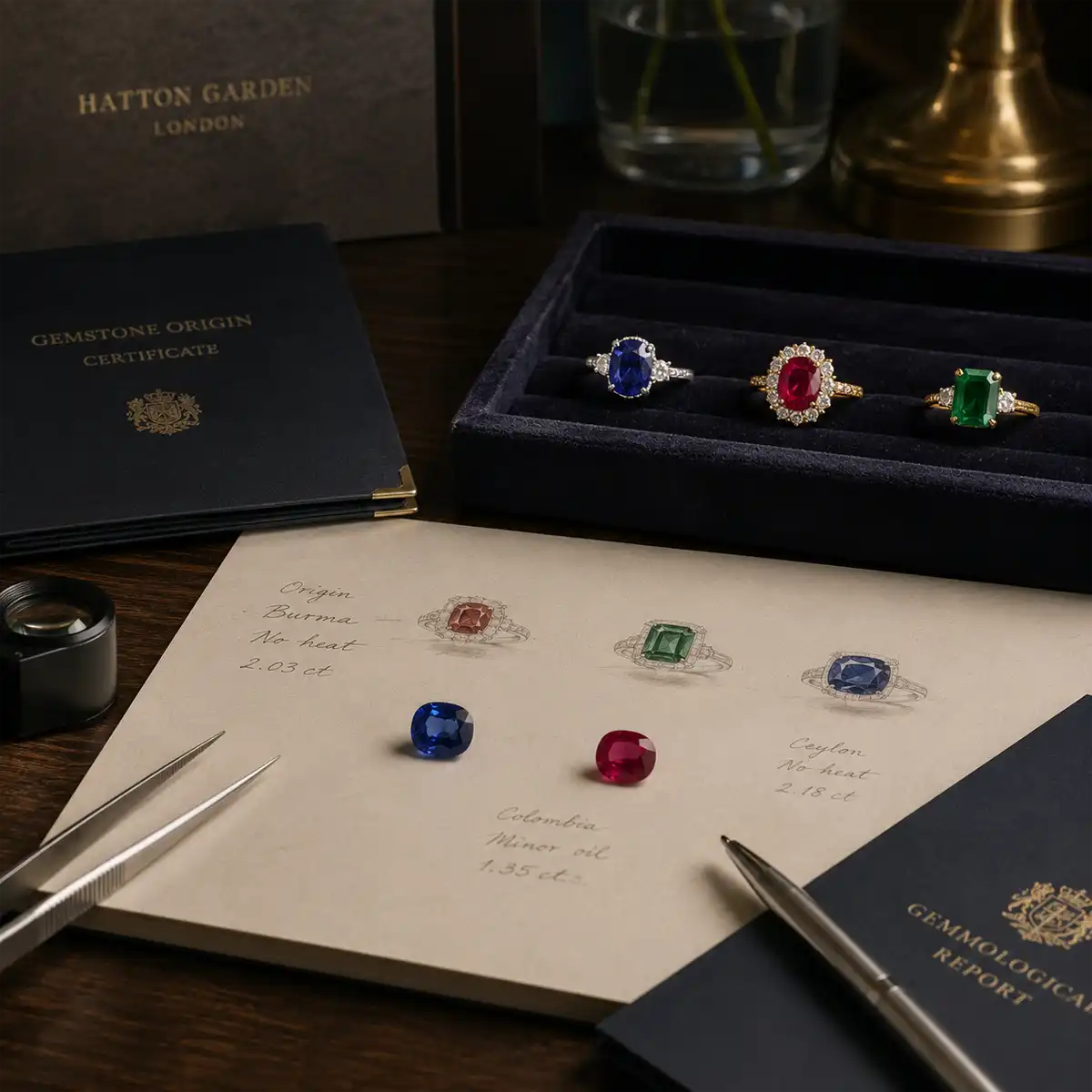
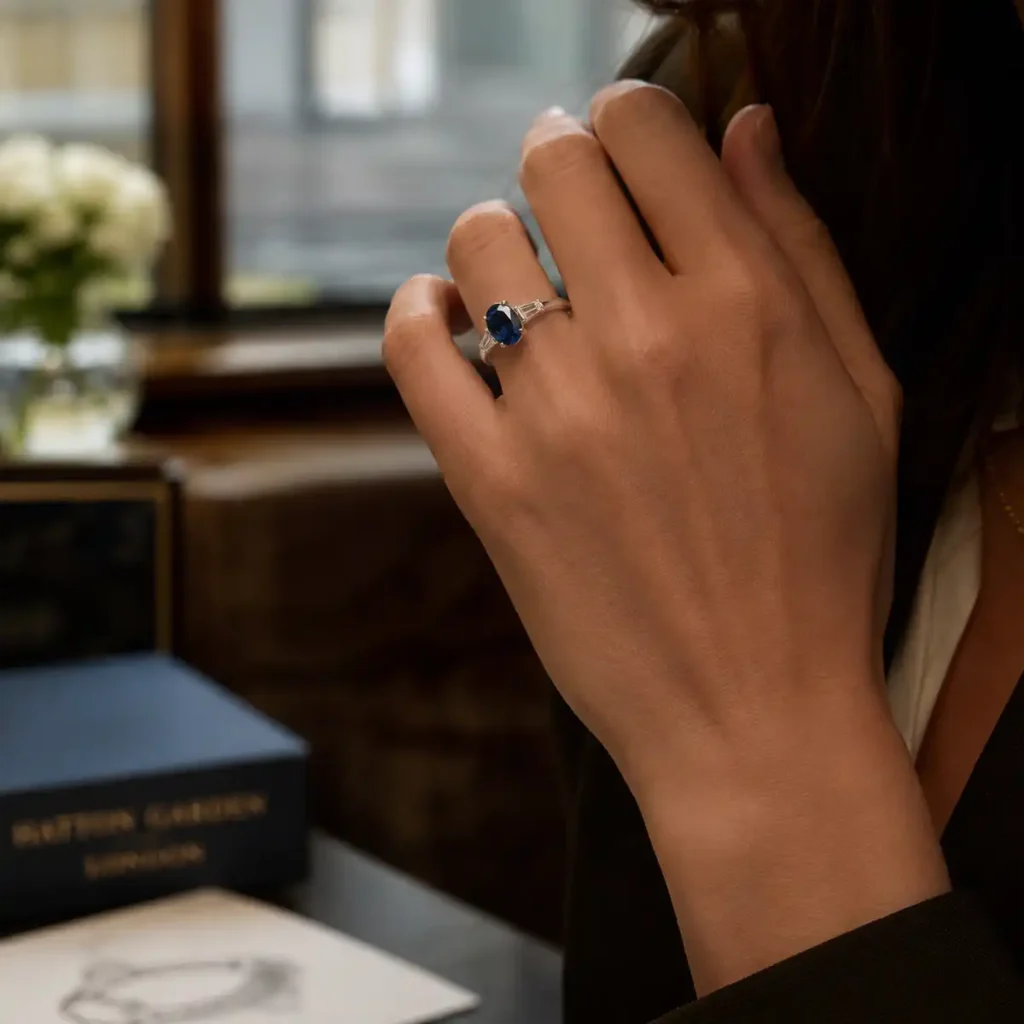
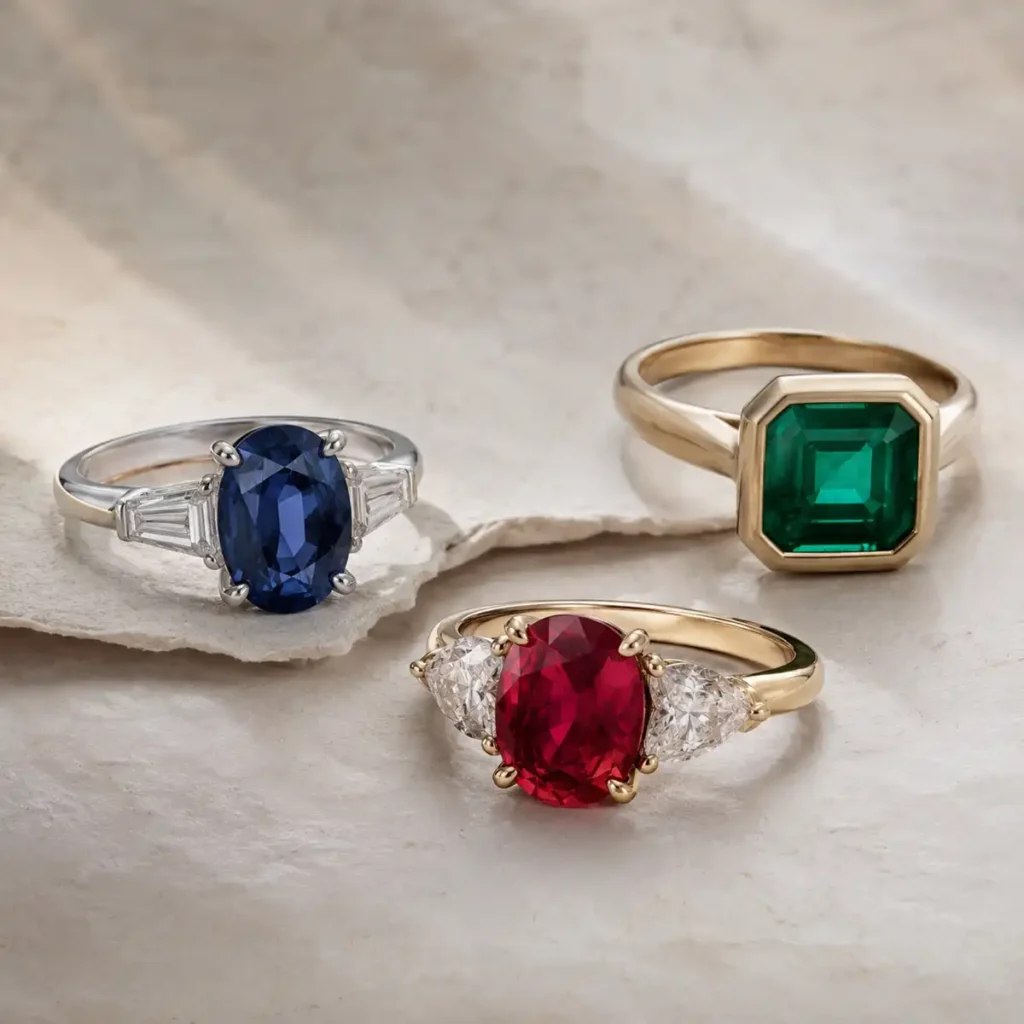
There is a particular kind of buyer who arrives at Smith and Green already knowing they do not want a diamond. Not because a diamond is wrong but because something else is more right. A deep Kashmir-blue sapphire in an 18ct white gold bezel. A vivid Mozambique ruby flanked by trillion-cut white diamonds. A Colombian emerald, slightly included, with that internal forest-green life that no coloured stone quite replicates. These are not compromises. They are precise, considered choices made by people who understand that the most personal ring is not always the most conventional one.
Coloured gemstone engagement rings are experiencing a genuine resurgence in Hatton Garden, driven partly by a generation of buyers who saw a certain sapphire ring on a certain royal hand and thought: yes, that is the idea. But mostly they are gaining ground because buyers are doing more research before they visit, arriving at consultations with questions that go well beyond carat weight. The right sapphire, ruby, or emerald in the right setting is not a budget alternative to a diamond. It is a different category of jewellery entirely, with its own grading logic, its own certification landscape, and its own long-term ownership considerations.
Gemstone hardness is measured on the Mohs scale, a relative scale running from 1 (talc) to 10 (diamond). For an engagement ring worn daily, hardness matters because it directly determines resistance to scratching from everyday environmental contact dust, surfaces, other jewellery.
Diamond rates 10. Corundum the mineral family that includes both sapphire and ruby rates 9. This is close enough to diamond that both sapphires and rubies are considered excellent choices for daily wear. The single-point gap between 9 and 10 on the Mohs scale sounds small but represents a significant difference in actual scratch resistance; diamond is considerably harder than any other natural mineral. However, a well-cut sapphire or ruby in a protective setting will survive daily wear in normal conditions without visible surface damage over decades.
Emerald is beryl, which rates 7.5 to 8 on the Mohs scale. This is meaningfully softer than corundum. Emeralds are also characteristically included the industry term for natural internal growth characteristics that are so common in emerald that they have their own name: jardin (French for garden). The combination of moderate hardness and typical inclusion patterns means emeralds are more vulnerable to chipping and cracking than sapphires or rubies if the stone takes a direct impact. An emerald engagement ring worn every day requires a more protective setting design and attentive ownership.
Fun fact: The largest known faceted emerald in the world the Mogul Mughal Emerald weighs 217.80 carats and dates to 1695. It is carved with Islamic prayers on one face and a floral motif on the reverse, demonstrating that emeralds have been considered worthy of a jeweller’s finest work for centuries.
Sapphire is corundum in any colour other than red (which is ruby). Blue sapphire is the most commercially significant, but sapphires exist across the full colour spectrum: pink, yellow, orange, padparadscha (a rare salmon-pink-orange combination), and colourless. For engagement rings, blue, pink, and padparadscha are the dominant choices.
Colour in sapphire is evaluated on three axes: hue (the basic colour blue, violet-blue, greenish-blue), saturation (the intensity of the colour from pale to vivid), and tone (lightness to darkness on a scale from very light to black). The most commercially prized blue sapphires sit at medium to medium-dark tone with strong saturation and a pure blue to violet-blue hue. Very light stones read as pale and lack presence on the hand. Very dark stones absorb so much light that they appear near-black indoors.
Geographic origin carries significant weight in sapphire valuation. Kashmir sapphires from a remote Himalayan deposit that was largely exhausted by the early 20th century is considered the benchmark for fine blue sapphire. Their characteristic velvety blue, caused by microscopic silk inclusions that scatter light evenly, commands extraordinary premiums at auction. Burma (Myanmar) sapphires are the second tier of prestige. Ceylon (Sri Lanka) sapphires are the most commercially available quality origin, producing a broad range from pale cornflower blue to rich royal blue. Madagascar has become a significant modern source of high-quality material.
Certification for sapphire origin is provided by laboratories including GIA, Gübelin Gem Lab, and SSEF (Swiss Gemmological Institute). For a sapphire of significant value, a Gübelin or SSEF certificate confirming Kashmir or Burma origin is the gold standard. the best settings for coloured stones
Ruby is red corundum. The distinction from sapphire is colour alone: corundum must display a sufficiently strong, sufficiently saturated red to qualify as ruby rather than pink sapphire, and where that line falls is a matter of laboratory judgement. The GIA uses a defined colour boundary; other laboratories draw it differently.
A true fine ruby vivid red to slightly purplish red, strong saturation, minimal brown or orange modifier is among the rarest coloured stones on earth. Burma (Mogok Valley) rubies are the prestige origin benchmark, producing the pigeon’s blood red that defines the finest material. Mozambique has emerged in the past two decades as a major source of high-quality ruby, producing stones with strong saturation and relatively good clarity that are now regularly certified by GIA and Gübelin.
Inclusions in ruby are nearly universal. A completely eye-clean fine ruby above 1.00ct from Burma is exceptionally rare and commands prices that exceed equivalent-quality diamonds by a significant margin. For engagement ring purposes, VS-level clarity in a well-cut stone is entirely appropriate. Heating a standard, widely accepted treatment that improves colour and clarity is present in the vast majority of commercial rubies. An unheated ruby of fine quality commands a substantial premium.
For a ruby engagement ring, a bezel or protective half-bezel setting offers the best combination of security and colour display. The metal collar at the girdle reduces the risk of chipping while framing the stone’s colour effectively.
The jardin of an emerald its internal network of inclusions, fractures, and growth characteristics is not a flaw to be minimised at all costs. It is part of the stone’s identity. A completely inclusion-free emerald above 1.00ct is so rare as to be practically impossible to source. The question for a buyer is not whether inclusions are present but whether they affect the stone’s structural integrity and how visible they are face-up.
Eye-clean to very slightly included emeralds do exist at commercial price points, primarily from Zambian production which tends to slightly better clarity than Colombian material. Colombian emeralds from the Muzo, Chivor, and Coscuez mines are the prestige origin, characterised by their warm, slightly yellowish-green colour that many buyers and gemmologists consider the most beautiful in the world.
Treatments are near-universal in emerald. Clarity enhancement through filling fractures with cedar oil or synthetic resin (rated on a scale from none to significant) is standard practice and disclosed on certificates. GIA and other laboratories rate the degree of enhancement. For an engagement ring, moderate enhancement is acceptable; significant enhancement indicates a more heavily fractured stone that may be structurally compromised.
The setting choice for an emerald is more constrained than for sapphire or ruby. A four-claw or six-claw setting that holds the stone at the girdle without placing pressure on the table or pavilion is preferable to high-tension designs. A bezel offers maximum edge protection and is particularly well suited to the emerald cut, the rectangular step-cut that takes its name from this stone.
Unlike diamonds, coloured gemstone certification does not follow a single universal standard. The laboratories that matter for coloured stone origin and quality are GIA, Gübelin, SSEF, and to a lesser extent AGL (American Gemological Laboratories).
A GIA coloured stone report covers colour grade, measurements, and any detected treatments. It does not provide an origin determination as standard (origin is an optional add-on). For a sapphire or ruby where origin significantly affects value, a Gübelin or SSEF certificate is the preferred document because origin determination is central to those laboratories’ expertise.
At Smith and Green, coloured stone commissions are discussed in terms of the specific stone first, origin, treatment status, certificate, before the setting design is finalised. The stone drives the design, not the other way round. Book a consultation at 9 Hatton Garden, EC1N, accessible via Farringdon on the Elizabeth line, and bring reference images of colour and setting styles that attract you. The right stone may take time to source. The right ring is worth it.
For the broader palette beyond the big three, see our colourful gemstone engagement rings guide.
Sapphire and ruby offer diamond-comparable hardness and are excellent choices for daily wear in the right setting. Emerald demands more attention to setting design and ownership care but rewards it with colour that no other stone replicates. All three carry origin stories and certification standards that matter to value. All three can be commissioned as bespoke engagement rings at Smith and Green, with access to certified material across the full quality spectrum. The decision between them is not a technical one. It is a personal one, informed by colour, character, and how you want the ring to read on the hand for the rest of your life.