
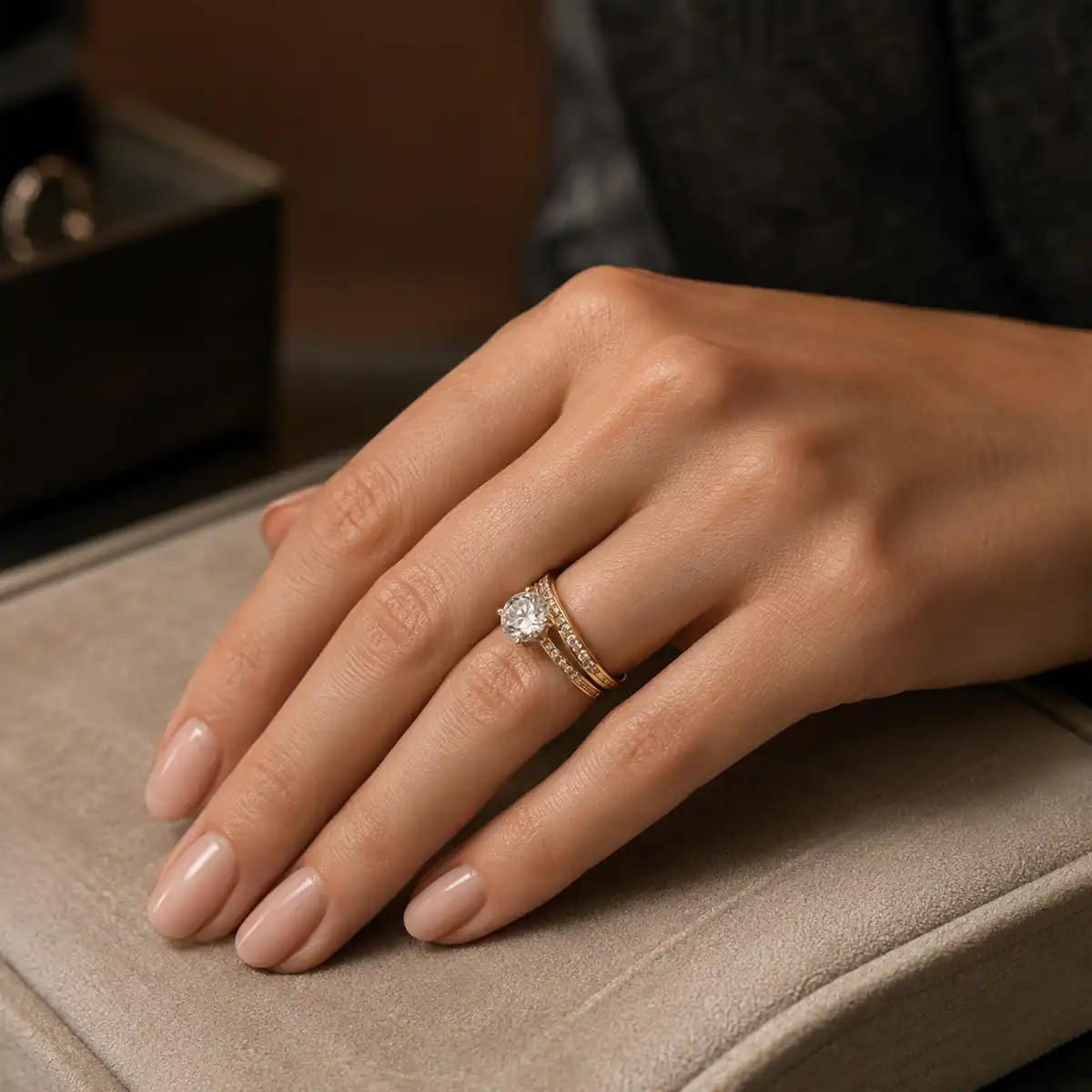
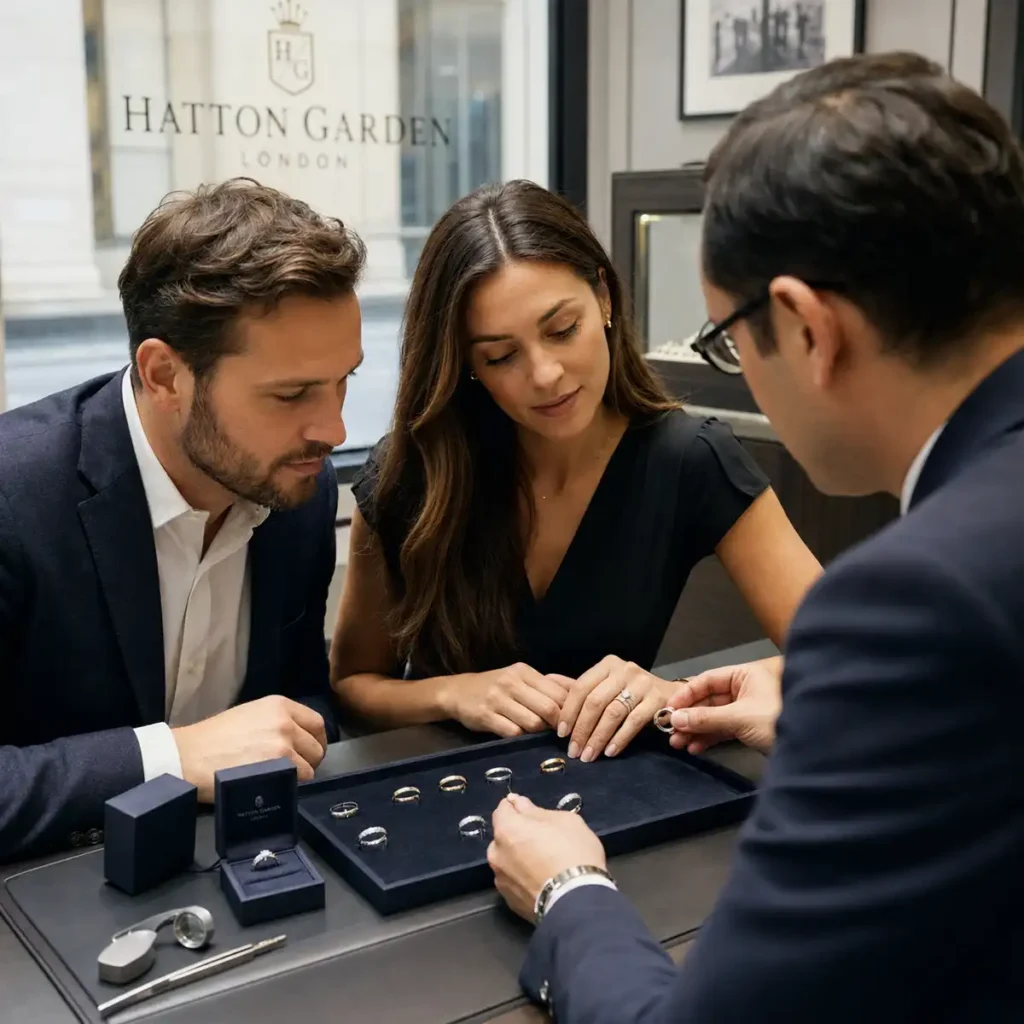
A couple sits at the consultation table on a quiet Thursday at 9 Hatton Garden, the engagement ring already a year old on the left hand, the wedding eight months away. They have come in to choose the wedding bands. Within ten minutes, it becomes clear that the engagement ring was bought in a hurry, the metal is white gold, the setting is a high-profile six-claw solitaire, and the wedding band the bride had in her head will not sit flush against it. This is a fixable problem. It is a far easier problem to avoid in the first place. Wedding band matching for an engagement ring is one of the small decisions most buyers underestimate, and it is the decision that determines whether the two rings live together for the next 40 years as a pair or as awkward neighbours. You will know the difference the moment you hold both rings together. This article is the considered approach to wedding band selection that pays back every careful decision for a lifetime.
Wedding band matching is not the same as wedding band identicalness. The two rings do not need to share every design element. What they need to share is compatibility, which is a different and more useful idea. Compatibility has four components, and each is worth understanding separately.
The first is metal compatibility. The wedding band and the engagement ring should be made of the same metal alloy, where possible. A platinum engagement ring sits beside a platinum wedding band, without the harder metal slowly wearing down the softer one over the decades. An 18ct white gold engagement ring beside a 950-platinum wedding band creates an uneven wear pattern, because platinum is harder and will gradually abrade the gold where the two rings touch.
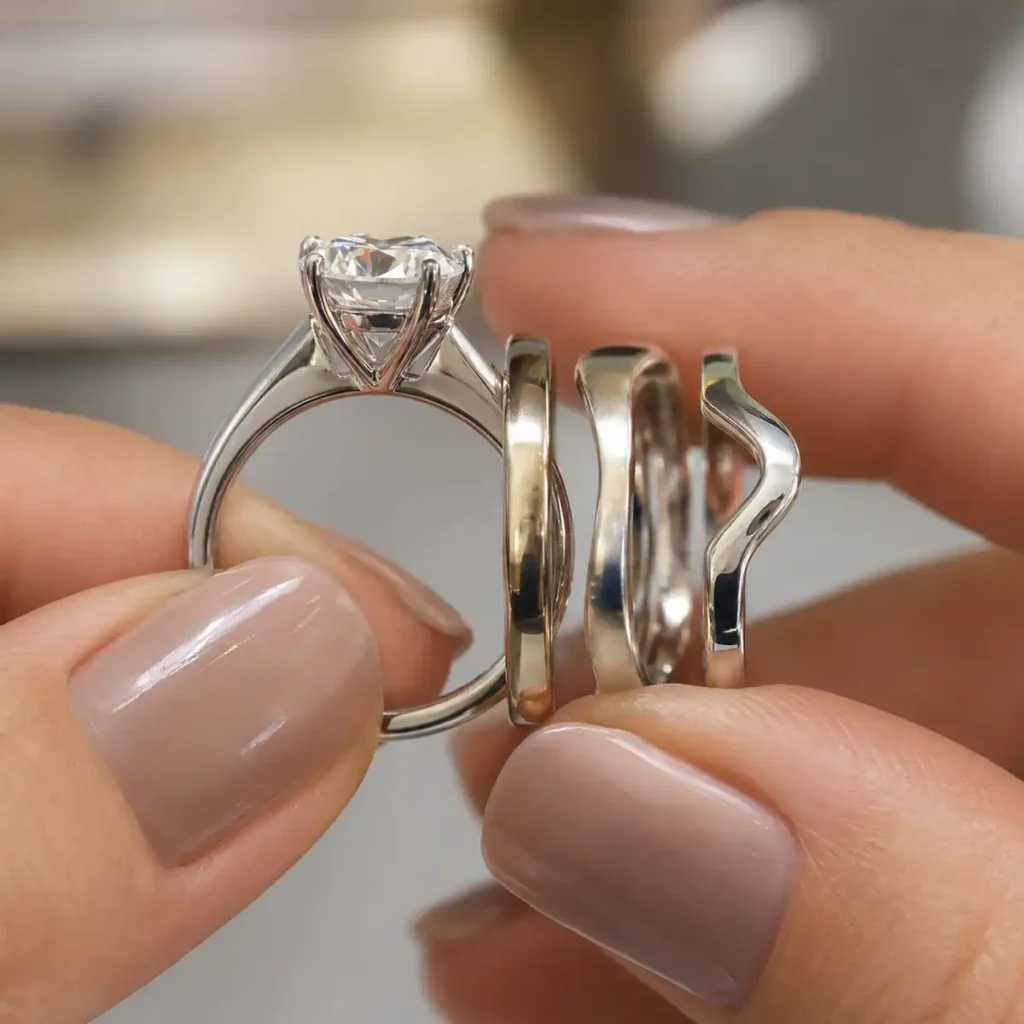
The second is profile compatibility. The wedding band’s cross-section, meaning whether it is flat, court-shaped, D-shaped or half-round, affects how it sits against the engagement ring. A flat band sits cleanly against most engagement ring shanks. A heavy court profile may push the engagement ring forward on the finger.
The third is height compatibility. The engagement ring sits at a certain height above the finger, dictated by the setting. The wedding band should not visually compete with that height. A tall claw solitaire pairs well with a relatively low, slim wedding band that does not echo the height. A bezel-set engagement ring sits lower and can be paired with a more substantial band.
The fourth is the shank shape compatibility. If the engagement ring band is curved at the front or has a hidden halo, a straight wedding band will leave a visible gap between the two rings. A shaped or contoured wedding band is the solution.
For more on how the engagement ring setting style itself affects wedding band pairing decisions,
The choice of metal is the first decision, and it is more consequential than it first appears.
Platinum is dense, hard, and white throughout. A platinum wedding band paired with a platinum engagement ring will hold its colour for the lifetime of the ring without surface treatment. The two rings will wear at the same rate, develop the same patina over years of wear, and read visually as a single integrated piece. For a bride whose engagement ring is platinum, a platinum wedding band is almost always the right answer.
18ct yellow gold is warm, rich, and ages beautifully with wear. An 18ct yellow gold engagement ring pairs naturally with an 18ct yellow gold wedding band of the same alloy, and the colour match will be consistent because both rings are made from the same fundamental metal composition. Different gold suppliers can produce marginally different colour tones in 18ct yellow gold, so where possible, source both rings from the same workshop to ensure the alloy is identical.
18ct white gold is a white gold alloyed with palladium or other white metals and is finished with a rhodium plating that gives it its bright white surface. The rhodium wears off gradually over 18 to 36 months of daily wear and requires periodic re-plating. If your engagement ring is 18ct white gold, your wedding band should be 18ct white gold and not platinum, because the platinum will not need rhodium replating while the gold will. Mixing the two creates a visible colour mismatch within a year or two as the rhodium begins to wear.
18ct rose gold is a yellow gold alloyed with copper, which gives it the warm pink tone. Rose gold pairs only with rose gold. The colour is distinct, and any other metal beside it will read as a contrasting accent rather than a matched pair, which can be a deliberate design choice for some couples but is not what most buyers want.
Mixed-metal pairings can be done deliberately and beautifully, particularly if the design intent is to combine two contrasting colours. The key is intent. A mixed-metal pairing that was the result of buying the two rings at different times from different jewellers without coordination is usually a mistake. A mixed-metal pairing that was designed together as a contrast is a different proposition entirely.
The engagement ring’s setting profile dictates what wedding band shape will sit comfortably alongside it. This is the technical reality most couples encounter too late.
A claw-set solitaire with a straight shank pairs cleanly with a straight wedding band. The two rings sit flush against each other without modification, and you have maximum freedom in choosing the wedding band design. This is the most accommodating engagement ring profile for wedding band matching.
A halo engagement ring presents a small but real problem. The halo extends beyond the shank, and a straight wedding band will sit with a visible gap between itself and the engagement ring shank, with the halo overhanging. The solutions are a contoured wedding band that curves inward to meet the engagement ring shank, a fitted band designed specifically for the engagement ring, or a slightly offset wedding band worn separately on the finger rather than directly against the engagement ring.
A vintage or art deco engagement ring with shoulder decoration, such as filigree, milgrain edging, or side stones at the shoulders, requires a wedding band that either complements those details or steps back from them. A heavily decorated wedding band beside a heavily decorated engagement ring produces visual noise. A clean, simple wedding band beside a vintage engagement ring lets the engagement ring remain the lead piece.
A bezel-set engagement ring sits low and clean, and it can be paired with almost any wedding band shape without conflict. This is the most forgiving engagement ring setting for future wedding band decisions.
A trilogy engagement ring with three stones across the front needs a wedding band that respects the visual weight of the trilogy. A slim, straight band works well. A heavily decorated wedding band will compete with the three stones.
Wedding band matching is traditionally framed as a question about the bride’s pairing, but the husband’s band is a parallel decision that deserves the same care.
A matched-set approach pairs the two wedding bands in a coordinated way, typically through shared metal, shared profile, or shared design language. This is the choice for couples who want their rings to read as a pair when worn side by side.
The most common matched-set approach is shared metal across both bands. If the bride’s wedding band is 950 platinum, the husband’s wedding band is also 950 platinum. This is the simplest and most enduring form of coordination, and it survives any future design changes without difficulty.
A shared profile approach extends the coordination further by matching the cross-section of the two bands. A court-profile platinum band for both rings, in widths suited to each hand, reads as a clearly matched pair without being identical.
A shared design detail approach introduces a small element common to both bands, such as a milgrain edge, a hammered finish, or a hidden engraving inside both bands. This is a subtle form of matching that means more to the couple than to outside observers, which is often exactly the point.
The husband’s wedding band is also a separate practical decision. Men’s wedding bands are typically wider than women’s bands, ranging from 4mm to 7mm in most cases. Profile choice matters as much for men as for women, and the choice between flat, court, D-shape, or comfort-fit depends on the hand and the lifestyle. A surgeon’s husband’s band needs to be smooth and snag-free. A manual worker’s band needs to be substantial enough to absorb daily contact without deformation.
For couples concerned about protecting their investment in both rings
Fun fact: The tradition of the wedding ring being worn on the fourth finger of the left-hand dates back to the ancient Roman belief in the vena amoris, the vein of love, thought to run directly from that finger to the heart, and the modern UK tradition of an engagement ring and a wedding band worn together on the same finger only became widespread in the late 19th century.
The timing of the wedding band decision matters more than most buyers realise.
The ideal sequence is to buy the wedding bands together, at least 12 weeks before the wedding date. This gives time for sizing, hallmarking, and any adjustments to be made comfortably. It also allows the bride’s wedding band to be designed to sit alongside the engagement ring, which is the easier way of solving any fit problems.
If you are buying the engagement ring with the wedding band in mind from the start, mention this at the engagement ring consultation. A good consultant will note the future pairing and steer you toward an engagement ring whose setting will accommodate a straight wedding band without modification. This is the cleanest, lowest-effort path to a well-matched pair.
If the engagement ring is already in hand and the wedding bands are the next decision, bring the engagement ring to the wedding band consultation. The consultant will design the wedding band to sit against the actual ring rather than against a description of it, and the result will be a fit you can see and feel before you commit.
If the engagement ring is a surprise and the proposal has not yet happened, the wedding band decision waits until after the proposal. Trying to coordinate a wedding band design without the bride’s input on the engagement ring is unwise. The couple should choose the wedding bands together.
We make both engagement rings and wedding bands in the same workshop using the same alloys, which means a pairing commissioned at our 9 Hatton Garden showroom is matched at the metal level from the first day. We hold a curated selection of wedding band styles in platinum, 18ct yellow gold, 18ct white gold, 18ct rose gold, and 950 palladium, and we can produce shaped or contoured bands to fit specific engagement ring profiles within standard bespoke lead times. The consultation desks at our showroom, a short walk from Bleeding Heart Yard, are set up so that the engagement ring and the proposed wedding band can be seen together under daylight-balanced lighting before any decision is made. We will tell you honestly if a wedding band you are drawn to will not sit well against your existing engagement ring, and we will offer alternatives that will.
Choosing wedding bands that match your engagement ring is a considered decision that rewards early planning. Match the metal where possible, pay attention to profile and height compatibility, and choose a wedding band shape that sits cleanly against your engagement ring’s setting. For couples buying both rings together, raise the wedding band question at the engagement ring consultation and let the two decisions inform each other. For couples buying the wedding band after the engagement ring is already in hand, bring the engagement ring to the wedding band consultation so the fit can be designed against the actual piece. Allow 12 weeks before the wedding date for the wedding band purchase. Choose your metal first, and choose your profile against your engagement ring’s profile. Wedding band matching done well produces a pair of rings that wear together as a single integrated piece for the lifetime of the marriage.