
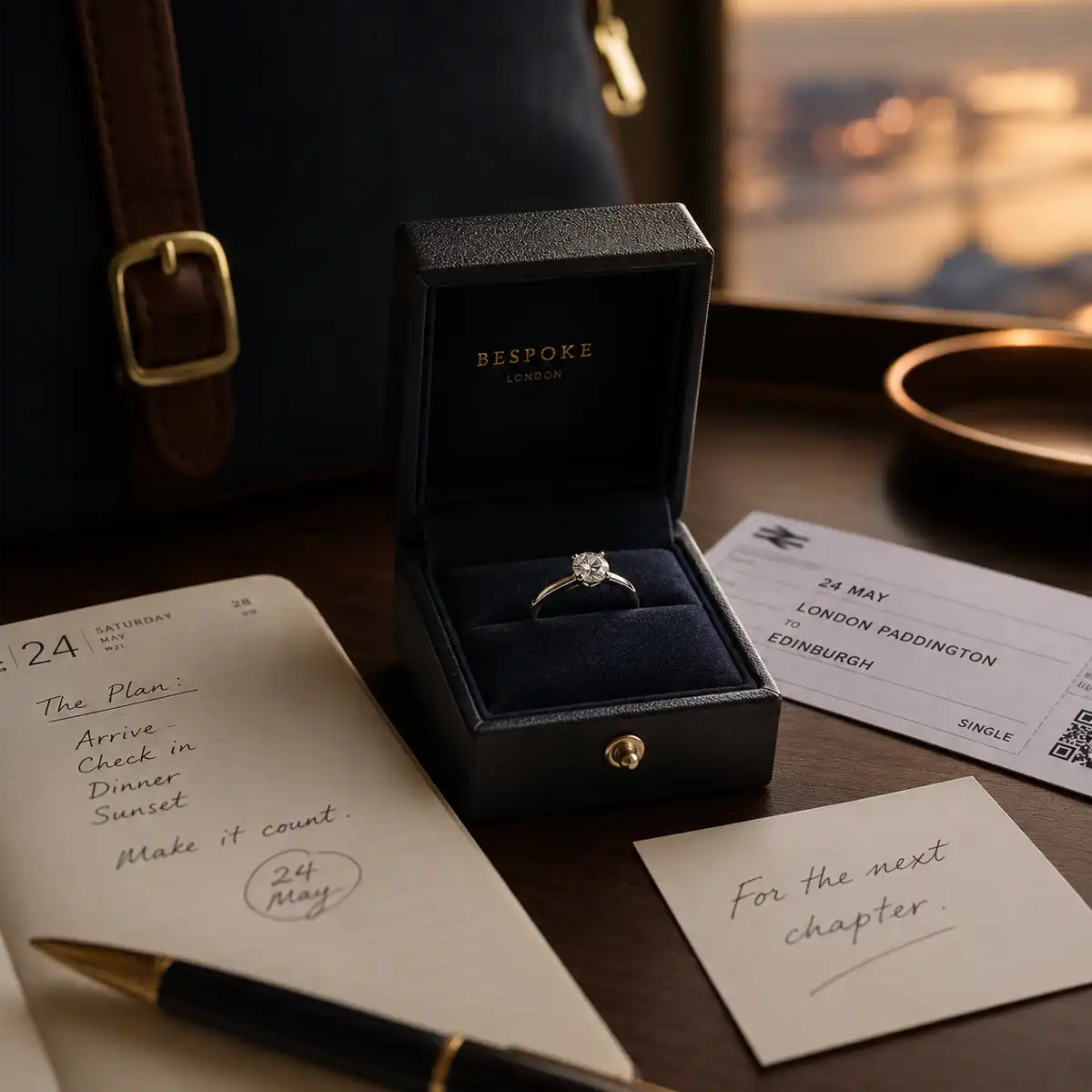
Someone walked into the 9 Hatton Garden showroom one Wednesday in late October with a flight booked to Edinburgh on the 23rd of December. He had not bought a ring. He had not chosen a stone. He had a partner he loved very much and a proposal location already chosen, and he wanted to know whether what he wanted was possible. The answer was yes, just. This article is for that buyer, and for every buyer who has a date in mind and is not sure whether the bespoke engagement ring lead time fits. There is nothing to worry about. Here is exactly what happens, week by week, and exactly how long each stage takes.
The standard bespoke engagement ring lead time at Smith and Green runs from 6 to 10 weeks from approved design to finished ring in hand. That range is honest, not optimistic. Some rings move faster. Some take longer. The variables that decide where you fall in that range are knowable, and most of them are within your control if you start the conversation early enough.
The 6-week timeline is achievable for relatively straightforward designs using stones already in our inventory. A solitaire claw setting with a centre stone we can show you on the day, in a standard metal in a standard ring size, will move through the stages efficiently and arrive comfortably within 6 weeks.
The 10-week timeline becomes necessary when the design is more complex, when the centre stone needs to be sourced from outside our existing inventory, when you have requested a rare or specific coloured gemstone, or when production falls across a peak season such as the run-up to Christmas or Valentine’s Day.
The 12-week timeline applies to highly complex commissions, very large centre stones requiring careful sourcing, or pieces using unusual metals such as palladium or specific alloys. These are the exceptions, and we will tell you on the first consultation if your commission falls into this category.
The bespoke process moves through six distinct stages, and knowing what happens in each stage helps you understand where the time goes.
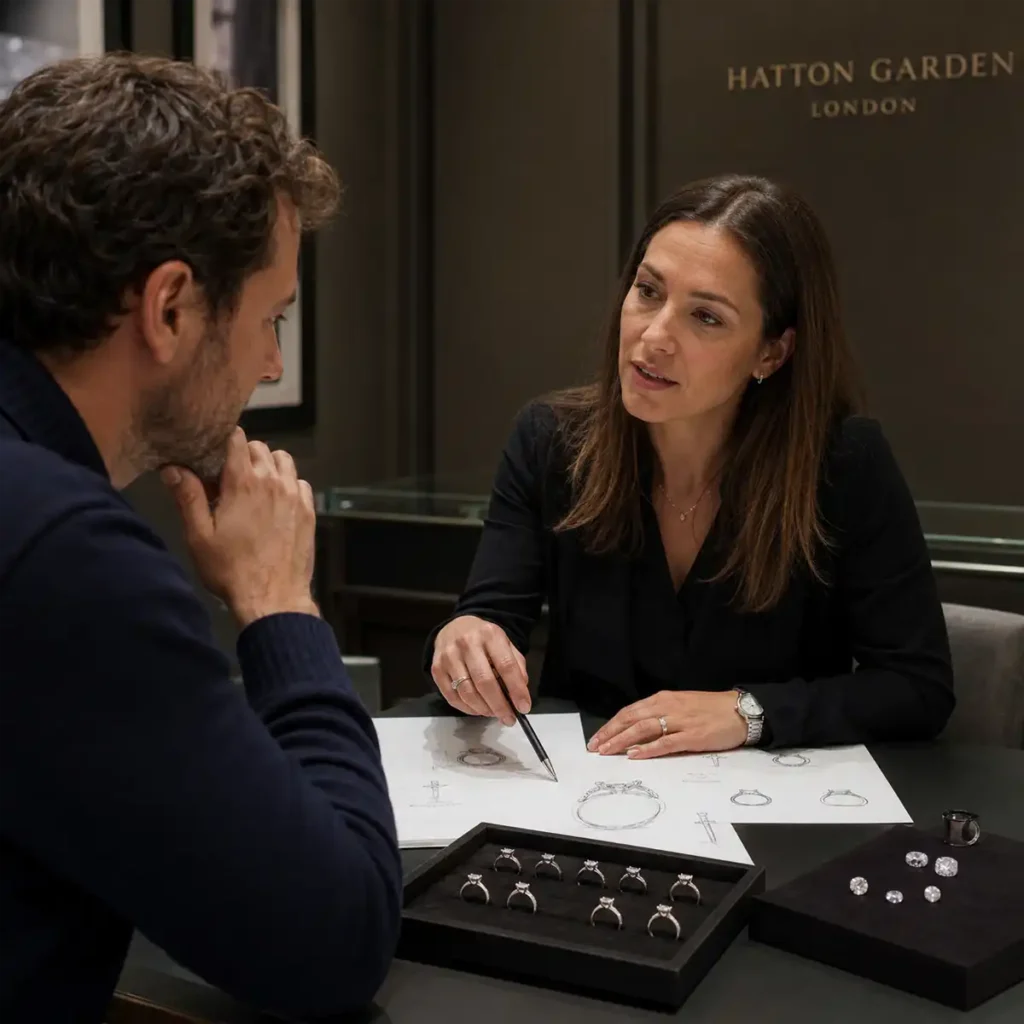
Stage one, the consultation, week one. You arrive at the showroom, ideally with reference images on your phone and a sense of budget. The consultant talks through stones, settings, and metal options. You handle sample rings, see stones under controlled lighting, and discuss the timeline against your proposal date. If you are working toward a specific date, raise that in the first ten minutes. This is the moment when we can tell you honestly whether the date is realistic.
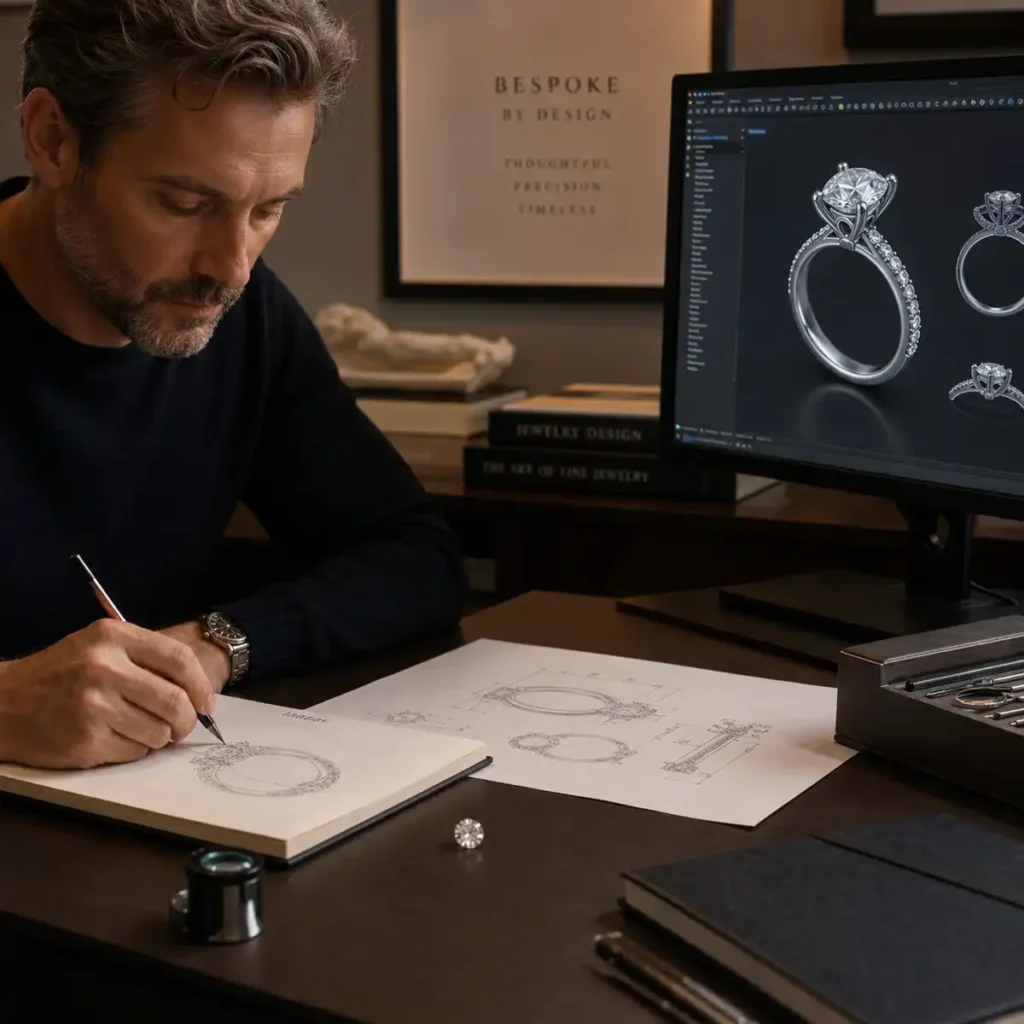
Stage two, design and CAD render, weeks one to two. Our designer produces a CAD rendering of the ring to your specification, accurate to the tenth of a millimetre. You receive the render by email and review it on screen. Revisions are common and expected. Most rings move through one to three rounds of revision before approval. This stage takes 7 to 14 days, depending on how many revisions are needed.
Stage three, stone sourcing and confirmation, weeks two to three. Once the design is approved, the centre stone is confirmed. If we are using a stone from our existing inventory, this stage is essentially complete on the day you choose it. If we are sourcing a specific stone from our wider network, expect 5 to 14 days for sourcing, viewing, and confirmation.
Stage four, production, weeks three to seven. This is the longest stage and the one most difficult to compress. The CAD design is converted into a wax model, the wax is cast in your chosen metal, the casting is cleaned and prepared, the setting is built, and the stones are set. Production typically runs 3 to 5 weeks. Setting alone takes 3 to 7 working days, depending on complexity. A pavé band with 40 small stones takes substantially longer to set than a four-claw solitaire.
Stage five, finishing and hallmarking, weeks seven to eight. The finished ring is polished, inspected, and sent to the London Assay Office for hallmarking under UK law. Hallmarking typically takes 5 to 10 working days. This stage cannot be rushed without exceptional arrangements. The hallmark is the legal confirmation of metal purity stamped on the inside of the band, and it must be applied before the ring leaves our workshop.
Stage six, final inspection and collection, week eight onwards. The ring returns to the showroom, receives a final polish and inspection, and is ready for collection. You can come in to see it before the day, or arrange collection or insured delivery for the date you need it.
Three things can compress the bespoke engagement ring lead time meaningfully.
The first is choosing from existing inventory. Every week we are not waiting for a stone to be sourced or a design to be finalised is a week back in the timeline. If you arrive with an open mind about the centre stone and choose one we can show you on the day, you save 7 to 14 days immediately.
The second is keeping the design simple. A solitaire claw setting moves through CAD and production faster than a halo with pavé shoulders and a hidden halo. If your timeline is tight, simplicity is your friend, and the simpler designs are no less beautiful, they are differently beautiful.
The third is approving CAD quickly. Most timeline delays in our experience are not on our side. They are buyers taking three weeks to review a CAD render because work was busy or because they wanted their partner’s surreptitious input from a sketch on a serviette. Each round of CAD review typically adds 3 to 7 days. If you can approve the first or second render, you save real time.
For more on how the setting choice affects production complexity and therefore leads to the time
Five things genuinely lengthen the bespoke engagement ring lead time, and being aware of them helps you plan.
A rare or specifically requested centre stone. If you have asked for a 2-carat unheated Sri Lankan royal blue sapphire, we are not finding that stone in 48 hours. Expect 2 to 4 weeks of sourcing.
A complex setting. Hidden halos, double halos, multiple pavé rows, channel-set side stones, intricate filigree, antique-style millegrain. All of these add setting and finishing time. Allow an additional week for genuinely complex designs.
A non-standard metal. Platinum and 18ct gold alloys are our standard metals and move through production efficiently. 950 palladium, specific recycled-source metals, or unusual alloys add sourcing and casting time. Allow an additional week.
Peak season. The five weeks before Christmas, the two weeks before Valentine’s Day, and the two weeks before the May bank holiday weekend are our busiest production periods. Allow an additional week if production falls across these windows.
Hallmarking delays at the London Assay Office. These are rare but possible during particularly busy industry periods. We monitor them and will warn you if we see signs of delay during your production schedule.
The simplest planning rule is this. Add 10 weeks to the day you walk into the consultation, and that is the safest date you can confidently propose. If your proposal date is 10 weeks or more away, you have a comfortable margin. If it is 6 to 10 weeks away, you can almost certainly proceed with care. If it is less than 6 weeks away, the bespoke route may not be the right call, and we will tell you so honestly.
If the date is non-negotiable and short, there are two alternative routes. The first is a ready-to-wear ring from the existing collection, which can be sized and collected within 1 to 2 weeks. The second is a hybrid approach, where you propose with a temporary placeholder ring of your choosing and then commission the bespoke piece together after the proposal. This is increasingly common at Smith and Green and works particularly well for couples who want shared input on the final design.
If you are visiting Hatton Garden for the first time and want to understand what to expect from the consultation
Fun fact: The London Assay Office, which hallmarks every Smith and Green ring, has been continuously testing and stamping precious metals on the same site near Goldsmiths’ Hall since 1478, making it one of the oldest continuously operating quality-assurance bodies in the world.
For a Christmas Eve proposal, start the consultation no later than the second week of October. Six weeks of comfortable production plus two weeks of buffer for hallmarking and finishing means October 15 is the practical latest start.
For a Valentine’s Day proposal, start the consultation no later than the first week of December. Be aware that production may slow down during the holiday week, so add a buffer.
For a summer holiday proposal in July or August, start in early May. Production is calmer at this time of year and your timeline will feel less pressured.
For an anniversary proposal where the date is fixed, work backwards 10 weeks from the date and that is the latest week you should begin the consultation. Earlier is always better. Most of our happiest commissions are the ones that began with a comfortable margin.
We do not promise timelines we cannot meet. If you walk into the 9 Hatton Garden showroom on December 1 wanting a finished ring by December 23, we will tell you whether it is possible based on the design you want, the stone availability, and the production calendar. Sometimes the answer is yes. Sometimes the answer is yes, but only with specific design choices. Occasionally, the answer is no, and when that is the case, we tell you straightforwardly and offer the alternative routes that will work. A short walk from Chancery Lane station, our consultation desks see a steady flow of buyers who arrive nervous about timing and leave with a clear plan. The first ten minutes of the consultation will tell you what is realistic, and there is no obligation beyond that conversation.
The bespoke engagement ring lead time is 6 to 10 weeks for most rings and up to 12 weeks for complex commissions. If you have a proposal date in mind, work backwards from that date, add a two-week buffer, and that is the latest week you should begin the consultation. Book early in your timeline rather than late, bring reference images, be honest about your budget on the first call, and approve the CAD render as promptly as you can. If your date is tighter than 6 weeks, ask about ready-to-wear options or the placeholder-and-bespoke-after approach. Either way, do not delay the consultation out of uncertainty. The conversation costs nothing, lasts an hour, and will tell you exactly what is possible. Book it now, and the timeline question will be settled by the end of the same week.