
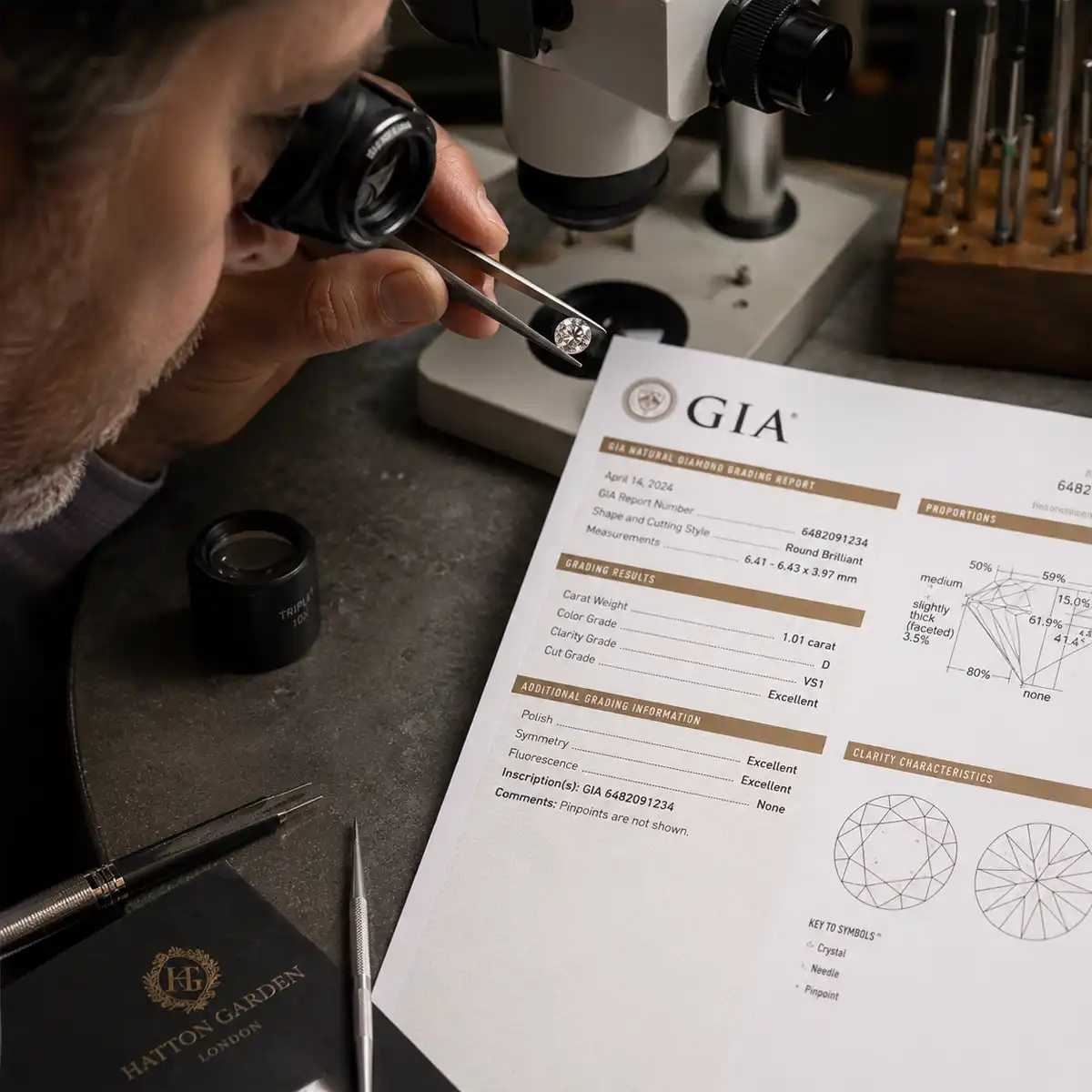
There is a small ritual that takes place every working day at the consultation desks of 9 Hatton Garden. A buyer is handed a folded piece of paper, slightly larger than a passport, with a hologram in one corner and a string of numbers running down its left edge. They glance at it, smile politely, and tuck it into the box. That paper is the diamond certificate, and almost nobody is taught how to read it. Diamond certification is the single most important document in your engagement ring purchase, and the moment you learn what each line of a GIA report means, the entire diamond market becomes legible to you. This article will give you that literacy. By the end, you will know the difference between GIA, IGI and HRD, you will understand what each grading line on a report actually measures, and you will know precisely what to ask before you commit to a stone.
A diamond certificate is an independent, third-party laboratory assessment of a polished stone’s measurable characteristics. It is not an appraisal, not a valuation, and not a guarantee of price. It is a scientific record. The certificate states, under controlled laboratory conditions and to defined tolerances, what the stone is. The price of that stone is then negotiated separately in the trade.
The major laboratories use master stones, calibrated equipment and trained gemmologists working under blind-grading protocols, meaning the grader does not know who submitted the stone. A typical report records carat weight to the hundredth, measurements in millimetres to the hundredth, colour grade, clarity grade, cut grade where applicable, polish, symmetry, fluorescence, and a plotted diagram of the inclusions visible at 10x magnification. The most important point a buyer can absorb is this. Without a certificate from a recognised laboratory, you are buying the seller’s opinion of the stone, not an independent assessment. At Smith and Green, no diamond above 0.30 carats leaves the premises without a major independent report.
Three names dominate the certification market, and they are not interchangeable.
GIA, the Gemological Institute of America, is the oldest and most consistently strict of the three. Founded in 1931, GIA developed the modern 4Cs and the diamond grading scale used throughout the industry. Its grading is widely considered the conservative benchmark, particularly on colour and clarity. A GIA G colour grade is reliably a G colour grade. For natural diamonds above 0.50 carats, GIA remains the certificate that buyers and trade professionals trust most.
IGI, the International Gemological Institute, is headquartered in Antwerp and operates a substantial global network, including a strong UK presence. IGI grades both natural and lab grown stones, and it became the dominant certification body for lab grown diamonds during their rapid market expansion from 2018 onwards. IGI reports are well-respected for lab grown, though some trade buyers historically considered IGI marginally less conservative than GIA on natural stones. The gap has narrowed considerably in recent years.
HRD, Hoge Raad voor Diamant, is the Antwerp Diamond Council. HRD reports follow European laboratory standards and are widely used in continental European trade. UK buyers will see HRD certificates less frequently than GIA or IGI, but the laboratory is reputable, and its grades are internationally recognised.
The practical implication for a buyer in Hatton Garden is straightforward. For a natural diamond, prefer GIA. For a lab grown diamond, IGI is the market standard, and GIA is now also grading lab grown on a separate report format. HRD is acceptable and reliable. Reports from less-recognised laboratories should prompt scepticism and at least one further question. For more on how lab grown and natural certification compare in practice, how lab grown and natural diamonds compare.
A standard GIA Diamond Grading Report runs to a single page front and back, and the information on it follows a fixed order. Learning that order takes around 10 minutes and will serve you for life.
The top of the report carries the report number, a unique identifier of seven to ten digits. That number is laser-inscribed in microscopic text on the girdle of the stone itself. Ask to see the inscription under magnification. If the inscription is missing or does not match the report, do not proceed.
Below the number sits the report date and the shape and cutting style, for example, Round Brilliant, Cushion Modified Brilliant, or Emerald Cut. Then the measurements are given as three dimensions in millimetres. For round stones, the format is minimum diameter, maximum diameter, and depth. For fancy shapes, the format is length, width, depth.
Carat weight is given to two decimal places. A stone reported as 1.01 carats is precisely 1.01 carats, not 0.99 rounded up.
Colour grade runs from D, the highest possible, through Z. D, E and F are colourless. G, H, I and J are near colourless and are where most buyers find the best value. K and below show visible warmth, which some buyers prefer for vintage-style settings.
Clarity grade runs from Flawless through Internally Flawless, then VVS1, VVS2, VS1, VS2, SI1, SI2, and finally I1, I2, I3, where inclusions become visible to the unaided eye. VS2 and SI1 are the eye-clean sweet spots for value in most stones.
Cut grade applies only to round brilliant stones in the GIA system and runs from Excellent through Poor. Cut is the single largest determinant of how a diamond actually performs in light. For fancy shapes, GIA does not assign an overall cut grade but reports polish and symmetry separately.
Polish and symmetry are graded Excellent, Very Good, Good, Fair, Poor. Look for Excellent or Very Good in both.
Fluorescence describes how the stone behaves under ultraviolet light and is graded None, Faint, Medium, Strong, Very Strong. Faint or Medium has minimal visible effect in daily wear. Strong blue fluorescence can occasionally produce a slightly milky appearance in higher colour grades, which is worth checking in person.
Below the grading data sits the plot diagram, a printed map of the inclusions visible at 10x. Red marks indicate internal inclusions, green marks indicate surface features. The plot is not a flaw chart so much as a fingerprint. It uniquely identifies the stone and proves that the certificate and the diamond match.
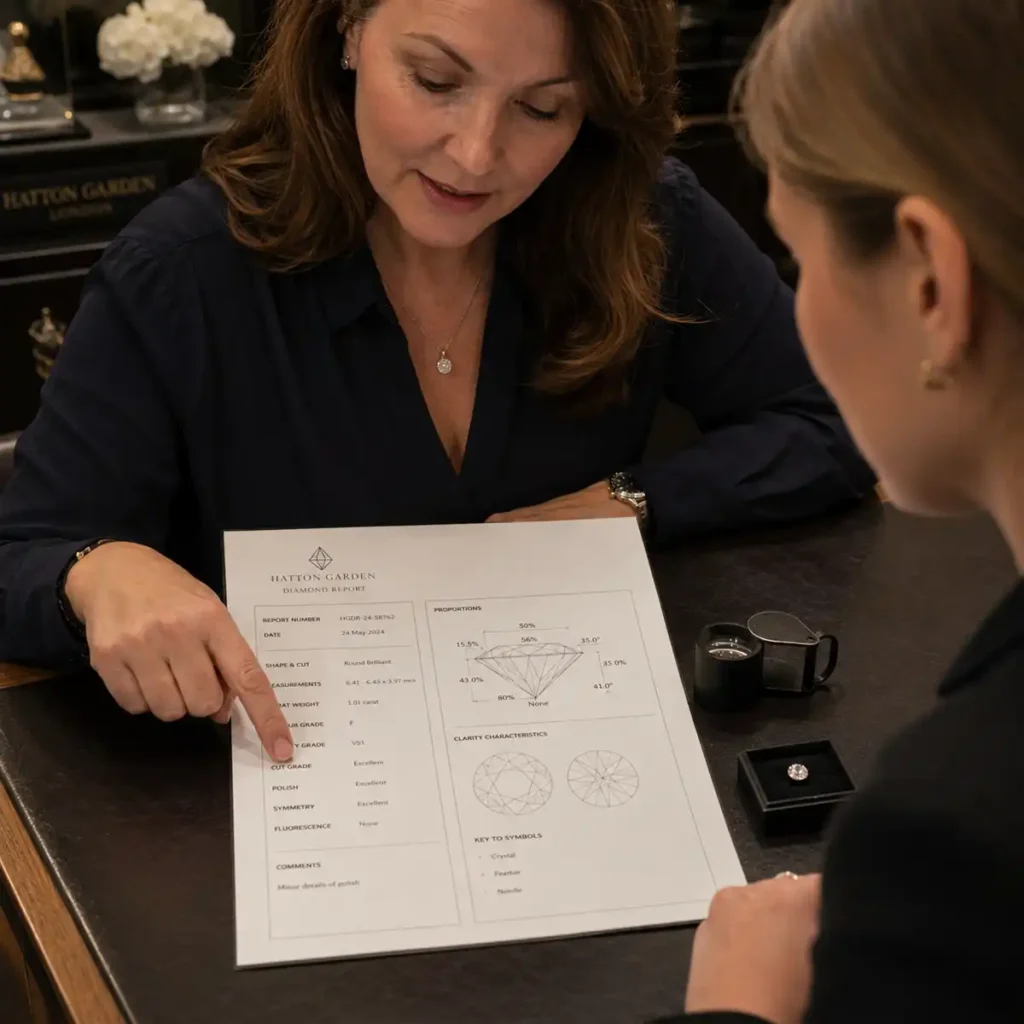
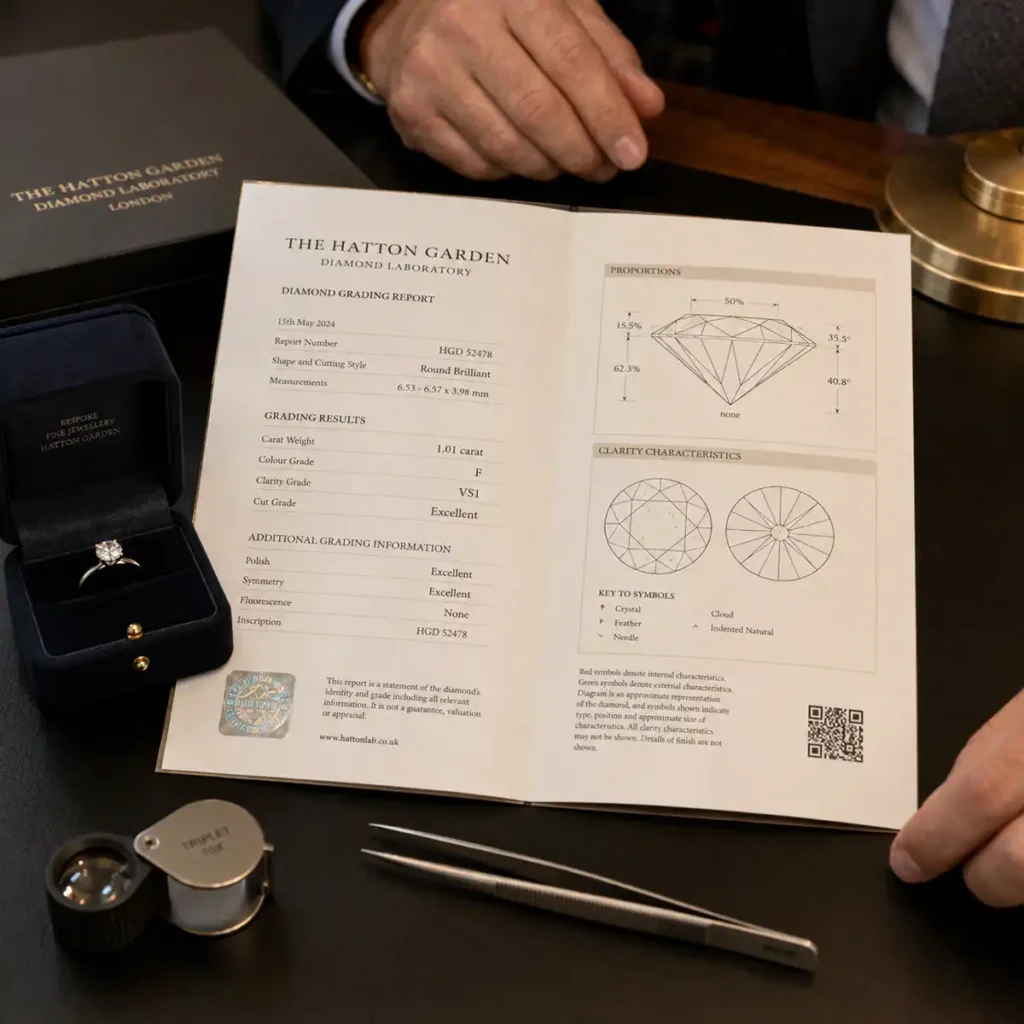
Not every certificate tells the full story, and a literate buyer can identify warning signs that catch out less informed purchasers.
The first sign is the issuing laboratory itself. If the certificate is from a laboratory you do not recognise, web-search the name before proceeding. Some house laboratories and smaller regional labs apply markedly looser standards than GIA, IGI or HRD. A stone graded H VS1 by an unknown lab may grade J SI1 at GIA.
The second sign is missing data fields. A reputable report carries cut grade for round stones, polish, symmetry, fluorescence, and a plot diagram. If any of these are absent, ask why.
The third sign is age. A certificate older than five years may not reflect the current state of the stone, particularly if it has been worn, re-polished or recut. For older certificates, request a re-grading before purchase.
The fourth sign is the absence of laser inscription. Modern reputable laboratories inscribe the report number on the stone’s girdle. If the stone you are shown has no inscription, request to see the inscription before payment, or insist on independent verification.
The fifth sign is mismatched plot diagrams. Compare the plot on the certificate with the actual inclusions visible through a loupe. They should align. If they do not, the certificate may belong to a different stone. This is rare at reputable houses, but it has occurred.
Fun fact: The GIA developed the diamond grading scale and the 4Cs concept in the 1940s and 1950s, and the colour scale begins at D rather than A specifically to avoid confusion with earlier informal grading systems that had been inconsistently applied across the trade.
Certification is not only for the moment of purchase. It is the document your insurer will require, the document your future jeweller will ask to see if you trade up, and the document your descendants will rely on if the ring is inherited. A high-quality independent grading report is the legal and commercial spine of the stone for its entire life.
For insurance, most specialist UK jewellery insurers require an independent valuation supported by the grading report. The valuation is a separate document, prepared by a qualified valuer, that establishes replacement cost. The certificate establishes what is being valued. For the practical steps after purchase, arranging the right valuation for insurance.
For resale or trade-in, a stone with a current GIA, IGI or HRD report sells faster and at a higher price than an uncertified stone of identical specification. The certificate is, in effect, the stone’s passport. Without it, a buyer is taking your word, and the market discounts accordingly.
For inheritance, the certificate is what allows a future jeweller to remodel the ring, reset the stone or verify the piece’s history. It is also the only practical means of confirming, decades later, that the stone in the family ring is the same stone that was purchased originally.
Every natural diamond above 0.30 carats sold at our 9 Hatton Garden showroom carries an independent grading report, predominantly from GIA. Every lab grown diamond carries an IGI report or, increasingly, a GIA lab grown report. We hold the original certificates with the stones, we verify the laser inscription in front of the client at the consultation table, and we hand over the original document at completion, along with a written invoice that references the report number. This is the standard the EC1N trade should set and the standard we follow. When you visit us, a five-minute walk from Chancery Lane station, ask to handle the certificate yourself, ask us to point out the inscription under magnification, and ask any questions on this page. None of them is unwelcome.
A diamond certificate is not a marketing accessory. It is the independent record of what the stone actually is, and learning to read it transforms you from a buyer who hopes for the best into a buyer who knows what they are signing for. Before you commit to a stone, confirm three things first: that the certificate is from GIA, IGI or HRD. Second, the laser inscription on the girdle matches the report number. Third, the plot diagram on the report aligns with the inclusions you can see under a loupe. If all three check out, the diamond certification work is done, and the rest of the conversation is about the ring itself. To see how certified stones look in person, book a consultation, allow 60 to 90 minutes, and bring any certificates you have already been shown elsewhere. We will read them with you, line by line.