

The centre stone is chosen. The carat weight is settled, the certificate is in hand, and the buyer at the consultation table has been quietly thrilled for 20 minutes. Then the next question lands and the room goes quiet. Which setting. Claw, pavé, bezel or halo. Most buyers arrive at Smith and Green’s 9 Hatton Garden showroom with a strong sense of which centre stone they want and very little sense of how to hold it. This article is the comparison that no website on the engagement ring setting styles topic gets right. By the end of it you will know which of the four major settings actually suits your hand, your lifestyle, and your stone, and you will know which one to walk away from.
Each setting is a structural solution to the same engineering problem. Hold a faceted stone in place, expose enough of it to the light to maximise its performance, and survive 40 years of daily wear on the hand of someone who is not thinking about their ring.
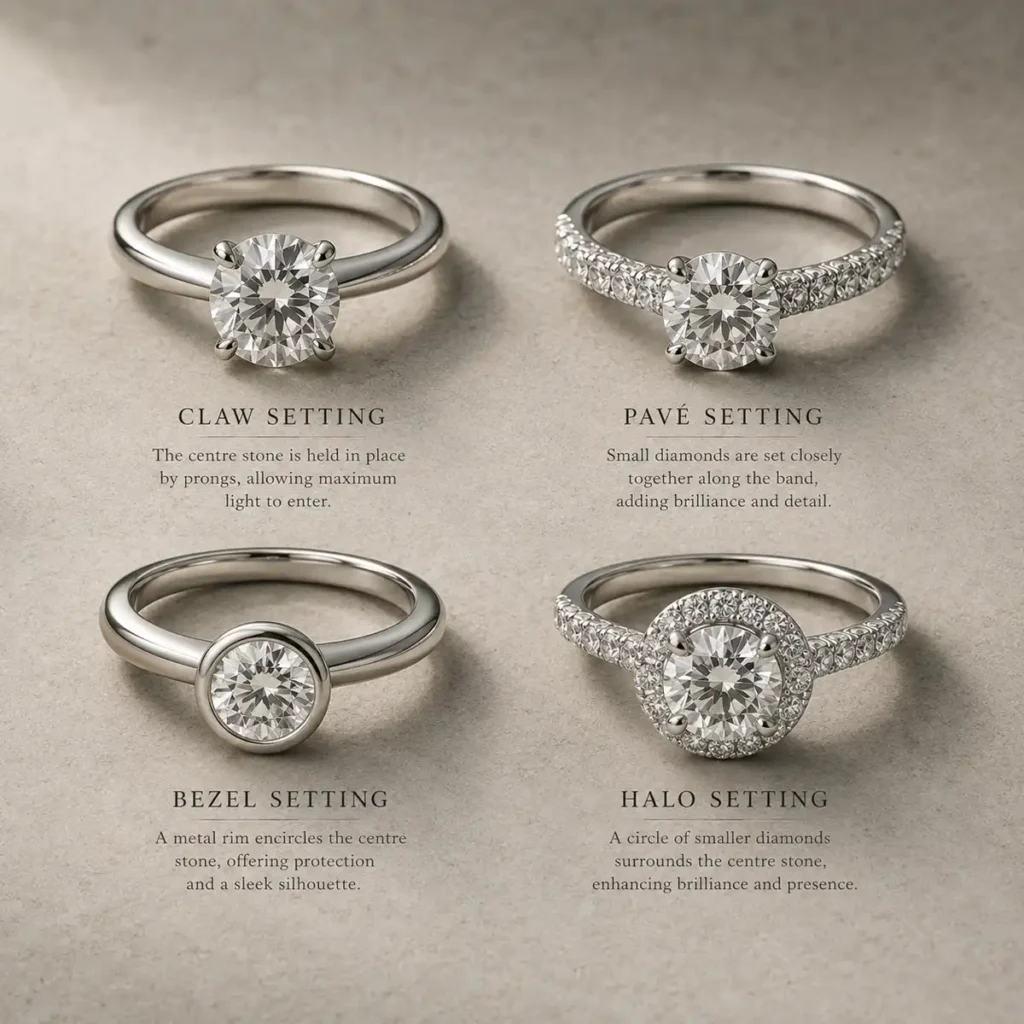
A claw setting uses three to six small metal claws, also called prongs, gripping the stone around its crown. The stone is lifted clear of the band, and light reaches it from almost every angle. Four-claw and six-claw round brilliant solitaires are the most familiar form.
A pavé setting uses tiny stones, usually 0.005 to 0.02 carats each, set close together along the band and held by minute beads of metal raised from the surface. The effect is a continuous line of sparkle along the shoulders of the ring, framing the centre stone.
A bezel setting wraps a continuous rim of metal around the entire perimeter of the stone, holding it in place by tension at the girdle. The stone sits flush within the metal collar, lower to the finger than a claw setting and with no exposed corners or edges.
A halo setting surrounds the centre stone with a continuous ring of smaller stones, typically 16 to 24 melee diamonds, set close to the centre and creating the visual effect of a substantially larger stone.
Each does its job. The question is which job suits you.
The claw setting is the most popular engagement ring style sold in the UK and has held that position for several decades. The reasons are practical, not nostalgic.
Claws maximise light entry. With only narrow metal contact at the crown, light reaches the stone from every direction, and the brilliance and fire are at their peak. For a well-cut round brilliant, the four-claw or six-claw solitaire is the configuration the cut was designed for.
Claws lift the stone clear of the finger. The visual effect is presence. The stone sits proudly, catches light from any angle, and reads as larger than its actual carat weight from across a room.
Claws are easy to maintain. Cleaning under and around the stone is straightforward, and worn or loose claws can be retipped or replaced individually by any competent jeweller without disturbing the rest of the ring.
The trade-offs are real. Claws can snag on knitwear, hair, and gym kit. A worn claw left too long can release the stone. Active wearers who work with their hands or sport regularly should expect to have prongs checked annually and retipped every five to ten years, depending on use. For very fine-fingered wearers, six-claw settings can sometimes feel visually heavy on the stone.
Claw suits buyers who want maximum sparkle, classic presence, and a setting that is recognised and repairable anywhere in the world.
A pavé setting is rarely the primary structural setting for a centre stone. It is, more commonly, the band treatment that frames whichever centre setting you have chosen. A claw solitaire on a pavé band, a halo with a pavé shank, a bezel with a pavé shoulder. The pavé sits behind the headline.
What pavé does is extend the sparkle of the ring across the entire finger rather than concentrating it in a single point. The visual effect is a band that glitters from every angle in any light, even at distances where the centre stone alone would not register.
The technical demand is high. Each tiny stone is held by minute metal beads raised from the band surface by the setter using a graver. A skilled bead-setter can set a row of pavé that looks like a continuous river of light. A less skilled setter produces gaps, uneven beads, and stones that loosen within a year.
The trade-offs. Pavé stones do work themselves loose over time, particularly in heavy wear. Expect to lose one to three small stones over a decade of daily wear, and budget for periodic resetting. Pavé bands are also marginally harder to resize than plain bands, as the metal cannot be cut and joined cleanly through the set stones. A skilled jeweller can resize within limits, but extreme resizing may require rebuilding the affected section.
Pavé suits buyers who want maximum visual presence across the whole ring rather than only at the centre, and who are comfortable with the periodic maintenance that comes with a stone-heavy band.
A bezel setting wraps the stone in a continuous rim of metal at the girdle. The stone sits low, the perimeter is fully protected, and there are no claws to catch.
This is the setting for buyers whose work or lifestyle is genuinely hard on a ring. Surgeons, vets, climbers, woodworkers, parents of very young children, anyone whose hands meet resistance daily. The bezel is the only setting in the four that genuinely protects the stone’s girdle and edges from impact.
The optical trade-off is real. The metal rim covers a small portion of the stone’s perimeter, reducing the angles from which light enters. A bezel-set round brilliant performs at perhaps 85 to 90% of the brilliance of the same stone in a four-claw setting. Most observers cannot see the difference. Some buyers can.
Modern bezel design has moved on. The half-bezel, where the metal rim wraps only two sides of the stone, balances protection with light entry. The bezel-halo combination wraps the bezel in a halo of small stones, recovering visual presence while keeping the centre stone protected.
Bezel suits buyers whose lifestyle is genuinely demanding on a ring, who value security over maximum sparkle, and who prefer the clean modern aesthetic over the traditional crown silhouette.
A halo surrounds the centre stone with a ring of smaller stones, creating the impression of a substantially larger centre. The visual maths is straightforward. A 1-carat round brilliant in a single halo reads on the finger as if it were a 1.5 to 1.7 carat stone.
For buyers working within a fixed centre-stone budget who want the largest possible visual presence, the halo is the most cost-effective design in fine jewellery. The melee stones in a halo are inexpensive relative to a single larger centre, and the visual return on that small additional spend is significant.
The halo also does design work. It frames the centre stone, suits cushion and oval shapes particularly well, and lends itself to vintage and art deco interpretations without overcommitting to a period look.
The trade-offs. Halos contain many small stones, and like pavé bands, they need periodic checking. A halo that has lost a stone reads as visibly incomplete and should be repaired promptly. Cleaning is fiddlier than a plain claw setting. And the halo can dominate a very small centre stone, producing a ring where the centre reads as part of a cluster rather than a featured solitaire. Below 0.50 carats centre, the halo often does too much.
Halo suits buyers who want maximum visual scale for the budget, who are open to a slightly more decorative aesthetic, and who are choosing centre stones above 0.70 carats, where the halo frames rather than overwhelms.
Fun fact: The bezel setting is the oldest known method of mounting a gemstone in jewellery, with examples found in Egyptian rings dating back more than 3,000 years, while the modern six-claw Tiffany setting was designed in 1886 and remains the most-copied engagement ring style in history.
The honest framework is three questions.
How active are your hands during a normal week? If the answer involves regular manual work, sport, or contact with hard surfaces, a bezel or a low-profile claw. If the answer is a typical desk-and-evenings life, all four are viable. If the answer is somewhere between, claw with a slightly lower setting profile or a half-bezel.
How important is the maximum scale for the budget? If scale matters most, halo. The visual return per pound is unbeatable. If sparkle quality matters more than scale, claw with the best cut you can afford. If protection matters most, bezel.
What is the centre stone shape? Round brilliants suit any of the four. Cushion and oval suit halo and claw equally well. Emerald and asscher cuts suit claw or bezel, less so halo, which tends to fight the geometric cleanness of step-cut stones. Pear and marquise suit claw with carefully placed end-protective prongs.
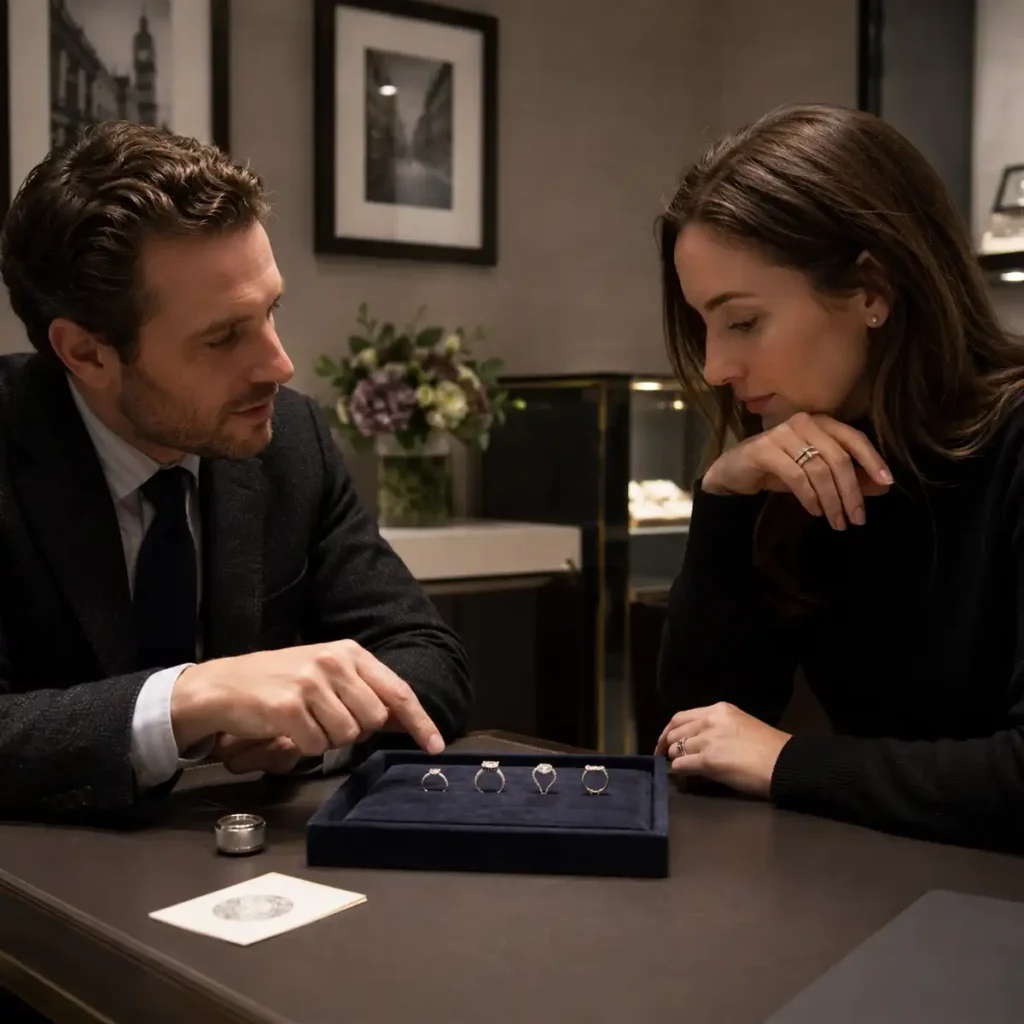
If the answer is genuinely unclear, see the four side by side. Smith and Green keep sample rings in each of the four settings, all in the same metal, for exactly this conversation. For the next step in this decision sequence.
Our position is that the setting follows the buyer, not the catalogue. We will not push a halo onto a buyer whose stone does not need one, and we will not put a bezel onto a buyer whose lifestyle does not demand it. The setting decision is reversible in only one direction. You can almost always reset a stone into a different setting later, but the cost and disruption of doing so mean it is worth getting it right the first time. At our 9 Hatton Garden showroom, a short walk from Leather Lane market, we keep CAD files for every setting style we have ever produced, and we can show you renders on screen before any metal is cut. The decision should feel settled before production begins. Wedding band compatibility also affects the setting choice and is worth raising at the same consultation.
The four major engagement ring setting styles are not interchangeable, and the right one for you depends on three things only. The lifestyle your hands lead. The priority you place on sparkle versus scale versus protection. The shape and size of the centre stone. Claw suits the classic everyday wearer who wants maximum brilliance. Pavé adds continuous shoulder sparkle to whichever primary setting you choose. The bezel protects the stone for buyers whose lives are hard on rings. Halo multiplies the visual scale for buyers working within a centre-stone budget. Before you commit, book a consultation, ask to see all four side by side in the same metal at the same carat weight, and try each one on the hand that will actually wear it. The right setting will feel obvious within ten minutes of seeing them in person.