

The question arrives more often now than it did five years ago, and it arrives with more precision. Not “is this diamond ethical?” which is a question that wants a reassuring answer but “what does ethical actually mean here, and how do I verify it?” That is a better question. It deserves a better answer than most jewellery marketing provides.
Ethical diamond buying is not a simple binary. It is a set of overlapping considerations about origin, about working conditions at every stage of the supply chain, about environmental impact, about transparency and the degree to which any given purchase satisfies those considerations depends on which ones matter most to the individual buyer. This article lays out what the frameworks actually cover, where their limitations sit, and what a buyer can practically do with the information.
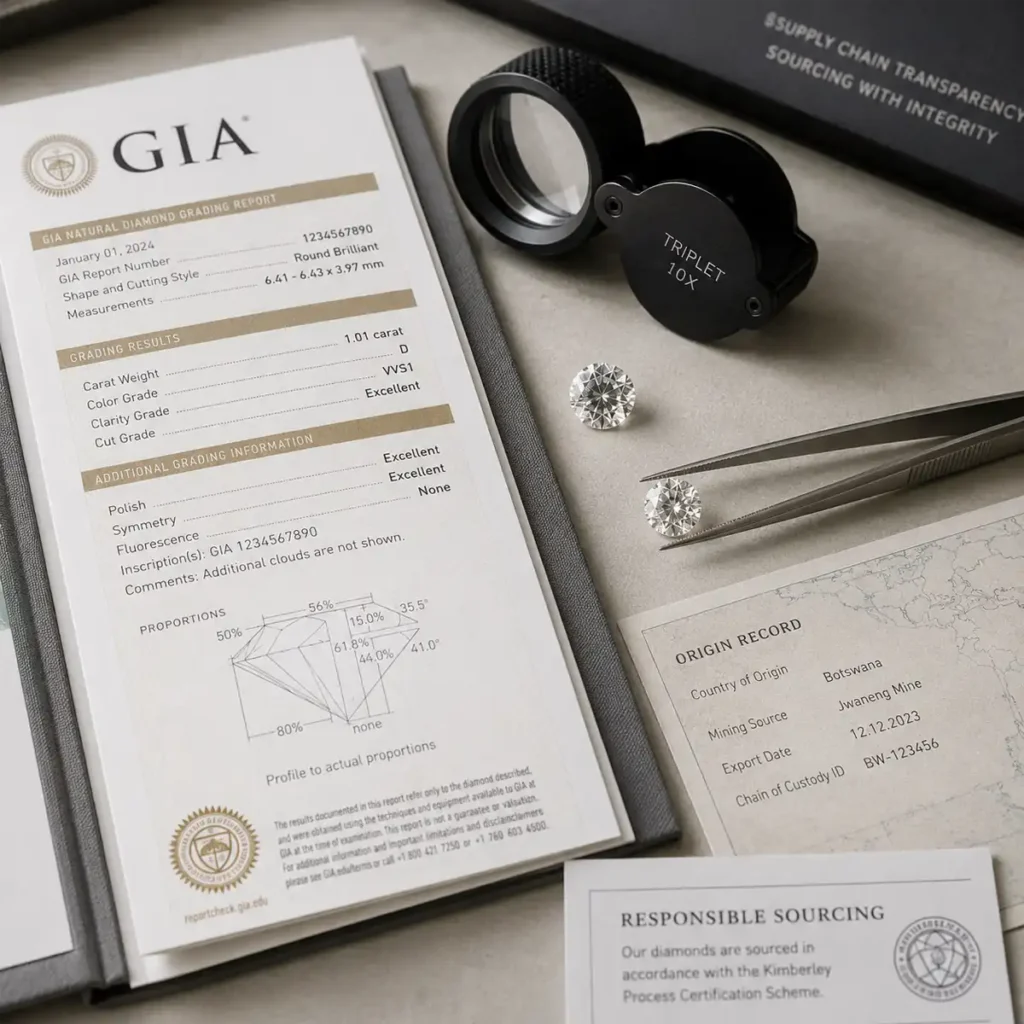
The Kimberley Process Certification Scheme (KPCS) was established in 2003 in response to the trade in conflict diamonds, rough diamonds used by rebel movements to fund armed conflict against legitimate governments. It requires participating governments to certify that rough diamond exports are conflict-free before they enter the international market.
The scheme covers over 85 participating countries and has succeeded in its narrow original mandate: the proportion of conflict diamonds in global trade has fallen significantly since 2003. For a buyer who wants to know that their diamond did not directly fund a documented armed conflict of the kind that characterised the Sierra Leone and Angola conflicts of the 1990s, the Kimberley Process provides a meaningful baseline.
The limitations are equally important to understand. The Kimberley Process covers rough diamonds only. It does not follow the stone through cutting, polishing, and wholesale distribution stages where chain-of-custody integrity can break down. It also does not address broader human rights concerns or labour conditions in diamond mining communities that do not reach the legal threshold of “armed conflict.” A diamond can be fully Kimberley Process compliant and still originate from a mine where labour conditions or environmental practices are poor by most standards.
Buyers who want to interrogate supply chain ethics beyond the conflict diamond definition need to look at additional frameworks.
The Responsible Jewellery Council (RJC) is an industry body that certifies members against a Code of Practices covering human rights, labour rights, health and safety, environmental impact, and business ethics throughout the diamond and precious metal supply chain. RJC certification requires an independent audit and covers the full supply chain from mine to retail, not only the rough stone export stage.
An RJC-certified jeweller has committed to a set of standards that go meaningfully further than Kimberley Process compliance. The audit process includes on-site assessments and is not a self-certification scheme. For a buyer who wants supply chain accountability beyond conflict diamonds, asking whether a jeweller holds RJC certification is the right question.
*Fun fact: The diamond supply chain between mine and retail can pass through as many as 10 to 15 separate hands, miners, sorters, traders, cutters, polishers, brokers, wholesalers, importers, and retailers, before the stone reaches a showroom. Each transfer point is where chain-of-custody documentation matters.
RJC certification does not mean perfection. It means a documented commitment to standards, verified by an independent third party, with periodic re-audit. That is meaningfully more robust than an uncertified claim of ethical sourcing.
Lab-grown diamonds have been marketed heavily on ethical and environmental grounds, and the claims are not without substance. A laboratory-grown diamond requires no mining, produces no mine-site environmental degradation, and eliminates the geographical supply chain through which conflict and labour exploitation risks exist.
The environmental argument requires more precision. Lab-grown diamond production is energy-intensive. The two primary methods, CVD (Chemical Vapour Deposition) and HPHT (High Pressure High Temperature) , both require significant electrical power. The environmental footprint of a lab-grown diamond depends substantially on the energy source used in production. A lab running on renewable energy has a genuinely lower carbon footprint than a mining operation of comparable scale. A lab running on coal-powered electricity does not.
The honest position is this: a lab-grown diamond from a producer using certified renewable energy, graded by IGI or GIA, eliminates the supply chain risk factors that concern most buyers and has a materially lower environmental impact than a conventionally mined diamond. It is a legitimate ethical choice, not only a budget one.
A natural diamond from a certified Canadian or Botswana mine, graded by GIA and sold through an RJC-certified chain, also represents a responsible purchase. The ethical case for natural diamonds, supporting regulated mining industries in developing economies, sustaining livelihoods in communities where diamond mining is the primary economic activity, is real, even if it is less marketable than the lab-grown narrative.

The ethical conversation about fine jewellery does not end with the stone. The metal carries its own sourcing history. Gold mining is one of the most environmentally impactful extraction industries globally, requiring large quantities of land, water, and chemical processing per ounce of recovered metal.
Recycled gold, refined from existing jewellery, industrial waste, and electronics, requires no new mining and has a substantially lower environmental footprint per gram than newly mined metal. Fairmined gold is a certified alternative sourced from artisanal and small-scale miners operating under verified social and environmental standards.
Asking your jeweller about metal sourcing is a reasonable question. Not all workshops will have a specific answer, but a jeweller committed to responsible sourcing will have considered it. At a minimum, the presence of any Fairmined or recycled metal certification is a positive signal.
None of this information is useful if it stays theoretical. Here are the specific questions worth asking in any consultation at a Hatton Garden jeweller or elsewhere.
Is this stone Kimberley Process certified? (The answer should always be yes. If it is not, leave.) Does the stone come with a GIA or IGI certificate? If the stone is natural, do you know its country of origin? Is your business RJC-certified? If the stone is lab-grown, do you know the production method and the energy source used? What metal are you using for the setting, and is any of it recycled or Fairmined?
You will not always get detailed answers to all of these questions. A transparent jeweller will tell you what they know and what they do not. That transparency is itself a reasonable proxy for trustworthiness.
At Smith and Green in Hatton Garden, EC1N, a five-minute walk from Farringdon station on the Elizabeth line, the sourcing conversation is part of the consultation process for any significant stone purchase. The team will not oversell ethical credentials they cannot document. ethical sourcing of rubies, sapphires and emeralds (see our gemstone engagement rings article)
Ethical diamond buying in 2026 means understanding what the Kimberley Process covers and what it does not. It means asking whether the jeweller holds RJC certification. It means evaluating lab-grown diamonds as an ethical position on their actual merits, energy source and production transparency, rather than accepting the marketing framing uncritically. And it means asking about metal sourcing as well as stone sourcing.
The buyer who asks these questions is in a better position than the buyer who accepts “ethically sourced” as a self-contained guarantee. Reputable jewellers in Hatton Garden welcome these questions. The ones who do not are telling you something useful.