
The engagement ring is done. It has been said yes to, photographed, admired at 3 separate dinners, and it has quietly become part of the hand it lives on. Then, some months later, a second question arrives that nobody prepared you for.
What goes next to it?
Matching a wedding band to an engagement ring gets treated in most conversations as a styling decision. Gold or platinum. Plain or set. Wide or narrow. That is the last part of the problem, and it is where almost everyone starts. The first part is physical, and it is not open to preference. A band either sits flush against your engagement ring or it does not, and whether it does was largely settled months ago, on the day the engagement ring was designed.
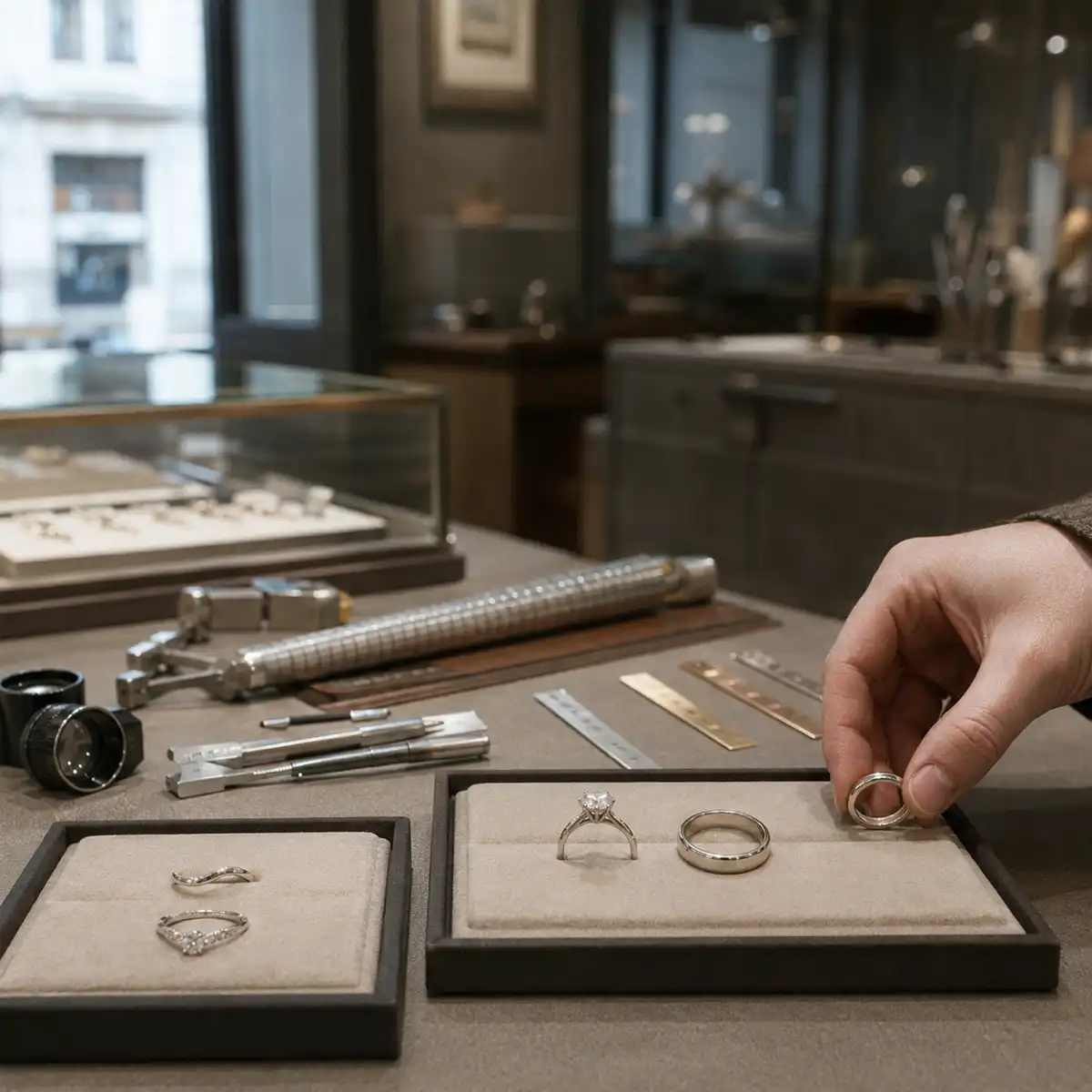
Knowing that before you go shopping rather than afterwards saves a great deal of disappointment. At the consultation desks at 9 Hatton Garden, EC1N, this conversation works best with the engagement ring physically on the table, because the ring answers most of the questions faster than either of us can.
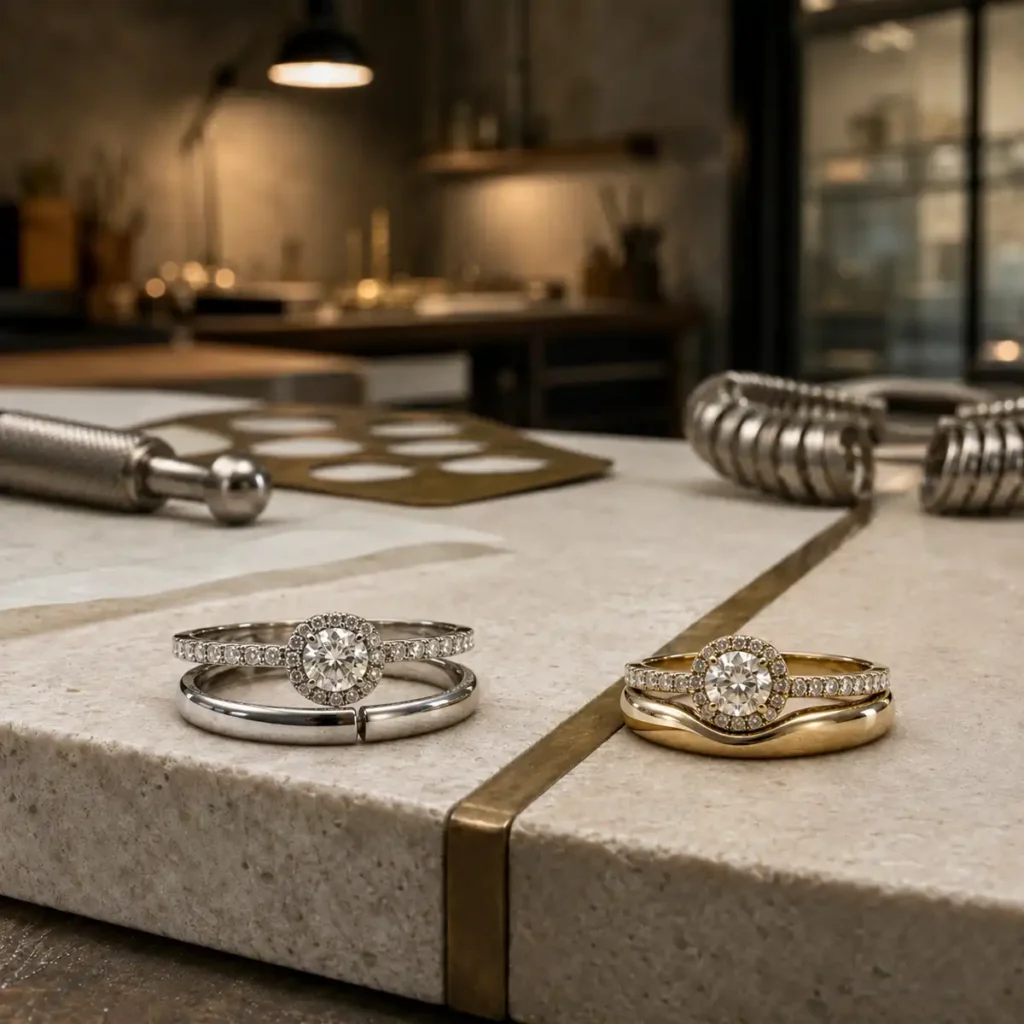
Start with fit, not style. Place a straight band against your engagement ring and look at the gap. If the band meets the ring cleanly along its length, a straight band works. If a wedge of daylight opens between them, you need a shaped band, contoured to follow the profile of the engagement ring. Only once fit is settled should metal, width and stones be discussed.
Everything else in this article follows from that 10-second test, and you can perform it yourself with any plain ring you already own.
Two rings on one finger are not 2 independent objects. They are a system, and they spend 16 hours a day pressing against each other.
A gap between them is not merely cosmetic. It means the bands are meeting at a point rather than along a surface, and a point contact concentrates wear precisely where you cannot see it. It also means the rings rock against each other as the hand moves, which is the sound some people describe as their rings clicking. Over years, that concentrated contact thins metal at the contact point on both rings.
A flush fit distributes the same forces along a line. The rings still wear, because everything worn daily wears, but they wear evenly and slowly and predictably.
There is also the matter of how it looks, which I will not pretend is unimportant. A shaped band that follows the engagement ring closely reads as one considered object. A straight band fighting a halo reads as 2 rings that met by accident.
The determining factor is what sits below the plane of the band, not what sits above it.
A classic solitaire with the stone raised on a basket or cathedral shank usually accepts a straight band without difficulty. The stone and its setting are above the band line, so nothing obstructs the band’s approach. This is one of the quieter reasons the solitaire has never gone out of fashion.
A halo design is the most common case requiring a shaped band. The halo extends laterally, beyond the width of the shank, and a straight band cannot pass beneath it. The band must be notched or contoured to accommodate the overhang.
Low-set stones present the same problem for a different reason. Where the setting has been designed to sit close to the finger, the gallery or the underside of the setting occupies the space the band wants.
Pear and marquise shapes, with their points running along the finger, and rings with a pronounced cathedral shank sweeping down toward the band, both frequently need shaping. Pavé shoulders that continue around the shank can also complicate matters, since there may be nowhere to sit a band without stone meeting stone.
None of this is a problem. It is a specification, and it is one your jeweller can only produce accurately with the engagement ring in front of them.
Fun fact: The convention of wearing the ring on the fourth finger of the left hand is usually explained by the vena amoris, a vein said to run directly from that finger to the heart, which anatomically does not exist, meaning the custom has comfortably outlived its own justification by several centuries.
Here the trade repeats a rule that deserves more scrutiny than it usually receives.
You will be told, often confidently, that a platinum band will wear away a gold engagement ring, because platinum is harder. The physics of adjacent wear is sound. Two metals of different hardness rubbing together for years will wear unevenly, and the softer one loses material. The problem is the second half of the claim.
Most 18ct white gold alloys are, in fact, harder than most platinum alloys. Platinum’s virtue is density and ductility rather than surface hardness. When platinum is scratched the metal displaces rather than disappearing, which is why a platinum ring holds its mass across decades while a gold ring slowly thins. That is a genuine advantage, and it is a different property from resisting a scratch in the first place.
Which means the honest answer to which ring wears which is that it depends on the specific alloys, and anyone giving you a confident answer based on the words platinum and gold alone is reciting rather than assessing. Platinum alloys vary considerably. So do white gold alloys. The pairing matters more than the category.
The practical response is not to abandon mixed metals. Ask which alloys are involved. Ask whether the 2 rings should be soldered together into a single unit, which removes the friction entirely and is common. Ask what the wear will look like in 15 years, and expect a specific answer.
The finish issue is separate and simpler. White gold is rhodium plated, platinum is not, and they will therefore age at different rates and need different attention. That is manageable. It is just worth choosing rather than discovering.
The engagement ring comes first, and not only for the obvious reason.
A shaped band cannot be finalised in the abstract. It has to be made against the actual ring, because the contour follows that specific piece rather than a general idea of its style. Bespoke commissions at Smith & Green run 6 to 10 weeks from approved design, and a shaped band sits inside that range rather than outside it.
Work backwards from the wedding, and allow more room than feels necessary. A band that arrives 3 days before the ceremony has no margin for the small adjustment that most rings need. Starting 4 months out is comfortable. Starting 6 weeks out is a decision to accept whatever is available.
If the engagement ring is still being made, say so at the first consultation. Designing both together is easier than designing one around the other, and it is the single most useful piece of timing advice in this article.
Some couples use this moment to bring inherited material into the band, which is a fine instinct and an entirely different conversation about what the stones will and will not permit.
A finger wearing 2 rings is not the same finger.
Bands sit against each other and the combined width behaves differently to either ring alone. It is common for a band ordered at the identical size to the engagement ring to feel tighter than expected once both are on. It is equally common for the opposite. This is why sizing for a wedding band should be done with the engagement ring worn, in the afternoon rather than first thing, and ideally not in January when hands are at their smallest.
Fingers also change across a life. Pregnancy, weather, weight, age and medication all move ring size, which is the argument for keeping at least one ring in the pair resizeable. A full eternity band set all the way round cannot be resized conventionally, because there is no plain metal to cut. That is not a reason to avoid one. It is a reason to know before you commission it.
Bring the engagement ring to the appointment. That single act answers the fit question, the alloy question and the sizing question in the first 10 minutes, and none of the 3 can be answered properly without it. Smith & Green take appointments Tuesday to Saturday, 09.30 to 18.00, at 9 Hatton Garden, 4 minutes from Chancery Lane station and a short walk from the Farringdon Elizabeth line exit.
Ask 3 things. Ask whether your ring needs a shaped band or accepts a straight one, and ask to see the gap. Ask which specific alloys are involved if you are mixing metals, and whether soldering the pair is sensible. Ask whether your insurance valuation should be updated to describe both rings. Start 4 months before the wedding. Matching a wedding band properly is not difficult, but it is not quick, and you will know the difference the moment you hold it