
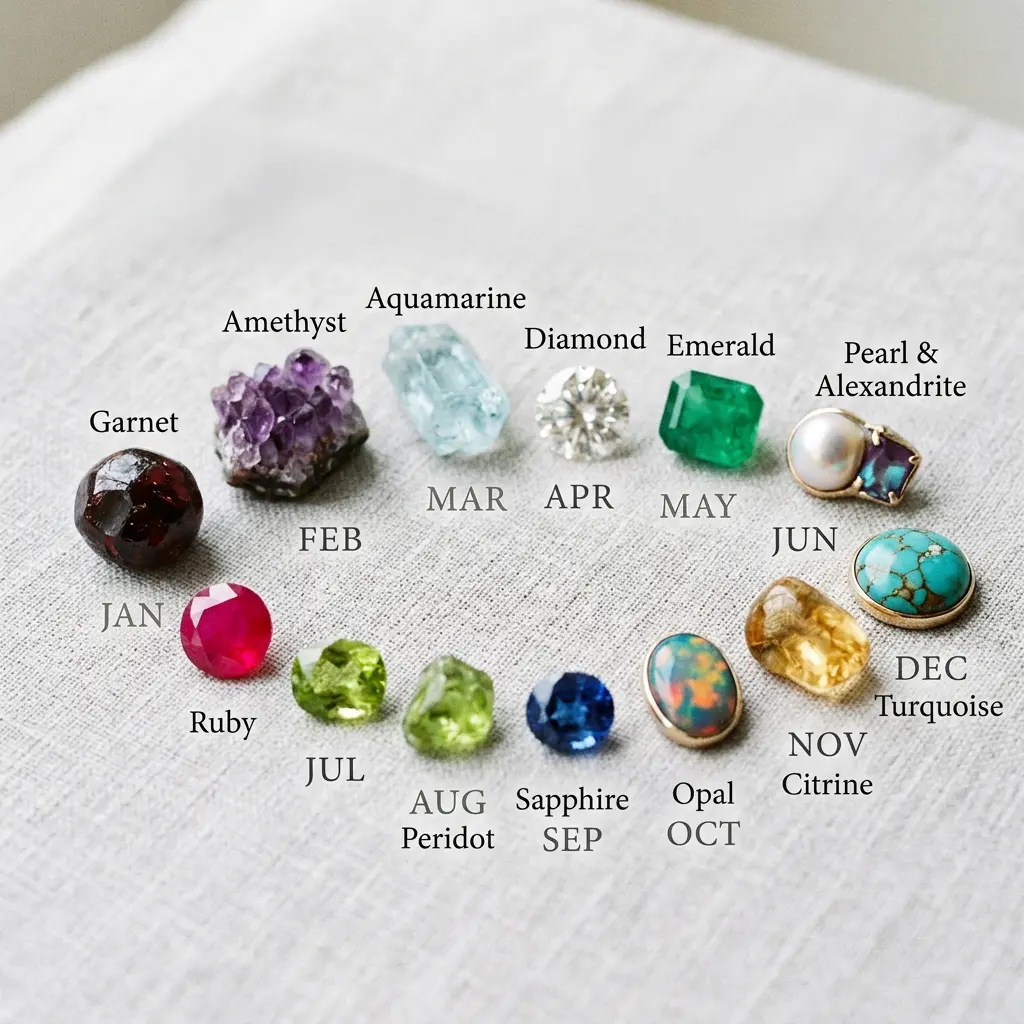
Every few days, someone stands at our counter at 9 Hatton Garden and asks the same quiet question: what is the stone for a May birthday, or an October one, and does it actually mean anything. Birthstones by month are one of the oldest gift traditions still alive in jewellery, and one of the most misunderstood. Some months hold a single famous stone, others offer a choice of three, and a few carry stones that frankly should not live on a hand at all. The gemstone rings in our collection cover the most wearable of them in 18ct gold and platinum. This piece walks the full calendar honestly, including which stones we would set in a ring and which belong in a pendant instead.
A birthstone is a gemstone associated with the month of a person’s birth, worn as a personal talisman or given to mark birthdays and other milestones. The tradition has ancient roots, but the modern list was standardised by the American jewellery industry in 1912 and has been adjusted only rarely since.
That standardisation is why every jeweller from London to Los Angeles now broadly agrees on the calendar, though a few months have gained alternatives over the years. The meaning attached to each stone is folklore rather than fact, and we treat it that way at the counter: a lovely story to give, never a promise to sell.
Fun fact: The modern birthstone list was formally agreed in 1912 in the United States, which means the tradition most people assume is ancient has been fixed for barely over a century.
The calendar runs as follows. January belongs to garnet and February to amethyst, followed by aquamarine for March and diamond for April. May carries emerald, June offers pearl alongside moonstone and alexandrite, July belongs to ruby and August to peridot, with spinel and sardonyx as its companions. September is sapphire’s month, October brings opal and tourmaline, November answers with topaz and citrine, and December closes the year with turquoise, tanzanite and zircon.
Three of those months carry the big four. April’s diamond speaks for itself, a story we trace in our piece on April’s diamond birthstone. July’s ruby carries the deepest colour lore of all, explored in our look at the ruby birthstone meaning, and September’s sapphire gives that month arguably the finest everyday stone on the entire list. August, often assumed to be a quiet month, actually holds three stones, and our report on the August birthstones makes the case for spinel as the connoisseur’s pick of the trio.
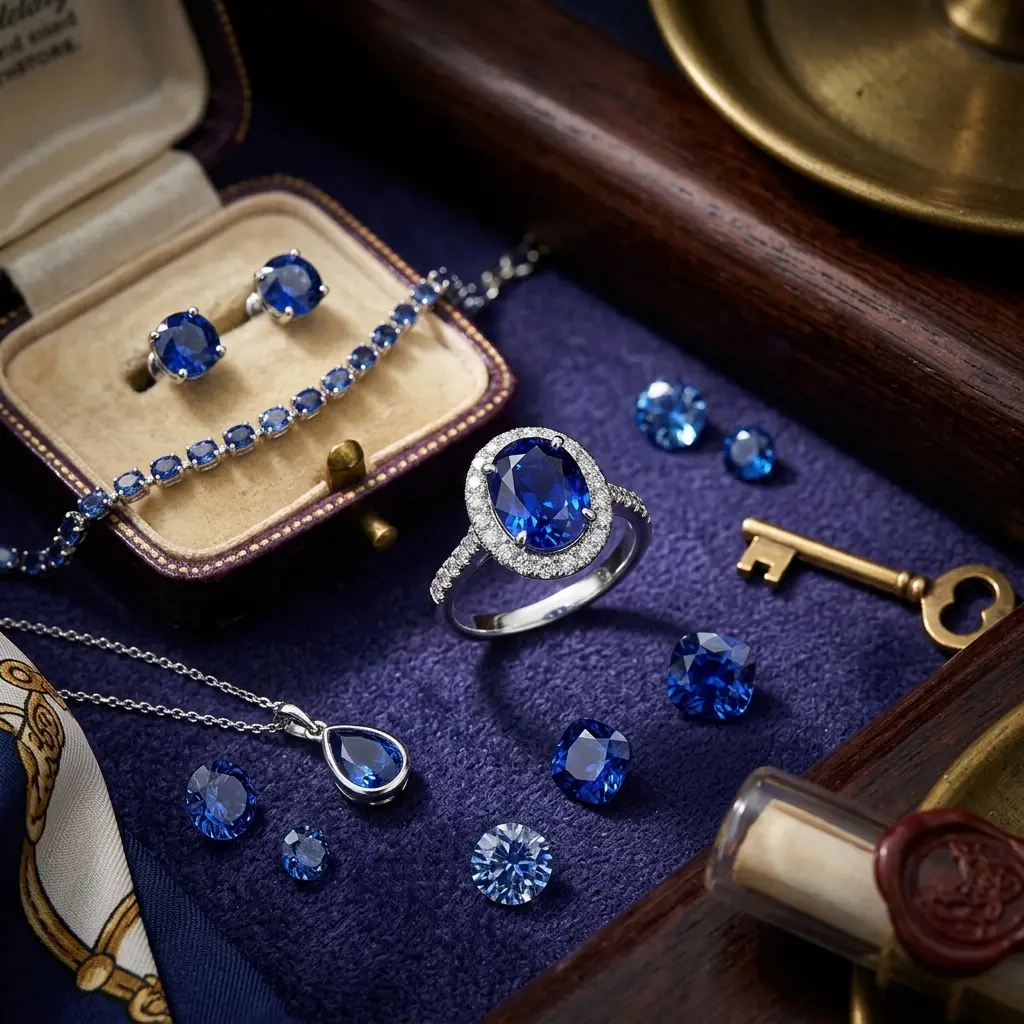
September deserves a special word. Sapphire combines top-tier hardness with a colour range far beyond the famous blue, running through pinks, yellows, greens and the rare padparadscha, which means a September birthstone can be matched to almost any taste without compromising on durability. It is the stone we recommend most often when someone wants birthstone meaning in a ring worn daily, and the reason September buyers rarely need the pendant compromise the softer months lean on.
Hardness decides which birthstones survive on a hand. Diamond, sapphire and ruby are the most durable stones on the list and suit daily-wear rings. Emerald, aquamarine, amethyst, garnet, spinel and topaz wear well with light care, while opal, pearl, moonstone and turquoise are soft stones best kept for pendants, earrings or occasional rings.
This is the advice that saves disappointment. An opal is genuinely beautiful and genuinely fragile, and setting one in an everyday ring is a repair bill on a schedule. A sapphire, by contrast, will outlast its owner’s grandchildren. When a soft stone carries the right month, the honest answers are a protective bezel setting, a design worn occasionally, or the stone reset into a pendant where it can be admired without being knocked.
A birthstone engagement ring works beautifully when the stone is hard enough for daily wear, which is why sapphire, ruby and diamond birthstones translate directly and why softer months usually borrow a harder stone in the birth colour instead. Colour, hardness and personal meaning have to agree.
We set natural rubies, sapphires and emeralds in engagement rings regularly, in 18ct gold and platinum with full UK hallmarks, and our comparison of sapphire, ruby and emerald engagement rings weighs the three honestly. For the softer months there is an elegant compromise: a diamond ring with the birthstone set discreetly inside the band, where it carries the meaning without taking the knocks.
Choosing birthstone jewellery well means seeing the actual stone, because colour varies enormously within every variety on the list. Two minutes comparing stones side by side at a jeweller’s counter teaches more than an afternoon of reading, and it is the difference between a colour that flatters and one that merely matches a chart.
Months carry multiple birthstones because the modern list has been amended several times since 1912, usually to add a more available or more wearable alternative beside a traditional stone. June gained alexandrite in 1952, and December added tanzanite in 2002, decades after the stone’s discovery in Tanzania.
The additions were practical as much as poetic. Pearl, June’s traditional stone, is organic and soft, so the month gained harder companions. August’s spinel, added formally in 2016, gave a month long ruled by peridot a stone that ranks among the most underrated in the coloured world, with vivid reds and pinks that historically passed as ruby in royal collections. When a month offers a choice, choose by colour preference and hardness rather than tradition alone; the calendar permits it, and your jeweller will encourage it.
The best birthstone gifts pair the right stone with the right setting for how the person actually lives: a hard stone in a ring for daily wear, a softer stone in a pendant or earrings, and the month’s story told at the moment of giving. The meaning is the gift; the stone is its proof.
Milestone birthdays are the classic occasion, but the tradition stretches gracefully. A first piece for an 18th or 21st, a pendant marking a child’s birth month given to a new mother, or a family piece combining several birthstones across one design are all commissions our workshop sees regularly. Because every piece is made to order, the stone, the metal and the engraving can carry the story precisely, and pricing is quoted per design once the stone is chosen. The one rule worth keeping: see the stone before it is set. Colour is personal, and the calendar only chooses the variety, never the exact stone.
Birthstone jewellery spans almost the entire price range of the coloured stone world, because the calendar mixes precious and semi-precious varieties. The factors that move the price are the stone variety itself, its size and colour quality, the metal, and whether the piece is ready-made or built to order.
A garnet or amethyst pendant sits at the accessible end of the calendar, while fine ruby, sapphire and emerald command serious prices, which is why the gemstone rings in our own collection run from £3,500 to £30,000 depending on the stone. Between those poles, most months offer honest options at most budgets once size and colour are balanced sensibly. Bespoke birthstone commissions are quoted per design after the stone is chosen, and we would far rather show the price drivers on a real stone under the loupe than promise a number a chart cannot keep. Colour quality, not carat weight, is where a coloured stone budget works hardest, and it is the single best lesson a first-time birthstone buyer can take into any jeweller’s shop.
Our workshop sources natural stones and builds around them to order, whether that is a July ruby in a claw setting or a December tanzanite in a protective bezel. Every piece is hallmarked, every purchase includes a free insurance valuation, and a booked appointment at 9 Hatton Garden, two minutes from Chancery Lane station, puts the whole calendar of birthstones by month on the counter in front of you. Bring the birthday; we will bring the stones.