
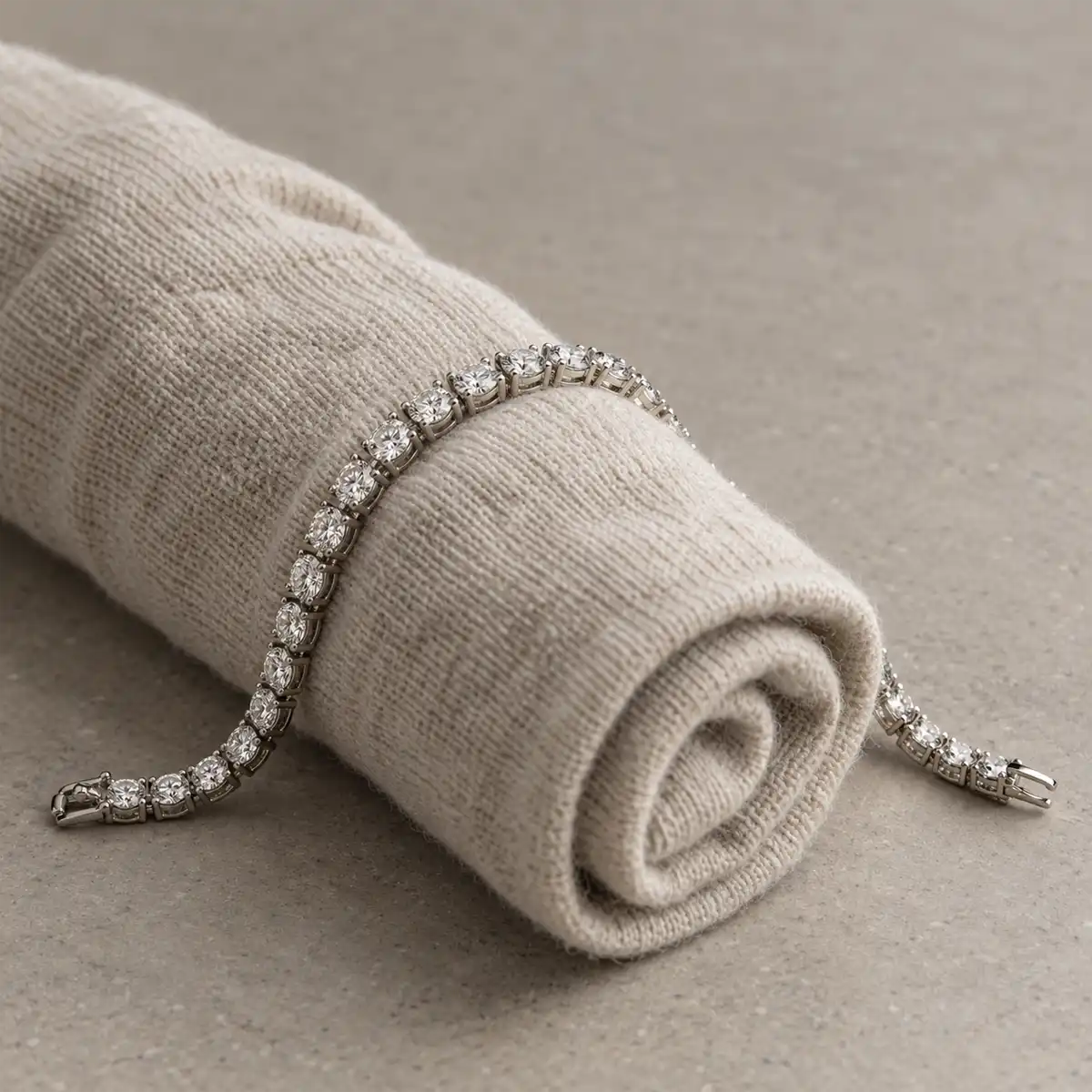
A diamond tennis bracelet is a single, flexible line of diamonds of matching size, each held in its own setting and joined by small hinged links, so the bracelet moves with the wrist rather than sitting on it like a bangle. The name dates from the 1987 US Open, when Chris Evert stopped a match to look for the diamond line bracelet that had fallen from her wrist, and the story still tells a buyer the most important thing about the piece. A tennis bracelet is made to be worn, and the parts that decide whether it survives being worn are the ones a photograph does not show.
This article covers what those parts are, how to judge them in person, and how the carat weight on the label relates to what you will see on the wrist. The examples come from the Smith & Green tennis bracelet collection, which runs from an essential line of just over 4.5 carats to statement pieces of more than 14 carats, all set with natural diamonds.
The carat weight quoted for a tennis bracelet is the total weight of every diamond in the line added together, not the size of any single stone. A 7 inch bracelet described as 10 carats may carry 40 to 60 diamonds, so each stone is a fraction of a carat, and the total tells you more about presence on the wrist than about individual quality.
Two bracelets of the same total weight can look very different. One may use fewer, larger stones set further apart, the other more numerous small stones set tightly, and the second will read as a continuous line of light while the first reads as a row of separate points. Ask how many stones the bracelet carries and roughly what each weighs, because that single figure explains most of the difference in appearance between two lines with the same number on the ticket.
Total weight also drives price in a way that is not linear. Doubling the carat weight of a line usually means moving to larger individual stones, and larger stones of matching quality are harder to find in quantity, which is why a 14 carat bracelet costs more than twice a 7 carat one.
The common advice is to buy the biggest total carat weight the budget allows. The trade view is different. A tennis bracelet is judged by eye as one object, and a single stone that is noticeably warmer in colour, or cloudier, than its neighbours breaks the line in a way that no amount of total weight repairs.
Matching 50 diamonds for colour, clarity and cut is the slowest and most skilled part of making the piece, and it is the main reason prices for bracelets of similar weight vary so much between makers. It is also why Smith & Green quotes bracelets individually rather than listing a fixed price: stones in these quantities vary piece by piece, and the collection is priced on request with a same-day answer. When you compare bracelets, lay them flat under daylight and look along the line from one end to the other. The better piece is the one where no stone draws the eye on its own. Our explanation of the four Cs of diamonds covers the grading terms used when those stones are described.
How each diamond is held changes both the look and the long-term care of the bracelet. Most tennis bracelets use one of three settings.
For a bracelet that will be worn daily, a bezel line is the most forgiving. For a bracelet worn for evenings and occasions, four claws give the most brilliance. Neither is better in the abstract. The right answer depends on how often the piece will leave the jewellery box.
A tennis bracelet should be bought on the wrist, and the check takes about ten minutes if you know the order to do it in.
That last point matters because laboratory-grown diamond tennis bracelets are now widely sold at a fraction of the price of natural ones, and the two should never be confused on an invoice. The Smith & Green collection is set with natural diamonds.
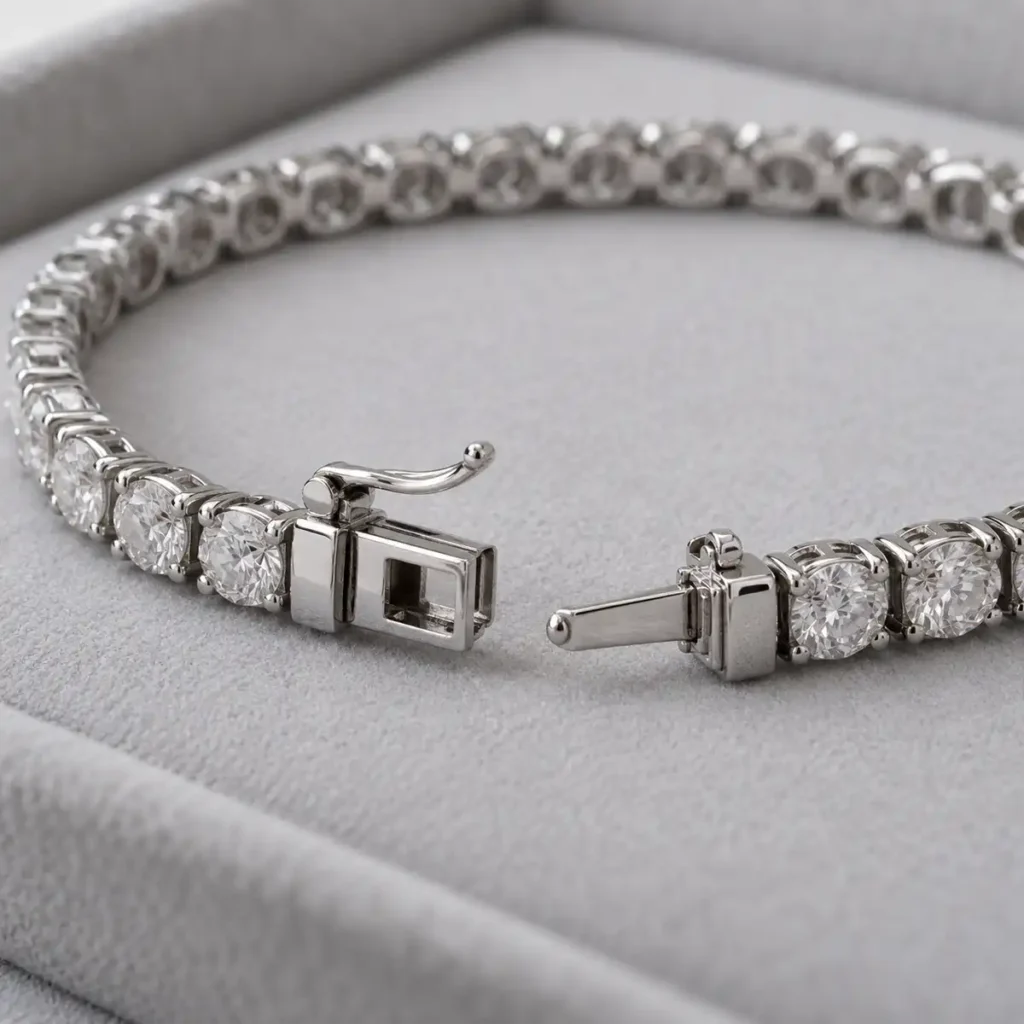

A tennis bracelet should be slightly loose. The usual approach is to measure the wrist snugly with a soft tape just below the wrist bone, then add around 1 to 1.5cm, so the line can move and sit against the hand when the arm is lowered. Too tight and the links are under constant tension. Too loose and the bracelet slides over the hand and catches on everything. Most of the Smith & Green bracelets are made at 7 inches, around 17.8cm, which suits a wrist of roughly 16 to 16.5cm.
Because each piece is made to order in the workshop, length can be discussed before it is made rather than altered afterwards. The easiest way to settle the size is to try a bracelet on at an appointment at 9 Hatton Garden, where the drape and the clasp can be felt in a way no product page allows.
Clean a diamond line at home with warm water, a drop of mild washing-up liquid and a very soft brush, working gently around each setting from underneath, then rinse and dry with a lint-free cloth. Take it off for the gym, gardening and swimming, where knocks and chlorine do the most damage to settings. Once a year, have a jeweller check the claws and the clasp, which takes minutes and prevents the lost stone that most owners only notice afterwards.
A bracelet of this value should be insured on a current valuation. Smith & Green provides a free insurance valuation with its pieces, and our article on insurance valuations in the UK explains what an insurer needs to see. Remember that a valuation for insurance is a replacement figure, not a resale price, and the two are very different numbers for any piece of fine jewellery.
Before committing, ask for the number and size of the stones, see the clasp close twice, check the hallmark, and wear the bracelet for a few minutes with your arm lowered. If it drapes, locks securely and no single stone catches your eye, it is the right line. The full range, from the 14.04ct Diamond Rose Tennis Bracelet in 18K rose gold to the essential 4.5 carat line, can be seen by appointment.
A diamond tennis bracelet is a flexible line of diamonds of matching size, each in its own setting and joined by hinged links. The name comes from the 1987 US Open, when Chris Evert paused a match to find her diamond line bracelet. It is designed to be worn every day, not only for occasions.
Most buyers choose between about 3 and 10 carats total weight. Lines of 4 to 5 carats suit daily wear and read as fine and delicate, while 9 carats and above make a clear statement. Stone matching matters more than total weight, so compare how evenly the diamonds look before comparing numbers.
A claw setting shows more of each diamond and gives the brightest line, but claws wear and should be checked yearly. A bezel setting surrounds each stone with metal, protects it on every side and catches less on clothing. For daily wear bezel is the more forgiving choice, for evenings claws give more brilliance.
Measure the wrist snugly just below the wrist bone and add about 1 to 1.5cm. The bracelet should move freely and rest against the hand when the arm is lowered, without sliding over it. A 7 inch bracelet, around 17.8cm, usually suits a wrist of roughly 16 to 16.5cm.