
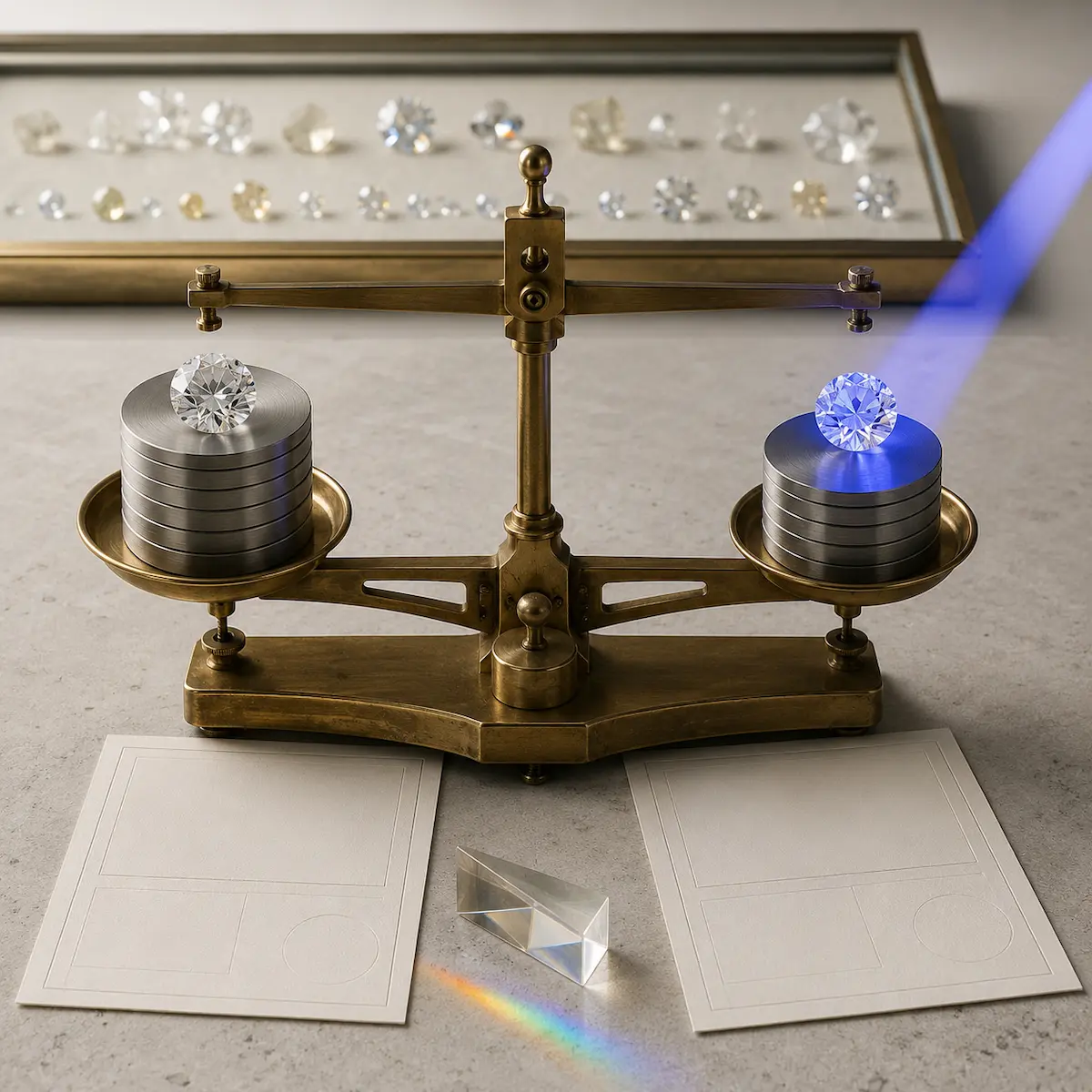
There is a specific moment at the consultation desks at 9 Hatton Garden when a buyer’s eyes travel down a grading report, past everything they have researched, and stop on a line nobody warned them about. Carat, they know. Colour and clarity they have read about for weeks. Cut, they have opinions on. Then, near the bottom, a heading they have never once seen discussed. Fluorescence. Strong.
The question that follows always carries a small edge of alarm. Is that bad?
Diamond fluorescence is the most misunderstood field on a laboratory report, and the confusion is not the buyer’s fault. It is not one of the 4Cs. It is not a quality grade. It is not a flaw; it does not weaken the stone, and in some cases, it improves how the diamond looks on the hand. Yet it moves prices by double-digit percentages, it generates more anxiety than colour and clarity combined, and the trade itself has never settled on whether it is a defect or a discount worth chasing.
The difference between a good stone and a great one is measurable. Here is how to measure this one.
Diamond fluorescence is the visible glow a diamond emits when exposed to ultraviolet light. Trace elements within the crystal lattice, most commonly nitrogen arranged in particular configurations, absorb UV energy and re-emit it as visible light. In over 95% of fluorescent diamonds, that light is blue. The effect is an identifying characteristic, not a quality assessment, and it appears on a GIA report as an observation rather than a grade.
That distinction is worth holding onto, because it explains almost everything downstream. Carat, colour, clarity and cut describe how good the diamond is. Fluorescence describes what the diamond does. A laboratory records it the way it records measurements and proportions, as a fact about that specific stone, alongside the other permanent identifiers that will follow the ring for its entire life.
GIA uses 5 descriptors. None, Faint, Medium, Strong, Very Strong. The assessment is made under a standard long-wave UV lamp against master stones, and it records intensity rather than desirability.
The distribution matters more than most buyers realise. In a GIA study of more than 26,000 submitted diamonds, only roughly 25% to 35% showed any fluorescence at all. Of those, only about 10% fluoresced at Medium, Strong or Very Strong, meaning at strengths that could plausibly affect appearance. Run the arithmetic and the population of diamonds where fluorescence is even a live question is small. For most stones on most trays, the field is genuinely inert.
The rarest grade is Very Strong, and it is also the one that carries the most trade suspicion. Faint fluorescence is functionally irrelevant, and nobody argues about it.
One point that gets lost. GIA assigns colour grades in a controlled viewing environment specifically designed to minimise the influence of fluorescence, which means the colour grade on your report is not inflated by the stone’s glow. That is a deliberate methodological choice, and it is the reason the two fields can be read independently.
Blue is the complementary colour to yellow. That single fact from basic optics governs the entire useful half of this subject.
A diamond graded I, J, K or lower carries a perceptible warm tint. Introduce blue fluorescence and the two cancel, in the additive way that blue light and yellow light combine toward white. A J colour stone with Medium to Strong blue fluorescence can present face-up as noticeably whiter than its grade suggests, in ordinary daylight, on an ordinary hand. GIA’s own position is that in many instances observers actively prefer the appearance of diamonds with medium to strong fluorescence.
The other direction is where the anxiety lives. In the D to H range there is nothing yellow to cancel, so the fluorescence has no corrective work to do, and the trade has long held that strong blue fluorescence in a high colour stone produces a hazy or oily look. Here the evidence is narrower than the reputation. GIA found this overblue effect in fewer than 0.2% of the fluorescent diamonds submitted to it.
More importantly, GIA’s research indicates fluorescence does not cause haziness by itself. Haziness comes from light-scattering defects within the stone, internal clouds and microscopic graining, and fluorescence can intensify an appearance problem that was already there. The two are correlated, not causal. Which means the honest instruction is not to avoid fluorescence. It is to look at the stone.
Fun fact: The 127.01 carat Portuguese diamond, held by the Smithsonian Institution and graded by GIA as M colour and VS1 clarity with very strong blue fluorescence, is the classic textbook example of an overblue stone, and a single famous diamond is largely responsible for a reputation now applied to an entire category.
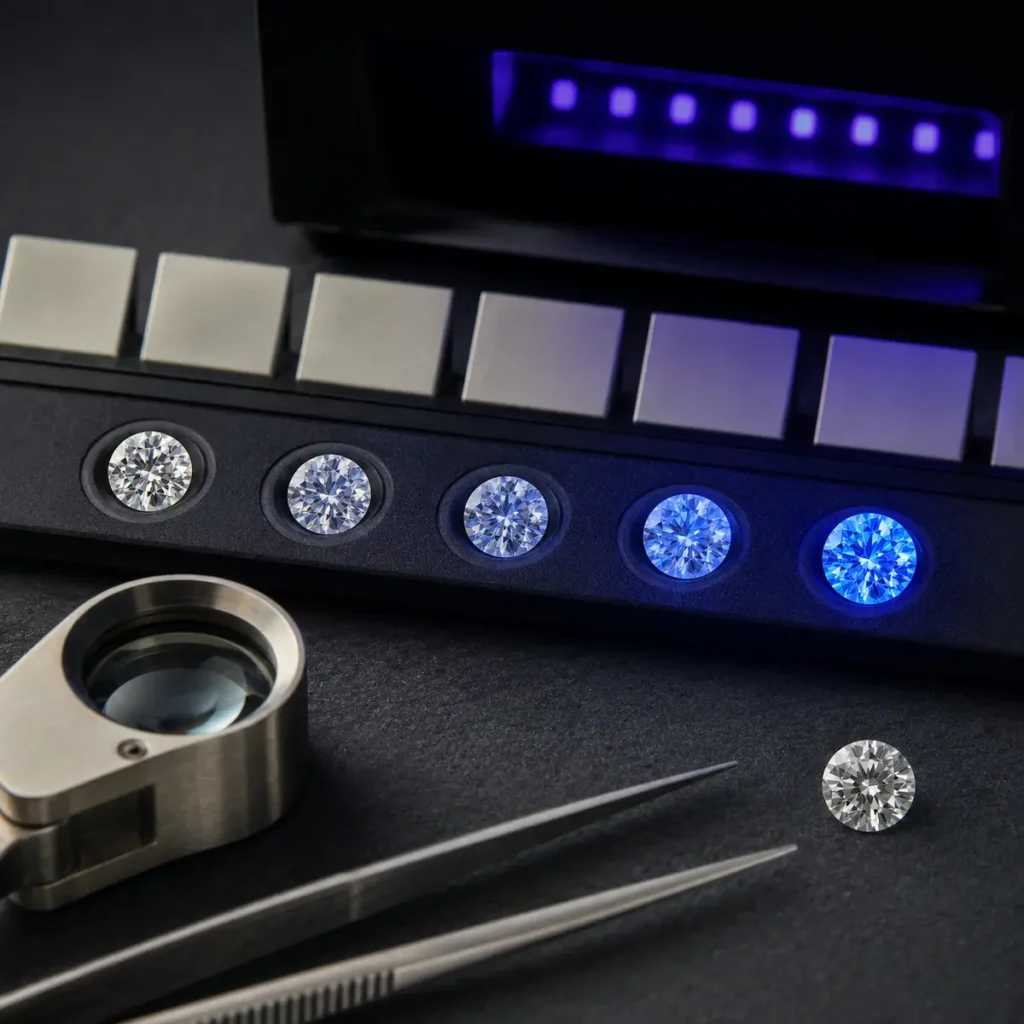

Price and appearance have come apart here, and understanding the gap is where a buyer finds an advantage.
The market applies a discount to Strong and Very Strong fluorescence in the higher colour grades. That discount is real; it is often in the region of 10% to 15% depending on the stone and the moment, and it exists because dealers price against what the next buyer will believe rather than against what the stone looks like. A trade that spent 30 years treating fluorescence as a defect has built a price structure around that belief, and the belief has proved considerably more durable than the evidence supporting it.
Some traders take the opposite position and pay more for blue-fluorescing stones in lower colour grades, precisely because the fluorescence does visible work there. Both behaviours coexist. GIA states plainly that jewellery professionals disagree about whether fluorescence adds to or detracts from value, and that disagreement is itself the most useful thing a buyer can know.
The practical consequence is a genuine arbitrage for anyone willing to use their eyes. A stone that has been discounted for a characteristic that does not affect its appearance is simply a cheaper stone. The buyer who inspects rather than filters gets more diamond for the same money.
The resale question is the counterweight and deserves an honest answer rather than a reassuring one. A fluorescent stone bought at a discount will also be sold at a discount, because the next buyer will apply the same stigma you declined to apply. If the ring is being bought to be worn for 40 years, that is irrelevant. If liquidity matters to you, it is not.
Fluorescence is one of the few fields on a report that a buyer can meaningfully assess without training, provided the stone is in front of them.
First, ask to see the diamond in daylight rather than under showroom spotlights. Retail lighting is engineered to flatter and typically carries a different UV component to the sun, so a stone that looks superb under a display lamp is not yet a stone you have evaluated. Take it toward a window. Any haziness intensified by fluorescence will be visible in daylight-equivalent light, to you, immediately.
Second, ask to compare it against a non-fluorescent stone of the same grade on the same pad. This is the entire test, and it takes 90 seconds. If you cannot see a difference, the difference does not exist for practical purposes.
Third, ask what the report says about clarity characteristics. Since haziness tracks with light-scattering defects rather than with fluorescence itself, clouds noted on the plot are a more relevant warning sign than the fluorescence line is.
At Smith & Green the report is put on the pad next to the loose stone before anything is set, which is what makes this test possible at all. A certificate produced after a decision is a receipt. A certificate produced beside a loupe is an instrument. Any route that will not show you both together has answered a different question than the one you asked.
Lab-grown diamonds fluoresce too, and the pattern of that fluorescence is a working identification tool rather than a value question.
HPHT-grown stones frequently show fluorescence in yellow, green or a distinctive banded pattern that follows the geometry of crystal growth, which is quite unlike the diffuse blue of most natural material. CVD-grown stones commonly show weak fluorescence or none. Gemmologists use these reactions, alongside phosphorescence and spectroscopic analysis, as part of the identification process. The consumer point is narrow but useful. Fluorescence on a lab-grown report describes the growth method rather than making a claim about quality.
Any lab-grown stone should carry a report from GIA or IGI stating laboratory origin explicitly. That is not a courtesy. It is the baseline, and a stone without one is a stone with an unverified history.
Book time with the stones rather than with the spreadsheet. Smith & Green take appointments Tuesday to Saturday, 09.30 to 18.00, at 9 Hatton Garden, EC1N, 4 minutes from Chancery Lane station and a short walk from the Farringdon Elizabeth line exit.
Ask 3 things at the desk. Ask to see any fluorescent stone in daylight beside a non-fluorescent stone of the same grade. Ask what the plot shows for clouds and graining, because that is the characteristic actually correlated with haziness. Ask what the discount is, and whether you can see what you are being discounted for. Filtering diamond fluorescence out of a search before you have looked at a single stone removes a large population of excellent diamonds from consideration on the strength of a reputation built from rare cases. Look first. Decide second.