
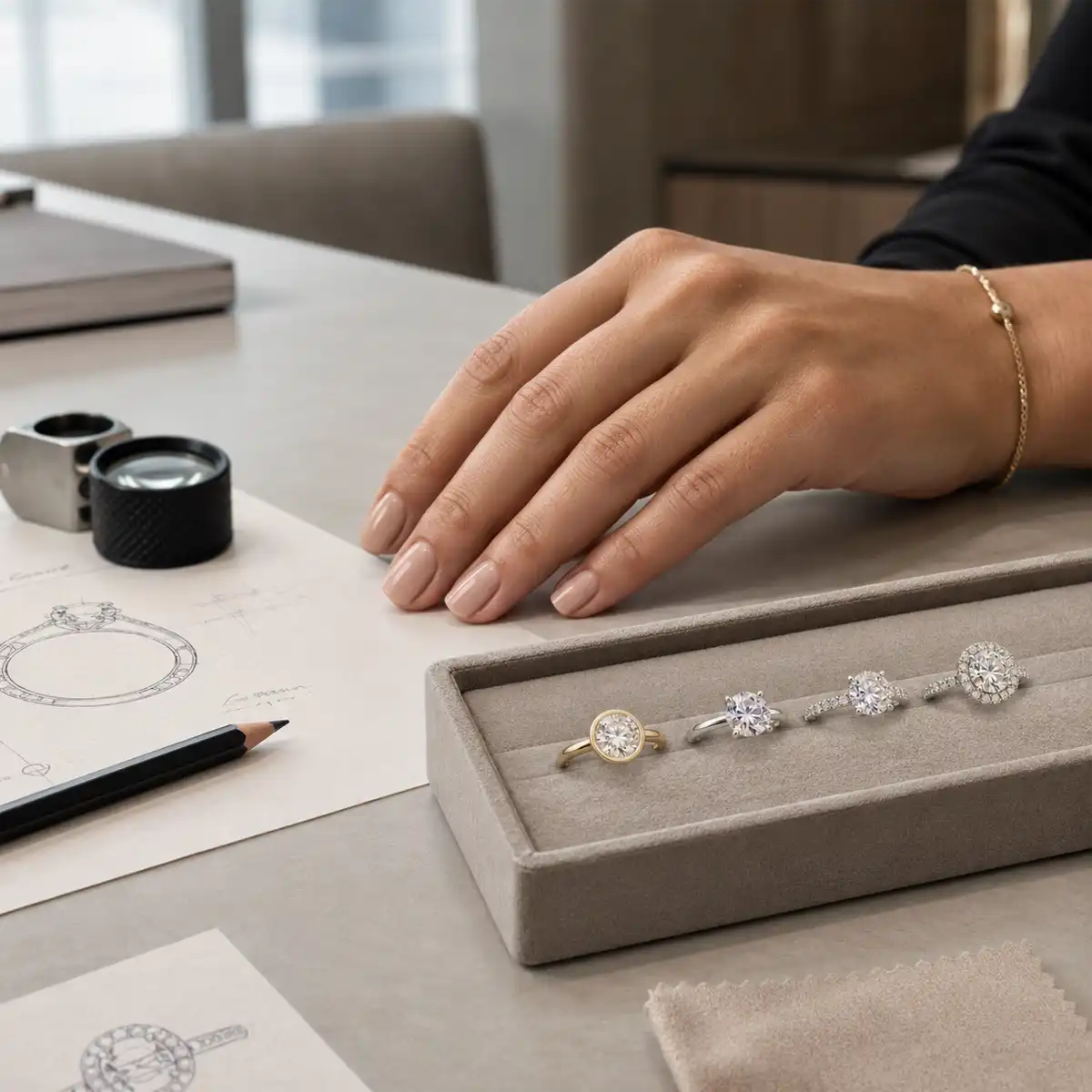
There is a moment in almost every engagement ring consultation at Smith and Green when the conversation shifts. The couple has spent twenty minutes discussing carat weight and colour grades, comparing two stones that look nearly identical in the light of 9 Hatton Garden. Then someone asks: Which setting? And the room changes. Because the setting is not decoration. It is the architecture of the ring. It determines how the stone sits, how light reaches it, how long the ring lasts, and whether it still looks right on the hand in ten years. Getting the engagement ring setting right is not a finishing touch. It is the decision that holds everything else together.
Smith and Green’s craftsmen work across the full range of setting types, from the classic four-claw solitaire to flush-set pavé bands and bezel-wrapped coloured stones. Understanding what each setting actually does, structurally, optically, and practically, is what allows a buyer to choose with confidence rather than guess.
An engagement ring setting is the metal framework that holds the centre stone and any accent stones in place. It controls the stone’s position relative to the finger, how much metal contacts the stone’s girdle and pavilion, how exposed the stone is to daily knocks, and how light enters and exits through the crown and table. Two rings with identical stones can look and perform entirely differently depending on the setting. The setting is not a style choice in isolation. It is a structural and optical decision with long-term consequences.
The claw setting (also called a prong setting) uses between four and six individual metal claws to grip the stone at its girdle. Four claws are the most common for round brilliant cuts; six claws offer additional security and are widely used on solitaires where the stone is the entire visual focus.
The primary advantage is light exposure. A four-claw solitaire allows light to enter the stone from almost every direction, which maximises the brilliance and fire that make a well-cut diamond worth the money. The secondary advantage is proportion: claws can be shaped to complement specific stone shapes, rounded claws for round brilliants, pointed or V-shaped claws for princess and marquise cuts.
The practical consideration is maintenance. Claws wear. Over years of daily contact with surfaces, the metal tips thin and can eventually lift, leaving the stone at risk. At Smith and Green, a prong check is standard as part of their aftercare service and should be done every 12 to 18 months on a ring worn daily. comparing the main setting styles side by side That is not a reason to avoid claws. It is a reason to stay on top of servicing, which applies to any well-made fine ring regardless of setting type.
A bezel setting wraps the stone in a continuous band of metal that runs around the full circumference of the girdle. The metal folds over the edge of the stone, holding it entirely within a metal collar.
The result is a very clean, modern profile. There are no protruding claws to catch on fabric, no tips to wear down, and the stone is as well protected as any setting allows. A full bezel gives complete edge protection; a half-bezel (which leaves two sides of the stone exposed) retains some of that security while allowing more light to enter from the sides.
The trade-off is optical. Because the metal collar obscures part of the stone’s girdle, some light is blocked. In a round brilliant, the face-up appearance changes slightly. The stone can look marginally smaller than its carat weight suggests, because the girdle measurement, which contributes to the apparent diameter, is partially hidden. For buyers who prioritise security, low profile, and a contemporary aesthetic over maximum face-up spread, the bezel is an excellent choice. For buyers who have invested in a high-carat stone specifically for its size impact on the hand, claws will serve them better.
Pavé (from the French for paved) describes a technique in which small accent diamonds are set very close together across the band, held by tiny shared prongs or beads of metal. The effect is a continuous glittering surface. When executed well, you see a diamond rather than metal along the shank.
Pavé is most commonly used on the shoulders or full band of an engagement ring rather than on the setting holding the centre stone. A round brilliant solitaire with pavé shoulders is one of the most commercially popular configurations in Hatton Garden today. The centre stone carries the weight and certification; the pavé amplifies the overall presence on the hand.
The practical consideration: pavé stones are small, and the prongs holding them are correspondingly tiny. Vigorous manual work, gardening, gym, hands-on trades, can dislodge individual pavé diamonds over time. Regular inspection catches any loose stones before they are lost.
*Fun fact: The pavé technique has been used in fine jewellery since the 18th century, originally applied to entire surfaces of jewelled objects in the French royal workshops, the same principle that now runs along the shoulder of a contemporary solitaire ring.
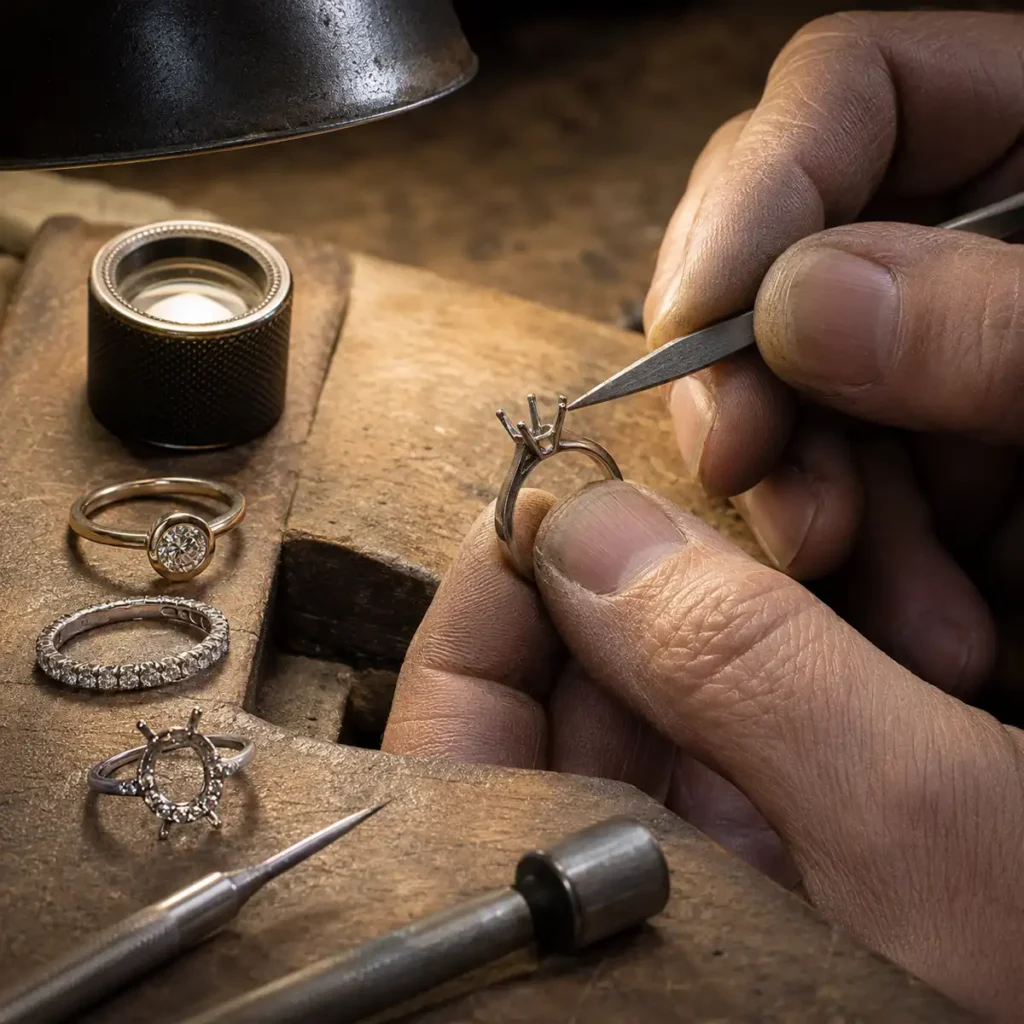

A halo setting surrounds the centre stone with a frame of small diamonds. The optical effect is significant: a 1.00ct round brilliant in a well-designed halo will appear close to the size of a 1.30ct solitaire when viewed from above. The halo adds apparent diameter without adding to the centre stone budget.
The halo has been the dominant engagement ring setting style globally for over a decade. It reads as classic in its round form and distinctly contemporary in a non-round, geometric variation. A double halo adds a second ring of smaller stones outside the first; a hidden halo sits beneath the table of the stone, visible only when viewed from the side.
The key quality variable in a halo is the calibration of the small stones surrounding the centre. Poorly matched pavé stones in the halo, inconsistent sizes, variable cut quality, will undermine the optical effect and suggest economy. At Smith and Green, where bespoke commissions are built stone by stone, halo calibration is part of the specification process.
A cathedral shank raises the centre stone high above the finger on arched metal supports, mimicking the soaring lines of gothic architecture. The result is a ring with significant visual height and presence. The stone catches light from a greater range of angles. The trade-off: height increases the chance of the ring catching on clothing and requires more conscious care during physical activity.
A tension setting holds the stone between two ends of the shank with no visible prongs or bezel, the diamond appears to float. The stone is secured by the compressive force of the metal. This is the most technically demanding setting to execute correctly, and the least forgiving of any error in stone dimensions. At Smith and Green, tension settings are built to exact tolerances and require a precise stone-to-setting specification before production begins. They are not suitable for stones with fragile inclusions near the girdle.
Not every setting suits every stone shape equally.
Round brilliants are the most versatile and work well in virtually any setting. Oval, pear, and marquise cuts have pointed or tapered ends that are vulnerable to chipping; these benefit strongly from V-shaped claw tips or a partial bezel protecting the points. Princess cuts have sharp corners that are equally vulnerable, four corner-prongs are the standard for good reason. Cushion cuts look exceptional in both claw and bezel configurations. Emerald-cut stones, with their large open table and step-cut facets, benefit from a clean four-claw or eight-claw setting that does not interrupt the geometry of the stone.
Matching stone and setting is one of the most practical things a buyer can ask about before committing to a design.
The setting style shapes every other decision about the ring. It determines how the stone performs optically, how the ring wears over years of daily use, how well it suits the specific stone shape chosen, and how much maintenance it will need. A claw setting maximises light and presence at the cost of regular prong checks. A bezel offers maximum protection with a slight reduction in face-up impact. Pavé adds brilliance to the band and rewards attentive ownership. A halo amplifies apparent size. Cathedral and tension settings are architectural statements that reward precise craftsmanship. At Smith and Green in Hatton Garden, EC1N, the setting conversation happens early in the consultation process, before the stone is selected, not after. Book an appointment via Chancery Lane or Farringdon on the Elizabeth line and bring your instincts about how the ring will be worn. The right setting is the one that carries your stone safely and beautifully for the rest of your life.