
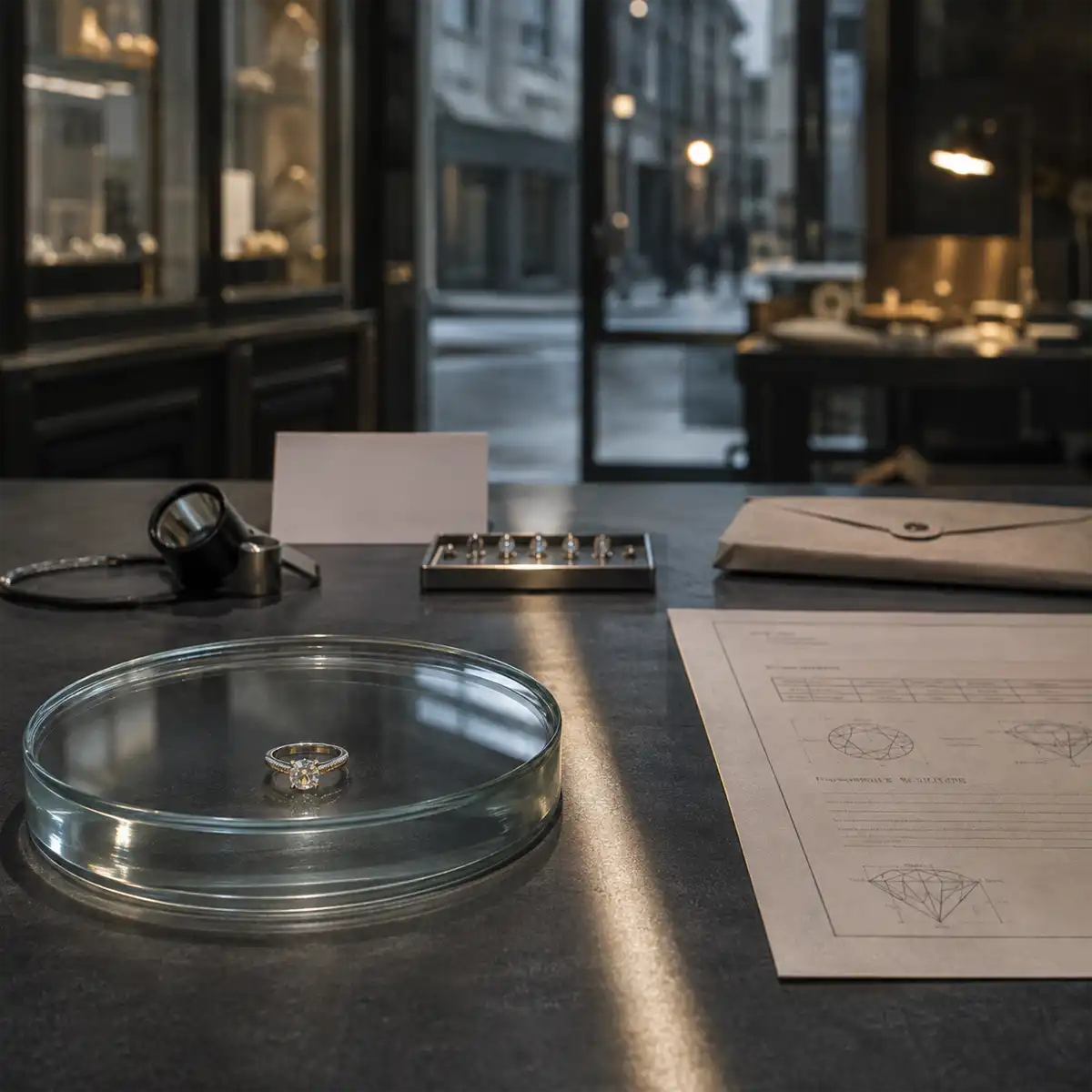
The certificate in the seller’s hand is not proof of anything.
That sentence is the whole article, and almost nobody buying a pre-owned engagement ring understands it before they hand over the money. A grading report is a description of a stone. It is not a chain of custody, it is not attached to the ring, and it is not evidence that the diamond currently sitting in that setting is the diamond the laboratory examined. Paper and stone are 2 separate objects, and a private seller in a coffee shop off Leather Lane can hand you both without either being connected to the other.
None of which means avoid pre-owned. The opposite. The retail-to-resale gap in fine jewellery is wide, and a buyer who knows what to check is buying the same diamond as the person who paid full retail 6 years ago, at a fraction of the number. That gap is one of the few genuine efficiencies left in this trade.
But you are also buying a service history you cannot see.
Here is what to check, in order, and what each check actually rules out.
Check 5 things in this order. Match the laser inscription on the stone’s girdle to the report number. Verify that report number against the laboratory’s online archive. Read the report title to confirm natural or laboratory-grown origin. Inspect the hallmark inside the band. Assess the setting for wear, prior repair and resizing. Anything the seller resists is the answer.
Every one of those is doable in a single appointment with the right person. None of them is doable across a car park.
The certificate is not proof and here is why
Stones get swapped. Not usually maliciously, and not usually recently.
A ring passes through hands over 20 years. It gets resized. It gets a claw rebuilt. It gets a stone reset after a knock. At any of those moments the diamond leaves the mount and comes back, and the honesty of every workshop in that chain is something you are being asked to assume. Meanwhile the certificate sits in a drawer, unchanged, describing a stone that may or may not be the one you are looking at.
The seller is very likely telling you the truth as they understand it. That is the point. They inherited the ring, they inherited the paperwork, and they have no more idea than you do whether the 2 still correspond.
A certificate proves that a laboratory once examined a diamond with those measurements and those grades. That is all it proves. Everything else is inference, and inference is what gets expensive.
There is exactly 1 mechanism that ties a specific certificate to a specific diamond, and it is microscopic.
Since 2006, GIA has laser inscribed the report number onto the girdle of stones it grades, alongside the GIA logo. The girdle is the thin outer edge between the crown and the pavilion facets. The inscription is invisible to the naked eye, readable under 10x with a steady hand and a practised one, and comfortable to read at 20x or above. Match that number to the number on the report and you have connected the 2 objects. That is the check.
Then verify the number against GIA’s online archive, which returns the grades the laboratory recorded. If the archive says G VS1 and the paper in your hand says F VVS2, you have just saved yourself a considerable amount of money and a conversation you would not have enjoyed.
Now the part the trade says less loudly. An inscription can be polished off. An inscription can be replicated. Neither is common, but neither is theoretical, which is why the inscription is your fastest check rather than your only one. Cross-check the measurements, the weight and the plotted clarity characteristics against the report. A diamond’s inclusion map is effectively a fingerprint, and faking that requires more effort than the entire fraud is worth.
If there is no inscription, the stone may simply predate 2006 or have been graded elsewhere. That is not a red flag. It just means the fast check is unavailable and the slow one is mandatory.
Fun fact: Every laboratory-grown diamond graded by GIA has the words Laboratory-Grown laser inscribed onto its girdle beside its assessment number, and the report itself is issued in a deliberately different format from a natural diamond report so that the 2 can never be confused on paper.
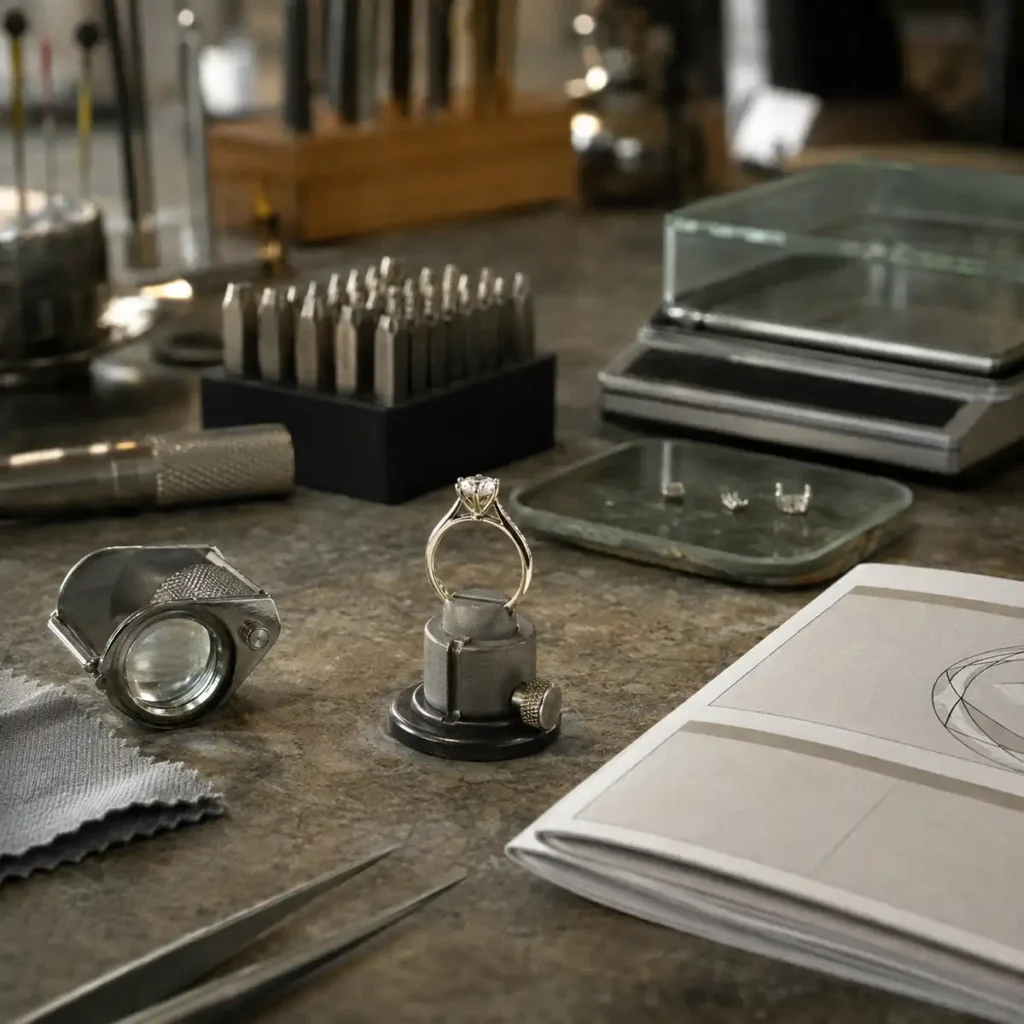
This is the risk that did not exist a decade ago and now sits underneath the entire second-hand market.
You cannot tell a lab-grown diamond from a natural one by eye. Neither can your jeweller. Neither can a gemmologist with 30 years at the bench and a loupe. There is no colour difference, no brilliance difference, no telltale inclusion visible without instruments. The material is the same material. Anyone who tells you they can spot one across a counter is selling you confidence rather than expertise.
Identification requires equipment. Fluorescence imaging that reveals growth structure, phosphorescence measurement, spectroscopy. That is laboratory apparatus, or at minimum a screening instrument, and a private seller does not have one.
Which produces an obvious and uncomfortable scenario. A lab-grown stone bought in 2020, set in a good mount, sold on in 2026 by someone who genuinely believes it is natural because that is what they were told. No fraud required at any point in the chain. Just an assumption travelling further than the evidence.
Read the report title. A natural stone carries a GIA Diamond Grading Report or a Diamond Dossier. A lab-grown stone carries a GIA Laboratory-Grown Diamond Report. GIA formats them differently on purpose. If there is no report at all and the price feels like a bargain, understand what you are actually buying, which is a diamond of unknown origin at a natural diamond price.
Turn the ring over. The band talks.
A UK hallmark tells you the fineness, the assay office and the sponsor. It is struck by an independent body under criminal statute and it is considerably harder to fake than a piece of paper. If the seller describes the ring as 18ct and the band carries no hallmark and weighs more than a gram of gold, something is wrong with the description, the metal, or both.
Look for a solder line at the base of the shank. That means a resize, which is entirely normal and tells you the ring has had at least one previous owner whose finger was a different size. Look at whether the join is clean. Look at whether the metal colour matches across it, because a mismatch suggests a resize done with the wrong fineness solder by someone who should not have been doing it.
Then look at what the shank has become. A band worn for 20 years next to a wedding ring thins where the 2 met, and it thins from the inside where you cannot see it without turning the ring. A thin shank is repairable. It is also a negotiating position.
Every pre-owned ring arrives with an accumulated history, and the seller’s account of it is worth precisely nothing.
Claws are the first thing to inspect. Tips wear, thin and lift, and a claw that has lost its tip is holding a stone by friction and optimism. Look under magnification at all 4 or 6. Ask the stone to be pushed gently with a probe, because movement you can feel is movement that will eventually become a loss you cannot recover.
Pavé is the second. Small stones in tiny beads of metal, any of which can have worked loose. Count them against the certificate or the original description if either exists.
Then rhodium. If the ring is white gold, the plating has almost certainly worn, and what you are looking at may be the underlying alloy rather than the finish. That is a re-plating job and a modest one. It is also why a tired-looking white gold ring often photographs worse than it deserves and prices accordingly.
None of this is disqualifying. All of it is cost, and cost is leverage. Price the remedial work before you agree the number, not after.
Three situations, and they are strong ones.
The first is arithmetic. A ring bought at retail and sold privately 6 years later loses a large fraction of its purchase price, and none of that loss reflects anything about the diamond. The stone is identical. The setting is identical. You are capturing someone else’s depreciation, and that is the most rational purchase in the entire category.
The second is the cuts. Old European and old mine cut stones were cut by hand to different proportions, before the modern round brilliant standardised everything. They behave differently in light. They are not worse. Many people prefer them, and you cannot buy one new.
The third is speed. A pre-owned ring exists. Bespoke commissions run 6 to 10 weeks from approved design, and if your date is inside that window, the second-hand market is not a compromise but the only route that works.
What you are giving up is the warranty, the aftercare relationship and any certainty about what happened to the ring before you. Have a jeweller assess it before you buy rather than after. At the consultation desks at 9 Hatton Garden, EC1N, a pre-owned ring can be checked against its paperwork in one sitting, and the cost of that appointment is trivial against the cost of being wrong.
You will also need a band that sits with it, and an older ring makes that a specification problem rather than a shopping one.
Do not buy a pre-owned ring anywhere you cannot put it under magnification. That single rule eliminates most of the risk in this market, and it eliminates the seller who was counting on you not applying it.
Book an assessment before money moves. Smith & Green take appointments Tuesday to Saturday, 09.30 to 18.00, at 9 Hatton Garden, 4 minutes from Chancery Lane station and a short walk from the Farringdon Elizabeth line exit.
Ask 3 things. Ask for the girdle inscription to be read and matched to the report number in front of you. Ask whether the report title says natural or laboratory-grown, and whether origin has been screened rather than assumed. Ask what the remedial work costs, then take that number back to the seller.
A pre-owned engagement ring is frequently the best value on the street. It is also the only ring you will buy where nobody is legally obliged to tell you anything. Check it yourself.