
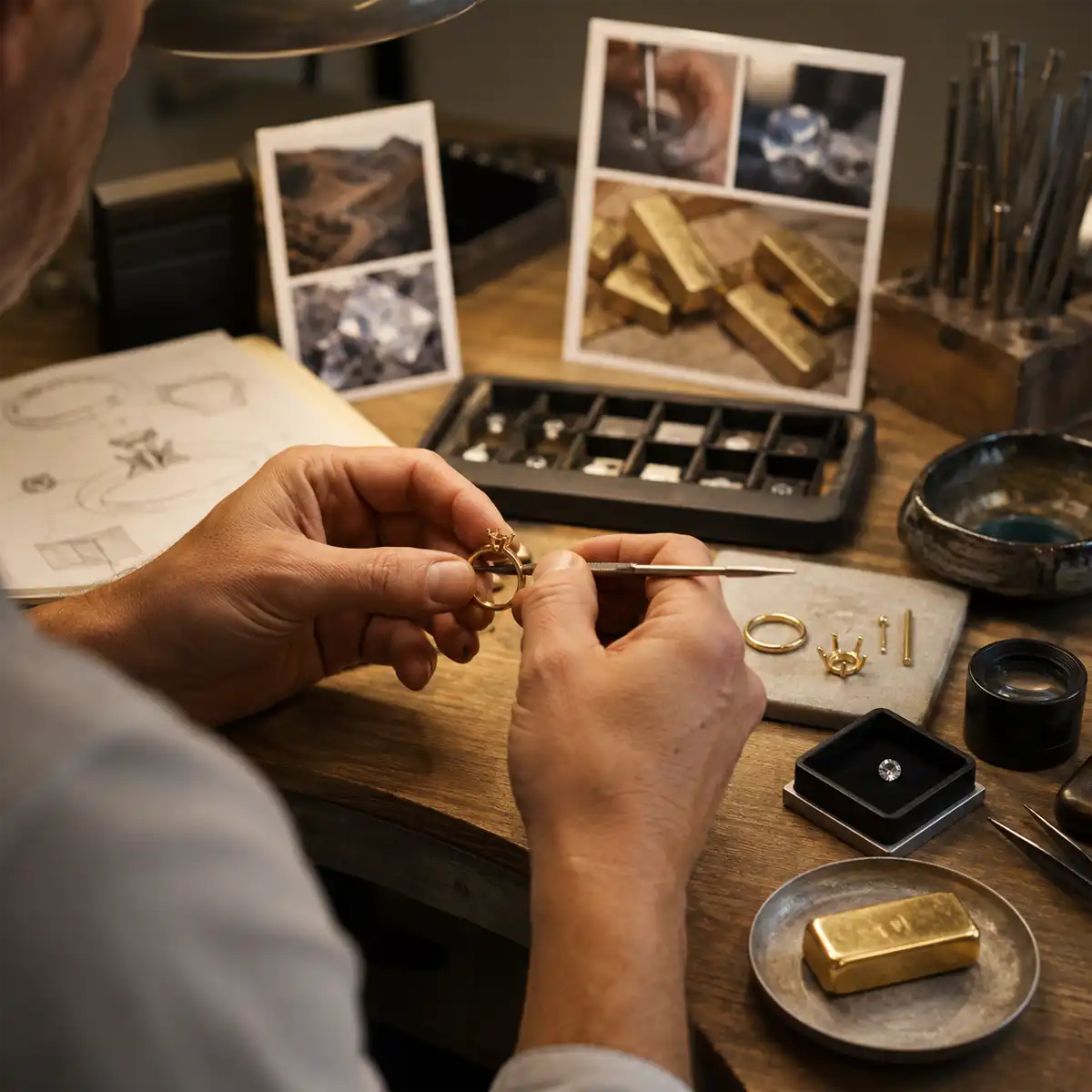
Ask a jeweller whether their diamonds are ethical and most of them will say yes. They will say it quickly, with confidence, and with very little supporting detail. This is worth paying attention to, because “ethical” is not a standardised term in the jewellery trade and it does not mean the same thing from one business to the next. A diamond can be legal, documented, and traceable to a mine in a stable country and still have been extracted under conditions that no reasonable person would endorse.
The question of responsible diamond sourcing is not a niche concern for a small group of buyers. It is a mainstream question that an increasing number of couples bring to their first engagement ring consultation, and the answer they receive tells them something real about the jeweller they are sitting across from. Smith & Green Jewellers at 9 Hatton Garden EC1N takes these questions seriously. This article explains the framework in detail, so you can ask the right questions and evaluate the answers you receive.
The Kimberley Process Certification Scheme was established in 2003 to prevent conflict diamonds, rough diamonds used to finance armed rebel movements against legitimate governments, from entering the mainstream diamond supply chain. It requires participating countries to certify that rough diamond exports are free of conflict origin. As of today, more than 80 countries participate, covering the vast majority of global rough diamond production.
The Kimberley Process has done real work. It is credited with removing the most obvious category of conflict diamonds from commercial supply chains. But it has 3 documented limitations that buyers should understand.
First, it applies only to rough diamonds, not polished stones. Once a diamond is cut, the KP certificate that accompanied the rough does not travel with the individual polished stone. Second, the definition of conflict diamonds is narrow. It covers diamonds funding rebel movements but not diamonds extracted by government-controlled mining operations under exploitative labour conditions. Third, enforcement varies significantly between participating countries. A KP certificate is therefore a necessary baseline but not a sufficient guarantee of fully responsible sourcing.
The Responsible Jewellery Council is an independent standard body whose members commit to ethical, human rights, social, and environmental practices across their operations and supply chains. RJC certification requires a third-party audit of those practices and is renewable on a defined cycle. It applies to businesses throughout the supply chain: miners, cutters, polishers, refiners, and retailers.
An RJC-certified jeweller has been audited against a defined standard by an independent party. This is meaningfully different from self-declared ethical commitments, which require no external verification. When a jeweller is RJC-certified, you can ask to see the certificate, confirm it is current, and look up the member on the RJC’s public registry. The standard is imperfect and the scope of what it covers has been debated within the industry, but it provides an independently verified baseline that self-declaration cannot match.
Ask your jeweller whether they are RJC members. If they are not, ask how they verify the sourcing of the diamonds they sell. The quality of the answer matters.
Lab-grown diamonds are chemically, physically, and optically identical to natural diamonds. They are produced in controlled manufacturing environments using one of 2 processes: chemical vapour deposition (CVD) or high pressure, high temperature synthesis (HPHT). Neither process involves mining, which means neither carries the land disruption, community impact, or supply chain complexity that natural diamond extraction does.
For buyers whose primary ethical concern is the environmental footprint and social impact of mining, a lab-grown diamond removes those concerns from the purchase. This is a rational and well-supported position. The stones are real diamonds. They can be graded and certified by the same laboratories that grade natural stones. They should carry a grading report specifying lab-grown origin, and reputable jewellers will always be explicit about the distinction.
The caveat for buyers focused specifically on ethics is that lab-grown diamond production is energy-intensive. The majority of global CVD diamond production currently takes place in India and China, where the energy mix leans heavily on fossil fuels. A lab-grown diamond produced in a facility powered by renewable energy has a substantially lower carbon footprint than one produced on a coal-heavy grid. This level of supply chain transparency is not yet standard across the lab-grown market, but it is worth asking about.


Recycled precious metals, sometimes described as Fairtrade gold or certified recycled gold, are processed from existing gold-bearing material rather than from freshly mined ore. The environmental and social case is straightforward: recycling existing metal avoids the land disturbance, water use, and chemical processes required to extract new metal from rock.
The Fairtrade Gold standard, operated through the Fairtrade Foundation, requires certified mines to meet specific social and environmental criteria and pays a premium to mining communities above market price. It is audited by an independent certification body and traceable through the supply chain. A ring described as set in Fairtrade gold is a specific, verifiable claim rather than a generic ethical statement.
For buyers who want to address the metal as well as the stone in their ethical assessment of a ring, asking specifically about the metal source, whether recycled, Fairtrade, or conventionally mined and refined, gives a more complete picture.
Responsible diamond sourcing is not an abstract principle. It is a set of specific, answerable questions. Ask any jeweller you are seriously considering buying from the following. Are you a member of the Responsible Jewellery Council? Can you confirm whether this specific diamond was certified by GIA or IGI and whether the report includes any origin information? Is this stone natural or lab-grown, and if lab-grown, do you know where it was produced and under what energy conditions? Is the metal recycled, Fairtrade certified, or conventionally sourced?
A jeweller who answers these questions specifically and without defensiveness is operating transparently. A jeweller who drifts into generalities about caring about ethics, without any supporting specifics, is telling you something about the limits of their supply chain knowledge. Either response is useful information.
You are not obliged to make the most ethical choice available at the expense of every other consideration. You are entitled to make an informed choice with full knowledge of what the sourcing situation actually is, and then decide how you weigh that against aesthetics, budget, and all the other factors a ring purchase involves. That decision is yours. But it should be a decision, not an assumption.
Fun fact: The United Kingdom became the first country in the world to require a supply chain due diligence report on precious metals and diamonds for businesses above a certain size under Section 54 of the Modern Slavery Act 2015, making transparency in the sourcing of jewellery materials a statutory reporting requirement rather than purely a voluntary commitment.
Responsible diamond sourcing is not a simple box to tick. It is a spectrum of practices, certifications, and choices, each addressing a different aspect of a complex global supply chain. The Kimberley Process addresses the most extreme abuses. RJC certification addresses broader social and environmental practices. Lab-grown addresses mining impact. Fairtrade gold addresses community welfare at the mine level.
No single purchase decision addresses all of these simultaneously, and no jeweller is in a position to guarantee perfection across a supply chain that spans multiple countries and dozens of intermediaries. What a serious jeweller can do is know their sources, be explicit about what they know and what they do not, and make the certifications they hold verifiable rather than merely claimed.
At Smith & Green Jewellers, 9 Hatton Garden EC1N, sourcing conversations are part of every serious consultation. Walk in from the Farringdon Elizabeth line, ask the questions above, and expect specific answers. If you are not getting them, you are in the wrong room.